Key Points
- Royal Papworth Charity, based in Cambridge, received its largest ever single donation from an individual: £453,611.60 from British-born philanthropist Wendy J. Tomlin-Hess, now living in the United States.
- The donation honours Wendy’s brother, Terry Tomlin from Melton Mowbray in Leicestershire, whose life was saved in 2015 by a pioneering heart transplant at Royal Papworth Hospital using donation after circulatory death (DCD) from a non-beating donor heart.
- Terry was among the first in Europe to receive such a DCD heart transplant; Royal Papworth was the first hospital in Europe to perform this procedure, which now accounts for 25% of adult heart transplants in the UK.
- Royal Papworth has conducted 147 DCD heart transplants, more than any other UK centre and one of the highest worldwide.
- Funds will support three research projects: improving donor heart assessment with non-invasive biomarkers, extending donor heart preservation from six hours to six days, and developing affordable perfusion technology like the Morgan device for adults and children.
- Additional funding strengthens the Clinical Research Facility at the Victor Phillip Dahdaleh Heart and Lung Research Institute, enabling a dedicated medical officer for early-phase trials.
- The donation via DAFgiving360 includes a contribution from Wendy’s late husband, Robert Hess, whose philanthropy was inspired by the 1973 death of his son Christopher.
- Wendy J. Tomlin-Hess stated: “We are extremely grateful to Terry’s heart donor and their family, who gave him a gift we could never repay – the gift of life. I am now very happy to be in a position where I can truly thank Royal Papworth with a donation that will help to save many, many more lives.”
- Dr Nicole Asemota, resident doctor in cardiothoracic surgery, said: “In the UK, there are around 300 people in need of a heart transplant at any given time, but approximately only 200 heart transplants are performed each year. If successful, this research could lead to a 20% increase in heart transplants across the UK – and bring new life to patients waiting for a second chance.”
- Dr John Louca noted on preservation research: “This work not only expands the donor pool but also strengthens the global potential of transplantation science. Beyond transplantation, extended preservation times have far-reaching implications for drug discovery. Extending preservation times will create a transformative research model for testing new drugs on those diseased hearts that are removed during transplant surgery.”]
- Krystyna Grant, Managing Director of Royal Papworth Charity, said: “We are overwhelmed by Wendy’s generosity and the potential of this gift to transform lives across the globe. Through Wendy’s support, Royal Papworth will continue to lead innovation in heart care and support, ensuring more patients receive the gift of life. This is a story of vision and compassion inspiring progress across our nation’s healthcare system.”
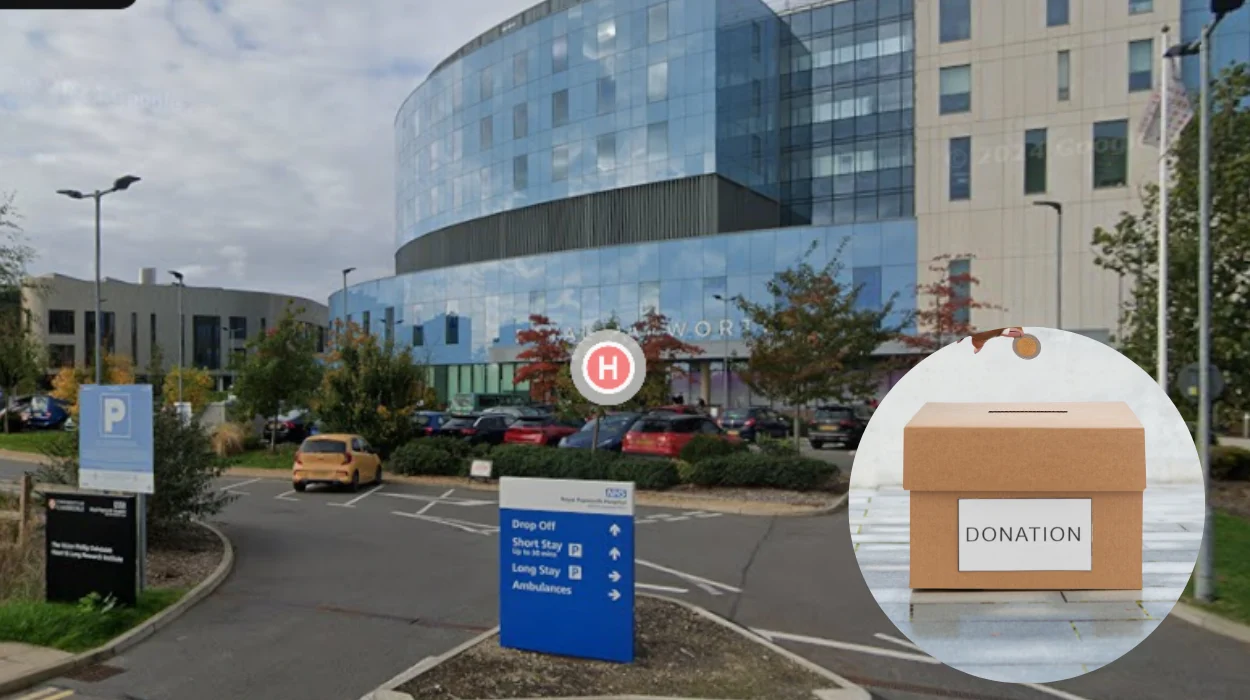
Cambridge (Royal Papworth Times) 14 January 2026 – Royal Papworth Charity has received its largest ever single donation from an individual, amounting to £453,611.60 from British-born philanthropist Wendy J. Tomlin-Hess. The gift, described as an extraordinary act of philanthropy, honours the life-saving pioneering heart transplant performed on her brother Terry at Royal Papworth Hospital in 2015. This donation, the biggest in the charity’s 30-year history, will accelerate groundbreaking research in heart transplantation at the Cambridge-based NHS Foundation Trust.
- Key Points
- What prompted Wendy J. Tomlin-Hess’s record donation?
- Who is Terry Tomlin and what was his pioneering treatment?
- How has Robert Hess influenced the donation?
- What research projects will the donation fund?
- Improving donor heart assessment?
- Extending preservation times for donor hearts?
- Developing affordable perfusion technology?
- What is the charity’s reaction to this historic gift?
What prompted Wendy J. Tomlin-Hess’s record donation?
Wendy J. Tomlin-Hess, originally from Britain and now residing in the United States, made the donation as a profound thank you to Royal Papworth Hospital for saving her brother Terry Tomlin’s life. Terry, from Melton Mowbray in Leicestershire, underwent one of the first heart transplants in Europe using a non-beating donor heart through donation after circulatory death (DCD) in 2015. As reported on the official Royal Papworth website, prior to this technique, donor hearts were only available from brain-stem death (DBD) cases where hearts remained beating; Royal Papworth pioneered DCD in Europe.
Reflecting on the family’s experience, Wendy J. Tomlin-Hess stated: “We are extremely grateful to Terry’s heart donor and their family, who gave him a gift we could never repay – the gift of life.” She added:
“I am now very happy to be in a position where I can truly thank Royal Papworth with a donation that will help to save many, many more lives.”
The donation, channelled through the platform DAFgiving360, also incorporates a contribution from her late husband Robert Hess.
Who is Terry Tomlin and what was his pioneering treatment?
Terry Tomlin received a groundbreaking DCD heart transplant at Royal Papworth Hospital in 2015, placing him among the first in Europe to benefit from this method. The procedure used a heart from a non-beating donor, a technique Royal Papworth introduced as the first hospital in Europe. Since then, DCD transplants now constitute 25% of all adult heart transplants in the UK, with Royal Papworth performing 147 such operations – the highest number by any UK centre and among the top globally.
As covered by BBC News, Terry hails from Leicestershire and his successful surgery marked a significant advancement in organ donation practices. Wendy noted a personal connection with her late husband Robert Hess, who promised Terry a fishing trip to Alaska post-recovery; in July 2017, Terry travelled to California and then Alaska, where they caught up to 50lbs of King Salmon, with the largest at 35-40lbs.
How has Robert Hess influenced the donation?
Robert Hess’s passion for philanthropy stemmed from the tragic death of his son Christopher in 1973, inspiring decades of research to prevent similar losses. Wendy J. Tomlin-Hess shared that Robert “cared very much for my brother Terry and promised him that, after his surgery, when he was well enough to travel, Robert would treat him to a fishing trip in Alaska.” She affirmed that Robert would be “extremely proud” to support Royal Papworth through this donation.
What research projects will the donation fund?
The £453,611.60 will support three transformative projects at Royal Papworth Hospital, as detailed in the charity’s announcement.
Improving donor heart assessment?
Dr Nicole Asemota, resident doctor in cardiothoracic surgery, leads this project in collaboration with the University of Cambridge Department of Surgery, Institute of Metabolic Science, under supervision of Mr Stephen Large, Consultant Cardiothoracic Surgeon at Royal Papworth, and Professor Michael Nicholson. The team, including Dr Richard Kay, Dr Albert Koulman, Dr Ben Jenkins, and Dr Paulina Guevara Dominguez, seeks non-invasive biomarkers to assess donor heart viability. Dr Asemota explained:
“In the UK, there are around 300 people in need of a heart transplant at any given time, but approximately only 200 heart transplants are performed each year. If successful, this research could lead to a 20% increase in heart transplants across the UK – and bring new life to patients waiting for a second chance.”
Extending preservation times for donor hearts?
Under Dr John Louca, supervised by Professor Sanjay Sinha of the University of Cambridge and Mr Stephen Large, this initiative aims to extend donor heart preservation from six hours to six days using advanced perfusion and metabolic techniques. Dr Louca stated: “This work not only expands the donor pool but also strengthens the global potential of transplantation science. Beyond transplantation, extended preservation times have far-reaching implications for drug discovery. Extending preservation times will create a transformative research model for testing new drugs on those diseased hearts that are removed during transplant surgery.”
Developing affordable perfusion technology?
The donation funds trials for the Morgan device, a cost-effective heart perfusion machine for adults and children, potentially reducing NHS costs and enabling paediatric transplants, supported by the Medicines and Healthcare products Regulatory Agency. Part of the gift also bolsters the Clinical Research Facility at the Victor Phillip Dahdaleh Heart and Lung Research Institute, funding a dedicated medical officer to speed up early-phase trials.
What is the charity’s reaction to this historic gift?
Krystyna Grant, Managing Director of Royal Papworth Charity, expressed: “We are overwhelmed by Wendy’s generosity and the potential of this gift to transform lives across the globe.” She continued: “Through Wendy’s support, Royal Papworth will continue to lead innovation in heart care and support, ensuring more patients receive the gift of life. This is a story of vision and compassion inspiring progress across our nation’s healthcare system.” As reported by Yahoo News, the charity hailed it as a “historic” contribution with global impact.
This donation underscores the profound gratitude driving medical advancements, positioning Royal Papworth at the forefront of heart transplantation innovation.