Key Points
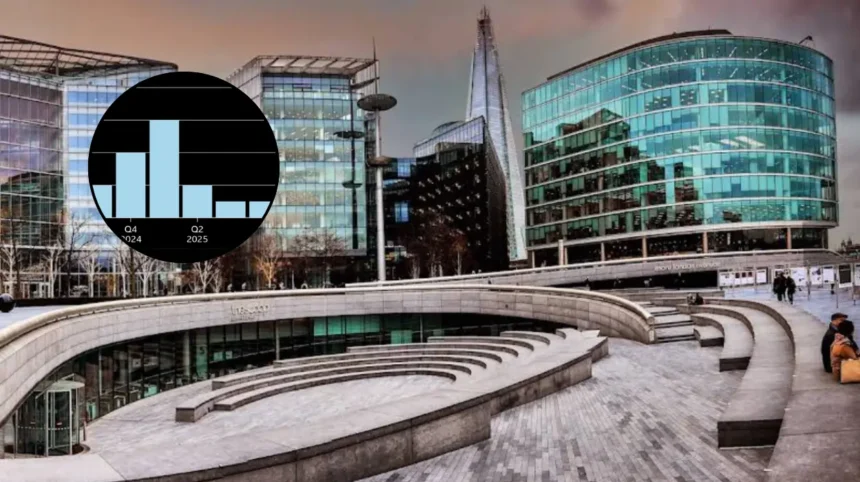
- Gross Domestic Product (GDP) in the United Kingdom expanded by 0.4% in the three months to June, down from 0.6% growth recorded in the first quarter.
- The growth figure met the expectations of City economists, reflecting economic resilience despite energy market disruptions caused by the war involving Iran.
- Sector-level data from the Office for National Statistics (ONS) shows services output grew by 0.5% and construction by 0.3%, while industrial production remained flat.
- KPMG Chief Economist Yael Selfin noted that households have weathered initial shocks well, but warned that economic momentum is likely to fade in the second half of the year.
- The economic performance sets the stage for Chancellor of the Exchequer John Healey, who is preparing to deliver his maiden Budget on 28 October.
London (Cardiff Daily) August 13, 2026 –The British economy experienced a slowdown in the second quarter of the year as rising energy costs driven by conflict in the Middle East began to affect broader activity, according to official data published by the Office for National Statistics (ONS). Gross Domestic Product (GDP) increased by 0.4% in the three months from April to June. This represents a moderation from the 0.6% growth rate recorded during the first quarter of the year. The outcome matched forecasts set by City economists, who had anticipated a cooling trajectory in response to global geopolitical tensions and elevated fuel charges.
- Key Points
- How Did Individual Sectors of the Economy Perform Between April and June?
- How Are Economic Analysts Evaluating the Impact of the Iran War on Consumers?
- What Are the Implications for Chancellor John Healey and Fiscal Policy?
- What Is the Background to This Economic Development?
- What Is the Outlook and How Will This Development Affect UK Households and Businesses?
How Did Individual Sectors of the Economy Perform Between April and June?
The detailed breakdown provided by the ONS highlights a divided performance across major industrial classifications. The services sector remained the primary engine of expansion, recording a growth rate of 0.5% across the second quarter.
The construction sector also maintained positive territory, registering a 0.3% increase in activity. Conversely, industrial production—a category encompassing manufacturing, mining, and energy generation—showed zero growth, remaining completely flat over the three-month period.
How Are Economic Analysts Evaluating the Impact of the Iran War on Consumers?
Despite the deceleration in expansion, financial analysts pointed out that the UK economy demonstrated greater durability than previously feared in light of severe disruptions in international energy markets. As reported by financial commentators reviewing the ONS dataset, Yael Selfin, Chief Economist at KPMG, observed that households had shown notable fortitude amidst compounding pressures.
“Consumers have faced a series of shocks since the start of the year but have weathered them remarkably well,”
Selfin stated.
However, Selfin expressed caution regarding the economic outlook for the remainder of the year.
“The UK economy closed out the first half of the year on strong footing, but momentum is likely to fade over the coming months,”
she added, pointing to ongoing volatility in global commodity markets and sustained interest rate pressures.
What Are the Implications for Chancellor John Healey and Fiscal Policy?
This official economic update arrives at a critical junction for the government, as Chancellor of the Exchequer John Healey prepares to deliver his inaugural Budget statement on 28 October.
The slowdown in GDP growth presents a delicate balancing act for the Treasury, which must navigate constrained public finances while seeking to foster long-term investment. The headline figures will serve as a foundational element for the Office for Budget Responsibility (OBR) when formulating its updated macroeconomic forecasts ahead of the Chancellor’s presentation to Parliament.
Explore More UK News
UK Foreign Secretary Ed Miliband Demands Israel Stop Settler Violence London 2026
Sumitomo Invests in Gwynt Glas Floating Wind Project, Celtic Sea 2026
What Is the Background to This Economic Development?
The deceleration of GDP growth in the second quarter follows a period of heightened geopolitical strain and commodity market fluctuation.
Early in the year, the UK economy demonstrated strong initial momentum, advancing by 0.6% in the first quarter as retail sales and commercial services recovered from previous stagnation. However, the outbreak and escalation of conflict involving Iran disrupted international shipping lanes and crude oil supply networks, causing wholesale gas and oil prices to surge globally.
Because the UK remains a net importer of refined energy products and industrial feedstock, elevated energy prices directly increased operational overheads for manufacturers and raised transportation costs for logistics firms.
This pressure accounted for the stagnation observed in industrial production during the second quarter. While domestic consumer spending sustained the services sector throughout the spring, the persistent pressure of higher utility bills and fuel costs gradually began to curb discretionary household expenditure towards the end of the quarter.
What Is the Outlook and How Will This Development Affect UK Households and Businesses?
For domestic consumers, the combination of slowing GDP expansion and elevated energy costs indicates a period of tighter real household budgets. Although real wage growth had shown signs of recovery earlier in the year, sustained energy inflation risks offsetting those gains.
Households are likely to exercise greater caution in discretionary spending, which could lead to reduced revenue for leisure, hospitality, and retail sectors during the autumn months.
Furthermore, if economic momentum continues to fade as predicted by market analysts, mortgage holders may face prolonged uncertainty regarding borrowing rates, as the Bank of England weighs persistent energy-driven inflation against cooling economic output.
For commercial entities, particularly within energy-intensive industries and manufacturing, the flatlining of industrial production highlights ongoing margin compression. Small and medium-sized enterprises (SMEs) face dual pressure from rising input costs and softening consumer demand.
In response, firms may delay capital investment decisions and hiring plans until the fiscal environment becomes clearer following Chancellor John Healey’s Budget in October. Conversely, businesses within the services sector may continue to experience modest growth, provided consumer confidence remains stable in the face of broader macroeconomic headwinds.