Key Points
- Expanded Services Confirmed: Transport for Wales (TfW) has announced additional early-morning train services for the Kidney Wales CDF 10K on Sunday, 6 September 2026.
- Key Routes Identified: The extra rail services will transport participants and spectators to Cardiff from four primary hubs: Pontypridd, Caerphilly, Barry Island, and Newport.
- Milestone Event: Over 10,000 runners have registered to mark the 40th anniversary of the race, making it the largest staging in the event’s history.
- Strategic Corporate Partnership: TfW has established a formal, long-term operational partnership with event organiser Run 4 Wales (R4W) Group to promote sustainable public transport.
- Race Day Schedule: The 2K family run will launch at 09:15, followed by the main 10K race at 10:00, with both starting and finishing on King Edward VII Avenue.
- Travel Guidance Issued: Rail passengers are instructed to purchase tickets prior to boarding, with revenue protection teams active and strict safety protocols in place across stations.
CARDIFF WALES (Cardiff Daily) September 3, 2026 — As reported by Phil Haigh of RailAdvent, Transport for Wales (TfW) has officially confirmed the deployment of additional early-morning train services to transport thousands of runners and spectators into the Welsh capital for the Kidney Wales CDF 10K on Sunday, 6 September 2026. The rail operator’s intervention comes as race organisers prepare for an unprecedented turnout, with over 10,000 registered participants assembling for the landmark 40th anniversary of the historic road race. To accommodate the early-morning surge, TfW will run enhanced services into Cardiff Central from key regional feeder stations, including Pontypridd, Caerphilly, Barry Island, and Newport. Coinciding with the milestone event, TfW has also launched a new strategic partnership with event organiser Run 4 Wales (R4W) Group to promote sustainable, low-carbon travel across its major sporting portfolio.
- What are the full transport operational details for race day?
- How is the 40th anniversary Kidney Wales CDF 10K structured?
- Who are the key contenders and participants in the 2026 field?
- Background of the particular development
- Prediction: How this development can affect the local community and event attendees
What are the full transport operational details for race day?
The scheduling decision by Transport for Wales addresses significant logistical requirements surrounding the assembly of over 10,000 runners and thousands of spectators within Cardiff city centre before 09:00.
The additional train capacity focuses specifically on the South Wales valleys and coastal lines. Early-morning departures from Pontypridd, Caerphilly, Barry Island, and Newport have been scheduled to ensure competitors arrive with ample time ahead of the race village opening.
As detailed in public travel notices issued by Transport for Wales, passengers are being urged to plan journeys well in advance and buy tickets prior to day-of-travel. Revenue Protection Inspectors will conduct checks across the network before and after the event.
Operational guidance also confirms that station queuing systems will be active, and safety staff will enforce strict travel protocols, including denying boarding to individuals under the influence of alcohol who pose a safety concern.
Complementing the additional rail provisions, race organisers at Run 4 Wales have advised attendees that extensive road closures will take effect across central Cardiff to facilitate the course. To ease local network strain, a free secure bicycle park is being provided within the Event Village on the City Hall Lawns for those choosing active travel.
How is the 40th anniversary Kidney Wales CDF 10K structured?
As reported by Rhys Gregory of Wales247, the 2026 event represents the largest edition in the history of the Cardiff 10K, following significant race expansion to celebrate its 40-year milestone. General entry registration across all categories has officially closed, with organisers confirming that no further places will be made available on the morning of the event.
The schedule commences at 09:15 with the junior and family 2K race, followed immediately by the flagship 10K event at 10:00. Both races will start and finish on King Edward VII Avenue, with the operational hub centred on the adjacent City Hall Lawns. The Event Helpdesk will be operational from 07:30 to assist competitors with late pack collection or race query resolutions.
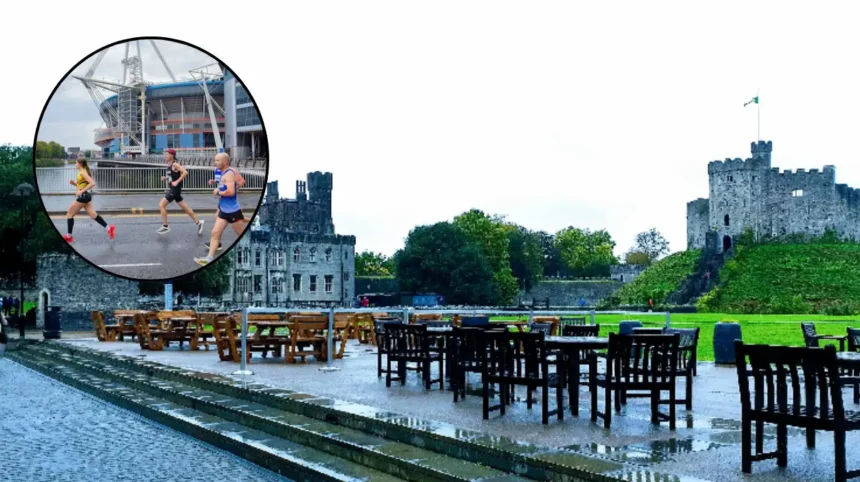
The 10K route provides a scenic capital tour, beginning near Cardiff Castle and Central Square before skirting the Principality Stadium.
Runners will navigate across the River Taff, proceeding into the suburb of Pontcanna and traversing the Grade II-listed parkland of Llandaff and Pontcanna Fields, before passing Sophia Gardens to reach the finish line in the Civic Centre.
Entertainment along the route will match the retrospective theme, with performances from The Rock Choir, Just Cheese, Sax for Fun, and Super Choir playing popular hits from the 1980s. Finishers will receive a commemorative 1980s-themed retro medal and T-shirt. The 2026 medal also acts as the final interconnected piece in the multi-event Run 4 Wales 10K Series, which previously featured races in Newport, Barry Island, and Porthcawl.
Who are the key contenders and participants in the 2026 field?
As reported by Run 4 Wales, the 40th anniversary edition has attracted a highly competitive elite field alongside major corporate and charitable cohorts.
The women’s elite field is spearheaded by Jenny Long (née Nesbitt), who holds a personal best of 32:19, alongside Almi Nerurkar (32:43). Welsh international Olivia Tsim (33:57) makes her return to competitive racing post-partum, competing against Anna Domville (33:59).
In the men’s elite division, Sam Tyas (29:22) and Welsh athlete Dan Nash (29:23) head a stacked lineup containing eight sub-30-minute runners, including Speedway 10K champion Felix McGrath. The wheelchair field features the return of 2025 champion Owain Terrell, who recorded a time of 30:12.
The event’s founding charity and headline partner, Kidney Wales, will field a dedicated team of 280 corporate and community runners raising funds for local kidney disease patient support. Furthermore, 20 corporate groups will compete in the Team Challenge, including squads from Sony, Team Vista, and Lab 22, the latter entering a 130-runner delegation.
Explore More Local Cardiff News
Seventh Person Charged in Cardiff Teens Thailand Investigation 2026
Masked Bikers Machete Attack Leaves Man Injured in Cardiff 2026
Background of the particular development
The establishment of early-morning rail capacity and the formal alliance between Transport for Wales and Run 4 Wales represent an evolution in regional transit management for major mass-participation events.
Founded in 1986 by Kidney Wales, the Cardiff 10K originally began as a small community road race designed to raise vital funding for renal research and medical equipment. Over four decades, the race grew rapidly, transforming into one of the flagship fixtures on the UK running calendar.
However, rapid growth presented complex urban management challenges for the Cardiff capital region, often leading to severe traffic congestion, parking gridlocks, and localized carbon emission spikes during race weekends.
In recent years, event management was transferred to Run 4 Wales (R4W), a not-for-profit social enterprise that also operates the Cardiff Half Marathon. To reduce the environmental footprint of major athletic gatherings, R4W initiated strategic dialogues with public transport entities.
The formalisation of additional rail scheduling for the 2026 Kidney Wales CDF 10K marks a shift toward public-transport-first event planning in South Wales. This collaborative framework reflects broader Welsh Government policy objectives, which target a transition toward active travel and decarbonised public transport networks.
Prediction: How this development can affect the local community and event attendees
The introduction of dedicated early-morning train capacity and public transport integration will directly impact several key demographic groups across South Wales:
- Event Participants and Spectators: The provision of early-morning rail services from Valley lines and regional hubs significantly reduces pre-race logistical stress. Runners are less likely to encounter delays caused by inner-city parking bottlenecks or extensive road closures. Spectators benefit from reliable, synchronized access to the capital, enabling easier navigation along the course to support participants.
- Cardiff City Centre Residents and Commuters: By shifting thousands of journeys from private motor vehicles to the rail network, central Cardiff will experience reduced vehicle congestion. Non-event commuters and local residents should see improved road safety, decreased tailpipe emissions, and less strain on municipal parking structures during the road-closure window.
- Local Economy and Hospitality Sector: Enhanced transit reliability encourages greater attendance from regional supporters across South Wales. Increased footfall in Cardiff’s retail and hospitality sectors following the race completion is expected to boost weekend revenue for local cafes, restaurants, and tourism vendors.
- Future Transport Policy and Mass Events: The strategic operational model established between Transport for Wales and Run 4 Wales provides a tested blueprint for future large-scale events in the region. Success during the 40th anniversary 10K will likely lock in permanent, expanded early-morning rail schedules for upcoming major fixtures, such as the annual Cardiff Half Marathon.