Key Points
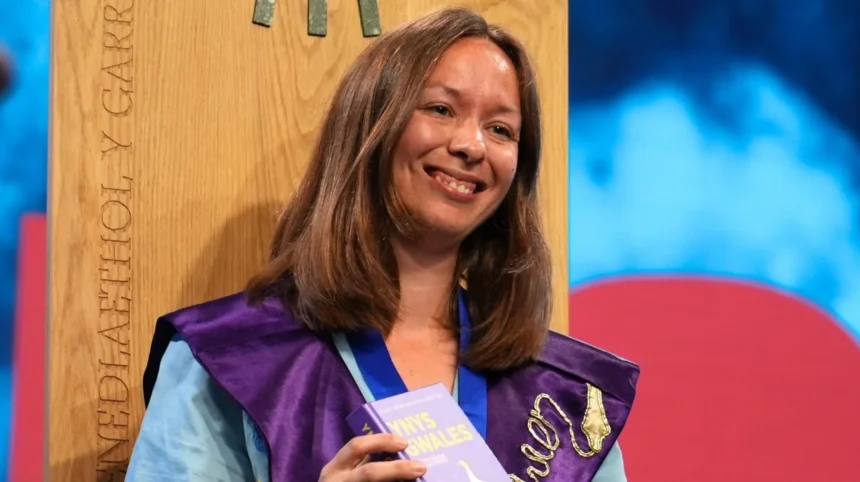
- Senior Lecturer in Medieval History at Cardiff University, Dr Rebecca Thomas, has won the prestigious Daniel Owen Memorial Medal at the 2026 National Eisteddfod.
- The award requires entrants to write an unpublished novel in Welsh of no fewer than 50,000 words; Dr Thomas submitted her manuscript under the pen name Drycin.
- Her winning work, titled Ynys Gwales, is an ambitious reimagining of the Second Branch of the medieval Welsh prose collection, the Mabinogi.
- The story centres on Llŷr and his family of fishermen, alongside Morfudd, the guardian of Ynys Gwales (Grassholm Island off the Pembrokeshire coast), exploring how the arrival of seven surviving soldiers carrying their giant king’s severed head impacts the island.
- Dr Thomas was inspired to write the book during university seminars in 2022 and began drafting the text while serving as an artist in residence on Ynys Enlli (Bardsey Island) in August 2025.
- The formal ceremony took place on the Pavilion Stage at the Eisteddfod Genedlaethol y Garreg Las on Tuesday, 4 August 2026.
- Adjudicators Meinir Wyn Edwards, Llwyd Owen, and Lleucu Roberts commended the novel as “ambitious”, “magical”, and “emotional”, comparing its epic appeal to Game of Thrones and The Lord of the Rings.
- Alongside the commemorative medal, Dr Thomas was awarded a £5,000 cash prize donated by the people of the Preseli area in memory of Martin and Meryl Lloyd of Cilgerran, along with immediate publication of her novel.
Cardiff (Cardiff Daily) September 9, 2026 — Senior Lecturer in Medieval History at Cardiff University, Dr Rebecca Thomas, has been awarded the prestigious Daniel Owen Memorial Medal at the National Eisteddfod for her unpublished novel, Ynys Gwales. Presented during a ceremony on the main Pavilion Stage with the support of the James Pantyfedwen Trust, the honour celebrates an ambitious reimagining of ancient Welsh mythology originally preserved in the Mabinogi.
The Daniel Owen Memorial Prize is widely regarded as one of the highest literary achievements in Welsh-language publishing. It challenges writers to submit a complete, unpublished manuscript of at least 50,000 words. Entering under the pseudonym Drycin, Dr Thomas crafted Ynys Gwales around the narrative world of the Second Branch of the Mabinogi, weaving together historical lore, fantasy elements, and human grief.
What Is the Story Behind the Winning Novel Ynys Gwales?
The narrative of Ynys Gwales follows Llŷr and his family of fishermen, alongside Morfudd, the steadfast guardian of Ynys Gwales—known in English as Grassholm Island, located off the western coast of Pembrokeshire. The plot shifts into motion when seven surviving soldiers returning from a devastating war in Ireland arrive at the Moelros tavern seeking the mythical sanctuary. In accordance with the original medieval myth, the soldiers carry with them the severed, still-talking head of their fallen giant king, Bendigeidfran.
In the tradition of the medieval tales, Ynys Gwales serves as an earthly paradise where those who enter can temporarily escape their physical trauma, forget their grief, and suspend the passage of time. However, whilst traditional Welsh folklore focuses predominantly on the heroic male survivors, Dr Thomas redirected her narrative focus towards the resident community of the island and the profound consequences of hosting the traumatised soldiers.
Explaining her creative direction, Dr Thomas stated:
“I decided to write a novel set in the world of the Second Branch of the Mabinogi after revisiting the tale in seminars with Welsh students in 2022. I was captivated by the final part of the tale, where seven men who survived a war in Ireland bring the head of their giant king to Ynys Gwales.”
She further elaborated on the emotional focal point of her narrative:
“This island is a paradise where they can forget everything about war and the friends that they’ve lost. The medieval tale focuses on the seven men and their grief, but I was drawn to thinking about how their visit impacted the island and its inhabitants. I started writing the novel during my time as an artist in residence on Ynys Enlli in August 2025. This was an invaluable opportunity for getting under the skin of my characters who live on Ynys Gwales.”
How Did the Eisteddfod Panel Adjudicate the Entries?
The 2026 competition was evaluated by a panel of literary judges comprising Meinir Wyn Edwards, Llwyd Owen, and Lleucu Roberts, who reached a unanimous verdict regarding the strength of the manuscript.
Delivering the formal adjudication from the Pavilion Stage, Meinir Wyn Edwards praised the author’s command of prose and atmosphere. As reported by Tom Sinclair of The Pembrokeshire Herald, Edwards stated that:
“This is an ambitious novel that offers a fresh interpretation of the Second Branch of the Mabinogi. Ynys Gwales captures our attention from the outset.”
Edwards added:
“The writing flows effortlessly, and the author is a master of vivid storytelling and of arousing the reader’s curiosity. A lively imagination is at work here, and Ynys Gwales has thrilled all three of us.”
Co-adjudicator Llwyd Owen drew comparisons between the historical reinterpretation and major global fantasy franchises. As reported by Tom Sinclair of The Pembrokeshire Herald, Owen described the text as a fantasy novel capable of appealing to audiences inspired by international successes such as Game of Thrones and The Lord of the Rings. Owen noted that the manuscript maintained “one foot on the ground” whilst allowing the distinct vision of the author to take flight.
Fellow judge Lleucu Roberts emphasised the emotional resonance of the prose. As reported by Tom Sinclair of The Pembrokeshire Herald, Roberts highlighted how the novel captivated readers through its seamless blend of mythical fantasy and deeply human emotions, bridging the gap between centuries for the modern reader.
In their collective summary, the panel concluded:
“Congratulations to the author for creating a magical and emotional novel that has left us marvelling at the storytelling talent on display and that lingers in the memory. All three of us are in complete agreement that Ynys Gwales, by Drycin, fully deserves the Daniel Owen Memorial Prize 2026.”
Who Is Dr Rebecca Thomas?
Dr Rebecca Thomas is a historian, academic, and author originally raised in Cardiff. She received her early education at Ysgol y Wern and Ysgol Gyfun Gymraeg Glantaf before completing her undergraduate and doctoral studies in history at the University of Cambridge. Following the completion of her doctorate in 2019, she actively returned to creative fiction.
She currently serves as a Senior Lecturer within the Department of History, Archaeology and Religion (School of History, Archaeology and Heritage) at Cardiff University. Her academic focus spans early medieval history, where she delivers teaching modules such as Medieval Worlds and The Age of Arthur.
Alongside her research work, Dr Thomas has cultivated an established career in Welsh-language literature. She previously authored children’s titles including Anturiaethau’r Brenin Arthur and Anturiaethau’r Afanc during her tenure as Writer-in-Residence at Bannau Brycheiniog National Park. Her debut adult novel, Y Tŵr, was published by Sebra in 2025.
Reflecting upon her achievement at the Pavilion ceremony, Dr Thomas stated:
“It’s an amazing feeling to have won the Daniel Owen Memorial Prize, which is my first win at the National Eisteddfod. It is such a special competition that has produced many wonderful novels by authors I admire. It’s hard to believe that Ynys Gwales will join these volumes on bookshelves, and it is exciting to be able to share the novel after working on it secretly for so long.”
Dr Thomas acknowledged the creative networks that supported her development, specifically citing her involvement with young writers’ workshops at Tŷ Newydd in mid-2024, the Writers at Work scheme at the Hay Festival in 2025, and her residency on Ynys Enlli supported by funding from the Ashley Family Foundation.
What Is the Background to the Daniel Owen Memorial Prize?
The Daniel Owen Memorial Prize (Gwobr Goffa Daniel Owen) was established to honour the legacy of Daniel Owen (1836–1895), who is widely regarded as the founding father of the modern Welsh-language novel. Owen’s works, including Rhys Lewis and Enoc Huws, brought realistic prose fiction into the mainstream of Welsh culture during the late 19th century.
The competition is administered annually by the National Eisteddfod of Wales (Eisteddfod Genedlaethol Cymru), the nation’s premier cultural festival celebrating Welsh language, literature, and performance art. To qualify for the award, authors must produce an unpublished novel in Welsh containing no fewer than 50,000 words.
Winning the award carries significant prestige alongside tangible career benefits. The recipient receives the Daniel Owen Memorial Medal alongside a monetary reward. For 2026, the £5,000 prize was donated directly by residents of the Preseli area in memory of Martin and Meryl Lloyd of Cilgerran. Furthermore, the winning manuscript is immediately fast-tracked for professional publication, ensuring that the work is printed and made available to the public directly from the Eisteddfod grounds during the week of the festival.
What Are the Future Predictions for Welsh Literature and Academic Fiction?
The awarding of the 2026 Daniel Owen Memorial Medal to Dr Rebecca Thomas is predicted to exert a notable impact on several key groups across the Welsh literary, cultural, and academic landscapes.
For readers of Welsh fiction, the success of Ynys Gwales signals a continued shift towards high-concept historical fantasy that bridges ancient folklore with modern storytelling techniques. By reframing classic tales from the Mabinogi through alternative perspectives—specifically focusing on ordinary inhabitants and non-combatants—the novel establishes a framework for modern Welsh authors to revisit classical canon without repeating historical tropes. Observers anticipate an increased appetite among younger readers for mythic fiction that engages with contemporary themes such as trauma, grief, and community resilience.
For scholars and academic institutions, Dr Thomas’ victory reinforces the growing synergy between academic research and public-facing creative writing. As a medieval historian teaching modules on early Welsh history, her capacity to translate scholarly knowledge into popular literature highlights the role academics play as cultural conduits. This recognition is expected to encourage higher education institutions to further support creative residencies and public engagement initiatives among early-career academic staff.
Finally, for the Welsh-language publishing industry, the release of a high-profile fantasy novel drawing comparisons to internationally renowned sagas offers substantial commercial potential. If marketed effectively across digital platforms and international translation markets, works of this nature can expand the reach of Welsh-language literature beyond traditional domestic borders, demonstrating the global viability of medieval Celtic myth in contemporary publishing.