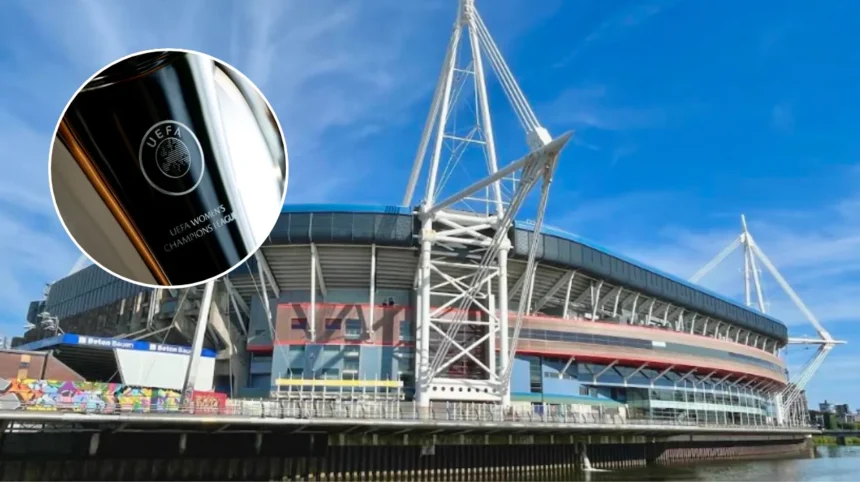
Key Points
- Cardiff Decision: The National Stadium of Wales in Cardiff has been formally chosen to stage the UEFA Women’s Champions League final in 2029.
- Temporary Naming Convention: In accordance with the strict sponsorship rules of UEFA, the stadium will be renamed as the National Stadium of Wales for the event.
- UEFA’s Other Decisions: In addition to the Cardiff decision, the European governing body of football also announced other club finals to be played in 2027-2029 in cities such as Munich, Barcelona, Lyon, Bucharest, Belgrade, Turin, and Budapest.
- Responses from Key Parties Involved: Both Noel Mooney, the CEO of the Football Association of Wales (FAW), and Abi Tierney, the group chief executive of the Welsh Rugby Union (WRU), were pleased by this decision.
Cardiff (Cardiff Daily) September 15, 2026 – Cardiff’s Principality Stadium is set to stage the pinnacle of European club football after being officially confirmed as the host venue for the 2029 UEFA Women’s Champions League final.
Why Has the Principality Stadium Been Selected to Host the 2029 Final?
As reported by BBC Sport, the 73,931-seater stadium—which previously staged the men’s Champions League final between Real Madrid and Juventus in 2017—will welcome Europe’s elite female talents later this decade.
Expressing his delight over the decision, Football Association of Wales (FAW) chief executive Noel Mooney stated that: “It’s brilliant news for Cymru and the FAW and the journey that we’re on, particularly in the women’s game.”
The upcoming fixture arrives nine years after the Cardiff City Stadium hosted the 2011 women’s Champions League final, which saw Lyon defeat Paris Saint-Germain on penalties following a goalless draw after extra-time. To adhere strictly to UEFA sponsorship protocols, the iconic Cardiff city centre venue will be temporarily rebranded as the National Stadium of Wales for the duration of the event.
Emphasising the broader strategic impact of securing the showcase, Noel Mooney added that: “This is about much more than one night in 2029. Our ambition is for the Uefa women’s Champions League final to become a catalyst for the continued transformation of women’s and girls’ football in Wales.”
Earlier in the year, the Principality Stadium—recognised as the largest stadium in Wales and owned and operated by the Welsh Rugby Union (WRU)—hosted the FA Community Shield, an encounter where reigning Premier League champions Arsenal secured a 3-0 victory against Manchester City.
Echoing the sentiments of the FAW, Welsh Rugby Union (WRU) group chief executive Abi Tierney noted that:
“This is a hugely significant moment for women’s sport in Wales and across Europe.”
Abi Tierney further explained that: “We are absolutely delighted that our stadium has been selected to host the 2029 Uefa women’s Champions League final, bringing one of the biggest occasions in world football to Cardiff and Wales.”
Furthermore, Abi Tierney remarked that:
“The rapid growth of women’s sport continues to inspire new generations of athletes and supporters, and hosting an event of this magnitude at the National Stadium of Wales is a powerful statement about the importance and future of the women’s game.”
What Other Host Venues Did UEFA Confirm Alongside Cardiff?
Alongside the landmark announcement for the Welsh capital, European football’s governing body confirmed a slate of host locations for forthcoming continental finals across its premier club competitions.
For the men’s equivalent tournaments, UEFA confirmed that Munich will host the 2028 Champions League final at the Munich Football Arena. A year later, the 2029 men’s showpiece will be staged at Camp Nou in Barcelona, arriving exactly 30 years after Manchester United’s historic and dramatic triumph over Bayern Munich in the same Spanish city back in 1999.
In the UEFA Women’s Champions League, the 2028 final has been awarded to the Parc Olympique Lyonnais in Lyon-Décines.
Meanwhile, the secondary club competitions will travel to different corners of the continent. The National Arena in Bucharest has been selected to host the 2028 UEFA Europa League final, while the National Stadium Serbia in Belgrade will hold the Europa League showpiece a year later in 2029.
In the UEFA Conference League, Turin’s iconic Juventus Stadium will stage the 2028 final, with the Puskas Arena in Budapest hosting the 2029 match. Additionally, the UEFA Super Cup fixtures were locked in, with the Johan Cruyff ArenA in Amsterdam scheduled for 2027 and the Astana Arena in Astana set to host in 2028.
Explore more Cardiff Sports News:
Cardiff City’s Six Striker Solutions to Fix Goal Drought Cardiff 2026
Bolton Wanderers Beat Cardiff City 1-0 at Toughsheet Community Stadium, Bolton 2026
Background of the Particular Development
The selection of Cardiff’s Principality Stadium for the 2029 UEFA Women’s Champions League final represents a logical progression in UEFA’s recent strategy to award major women’s showpieces to established, large-capacity rugby and football arenas rather than traditional smaller club grounds. Over the past five years, the profile, commercial revenue, and broadcast audiences of the UEFA Women’s Champions League have experienced exponential year-on-year growth.
Wales has a proven track record of successfully delivering major UEFA events, most notably hosting the 2017 men’s Champions League final at the very same Cardiff venue, alongside the 2014 UEFA Super Cup in Cardiff. By utilizing the 73,931-capacity Principality Stadium, the FAW and UEFA are aiming to build on record-breaking attendances seen across European women’s club football, creating a high-capacity destination capable of driving ticket sales, international tourism, and local civic engagement.
How This Development Can Affect Welsh Football and the Particular Audience
For the local footballing ecosystem, young female athletes, and grassroots participants in Wales, hosting a fixture of this magnitude is projected to act as a major structural catalyst. The presence of a global showcase in Cardiff is expected to accelerate government and governing body investment into regional facilities, coaching pathways, and school-level participation programmes for girls over the next three years.
For the primary audience—consisting of Welsh sports fans, local communities, and the rising generation of female footballers—seeing world-class athletes perform in their national stadium helps normalise elite women’s sport on prime television and live platforms. However, while the one-off event will generate significant short-term economic activity and inspiration, the long-term success of this development will ultimately depend on how effectively the FAW translates the 2029 spotlight into sustained, recurring domestic league attendances and grassroots funding across Wales.