Key Points
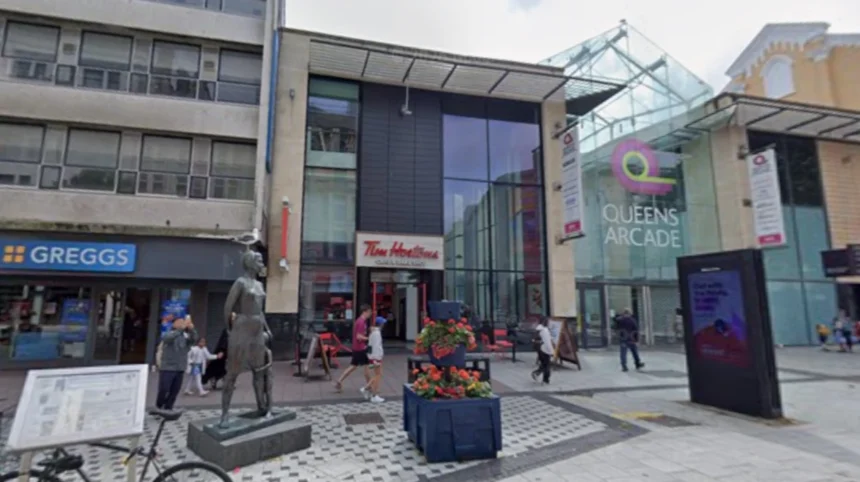
- Tim Hortons’ last coffee shop at Queen’s Arcade in Queen Street, Cardiff has shut down forever.
- This signifies the total withdrawal of the famous Canadian coffee and doughnut chain from the Welsh capital.
- Until now, Cardiff had been the stepping stone to enter the Welsh market for the company, with the city having hosted several outlets, one of them being at Albany Road in Roath, which opened in February 2018.
- With the shutting down of this last city centre outlet, there is just one Tim Hortons shop left in all of Wales.
Cardiff (Cardiff Daily) September 30, 2026 — As reported by Rhys Gregory of Wales24/7, the Canadian multinational fast-food restaurant chain Tim Hortons has officially severed its physical ties with Cardiff after shuttering its final operational site in the heart of the city. The permanent closure of the branch situated at Queen’s Arcade on Queen Street concludes the brand’s commercial chapter within the Welsh capital, leaving consumers and retail analysts alike to process the sudden contraction of the high-street giant.
Why Did Tim Hortons Close Its Final Cardiff Branch?
As detailed by Rhys Gregory of Wales24/7, the withdrawal from Queen Street means that “Tim Hortons has closed its last remaining Cardiff coffee shop, leaving the Canadian chain with just one location in Wales.” The Queen’s Arcade site, which had long served as a central hub for shoppers seeking the brand’s signature coffee, baked goods, and doughnuts, is now permanently shut.
The decision eliminates what was left of the company’s footprint in a municipality that was once earmarked as a primary target for aggressive regional expansion.
How Extensively Has Tim Hortons Retrenched Across the Welsh Capital?
According to data compiled by Rhys Gregory of Wales24/7, the landscape of the city’s hospitality sector has shifted dramatically regarding the brand’s presence. The journalist noted that historical expansion efforts saw the company launch multiple venues, pointing out that
“a third Tim Hortons location opened on Albany Road in Roath in February 2018”.
At the time of those earlier rollouts, corporate enthusiasm around opening multiple branches was heavily promoted as clear evidence of the firm’s long-term ambitions for the urban market. However, as Rhys Gregory of Wales24/7 highlighted,
“Now, all three former Cardiff branches have closed.”
This systematic scaling back transforms Cardiff’s commercial narrative, moving the city from a celebrated pioneer market for the brand in Wales to holding zero operational presence.
Explore more City Centre News
Lloyds opens 10-storey Cardiff office for 2,500 staff 2026
Feast On Cardiff Food Festival Confirms Return to Bute Park in Cardiff 2027
What Is the Current Status of Tim Hortons’ Operations Across the Rest of Wales?
As reported by Rhys Gregory of Wales24/7, despite the total wipeout of the brand within Cardiff itself, the corporate entity has not entirely eradicated its presence from the wider country. The journalist confirmed that following the loss of the Queen Street establishment, “Only one Tim Hortons remains in Wales.” Specifics regarding the exact geographic placement or operating metrics of this surviving Welsh outpost were noted within the context of the company’s broader contraction, illustrating a heavily trimmed operational map compared to its initial nationwide launch phase.
Background of the Particular Development
of Tim Hortons from Cardiff reflects broader economic and commercial pressures facing major high-street restaurant and cafe chains across the United Kingdom. Entering the UK market with high-profile openings, the brand—famous for its Canadian coffee culture heritage—expanded rapidly through franchise and corporate models. However, shifting consumer habits, rising operational expenditures including soaring energy and supply chain costs, and fluctuating commercial rent rates in city centres have forced numerous hospitality operators to reassess their portfolios. Cardiff, which once welcomed the brand as a major economic booster and employment provider in retail zones like Queen Street and Roath, has experienced successive high-street closures as national businesses adapt to tighter consumer spending and post-pandemic economic realities.
This development is expected to have a noticeable impact on local consumers, high-street footfall patterns, and commercial landlords in Cardiff. For local consumers and loyal patrons of the brand, the closure removes a popular social and dining option from the city centre, forcing them to seek alternative independent or corporate coffee houses. For landlords and property managers of prime commercial real estate—such as the Queen’s Arcade—the departure of a major international tenant adds to the ongoing challenge of securing long-term occupants for vacant retail spaces amidst a cautious retail climate. Furthermore, this contraction signals to the broader Welsh business community that even heavily backed global franchises are vulnerable to localized economic pressures, potentially dampening short-term investor confidence in high-street retail recoveries.