Key Points
- Ongoing Roadworks: Cardiff city centre is experiencing severe traffic congestion due to long-term and ongoing road improvement works across several key routes.
- Castle Street Development: Significant construction has been underway since February on Castle Street to transform temporary layout adjustments into a permanent road configuration and dedicated cycleway.
- Bute Street Restrictions: Access changes include no southbound vehicular access onto Bute Street from the Callaghan Square junction, altering local transit paths.
- Designated Diversions: Motorists travelling through the area are being directed to use alternative diversion routes such as Lloyd George Avenue and Dumballs Road.
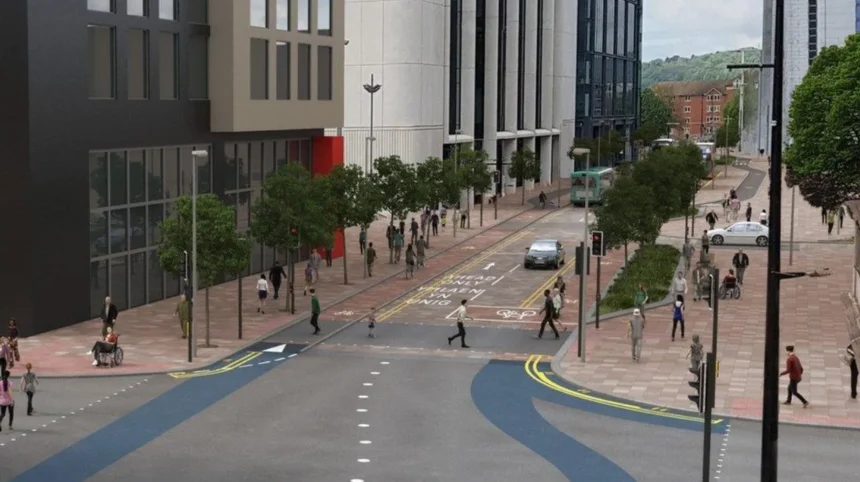
- Urban Pedestrianisation Goals: The wider scheme is part of a broader municipal plan to deliver a fully pedestrianised public realm featuring well-lit crossings, expanded pavements, integration with Friary Gardens and Cathays Park, and added urban greenery.
CARDIFF (Cardiff Daily) November 3, 2026 — Cardiff city centre has descended into severe traffic chaos and widespread congestion as ongoing infrastructure schemes and major roadworks continue to affect multiple key arteries across the Welsh capital. Motorists and public transport users are facing substantial delays as municipal construction projects move forward, significantly altering traffic flow patterns and restricting access through the urban core.
- Key Points
- What is causing the severe traffic congestion in Cardiff city centre?
- How are vehicle restrictions affecting Bute Street and Callaghan Square?
- What are the long-term urban design goals behind these roadworks?
- Background of the Particular Development
- Prediction and Impact on the Particular Audience
What is causing the severe traffic congestion in Cardiff city centre?
As reported by Kieran Molloy of the Herald. the disruption stems from a series of intensive civil works deployed across major traffic corridors. The municipal projects include long-term urban redesign initiatives aimed at modernising the layout of the city centre.
According to Kieran Molloy of the Herald. Wales, work officially began in February on Castle Street with the explicit objective
“to make the temporary road layout and cycleway permanent”.
While local authorities view these changes as vital for long-term sustainable transport, the ongoing construction phases have severely bottlenecked daily commuter traffic.
How are vehicle restrictions affecting Bute Street and Callaghan Square?
The traffic management measures implemented alongside the construction work have introduced strict directional bans across major junctions.
As detailed by Kieran Molloy of the Herald. Wales,
“There will be no southbound access onto Bute Street from the Callaghan Square junction”.
Consequently, vehicular traffic attempting to reach destinations south of Callaghan Square via Bute Street must alter their routes.
Kieran Molloy of the Herald Wales reported that
“Streets located south of Callaghan Square off Bute Street will only be accessible from the south”.
To mitigate total gridlock, transport planners have designated specific alternative routes for motorists navigating around the closures. As outlined by Kieran Molloy of the Herald. Wales, the official
“Diversion routes are Lloyd George Avenue and Dumballs Road”.
What are the long-term urban design goals behind these roadworks?
Despite immediate commuter frustrations and persistent delays, city planners maintain that the extensive structural disruption is a necessary precursor to a major environmental and pedestrian upgrade.
As outlined in the municipal project outlines highlighted by Kieran Molloy of the Herald. Wales,
“the project will deliver a completely pedestrianised area with well-lit crossings, wide pavements, and integration with Friary Gardens and Cathays Park”.
Furthermore, the completed scheme promises enhanced aesthetic and functional elements for urban visitors, including
“other urban greenery, benches, and small cafe spill-outs”.
Background of the Particular Development
The ongoing traffic congestion in Cardiff city centre is the direct result of a multi-year urban transformation strategy adopted by Cardiff Council to prioritize active travel, cycling, and pedestrian safety over traditional car-centric infrastructure. Castle Street, in particular, has been the subject of continuous debate and iterative redesigns following experimental traffic layouts introduced during the COVID-19 pandemic. The decision to permanently alter Castle Street and surrounding connectors like Bute Street reflects a broader UK-wide shift toward low-emission zones, active travel corridors, and public realm enhancements. However, these ambitious infrastructure overhauls frequently clash with high volumes of daily commuter traffic entering the core business district from surrounding suburbs and the wider South Wales valleys, resulting in recurring structural bottlenecks.
Prediction and Impact on the Particular Audience
The continuation of these major roadworks and permanent lane configurations will heavily impact daily commuters, local business owners, and delivery operators navigating Cardiff city centre. In the short term, drivers can expect prolonged peak-hour delays, increased fuel consumption, and extended journey times, forcing many commuters to switch to public transport or alter their traditional travel windows. For local retail and hospitality businesses located near the affected corridors, temporary access restrictions may cause a dip in spontaneous footfall. However, once the comprehensive pedestrianisation and urban greening schemes surrounding Friary Gardens and Cathays Park reach completion, the long-term outlook points toward a more accessible, pedestrian-friendly city centre that could ultimately increase foot traffic for local commercial establishments.