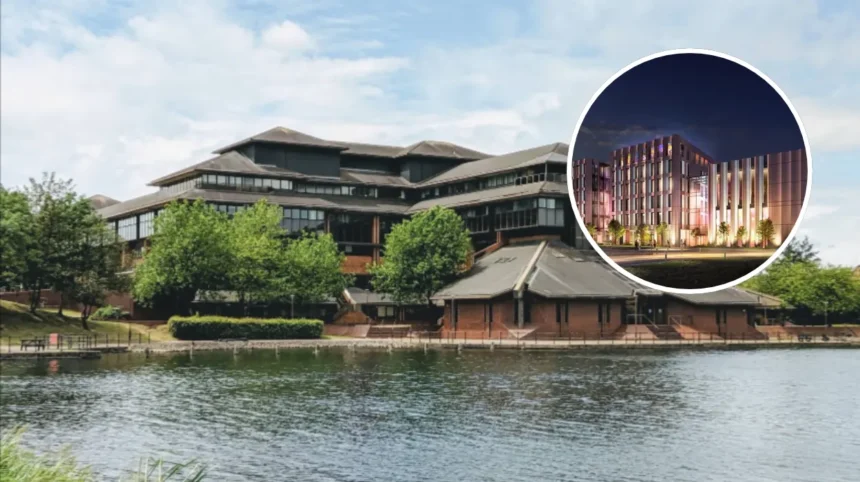
Key Points
- Final Approval Granted: Cardiff Council’s new £60m headquarters and the adjoining Capella immersive theatre project have officially received planning approval.
- Project Scope: Lodged by Goldbeck Construction Ltd, the development forms a “dual-use civic ensemble” intended to spearhead the regeneration of Atlantic Wharf and integrate with the upcoming Cardiff Live arena project.
- Design Division: Councillors and planning committee members expressed starkly contrasting views, with critics labeling the structure a “boring box” and a “missed opportunity” for the capital, while supporters defended its contemporary aesthetic.
- Local Disruption Concerns: Ward representatives highlighted deep-seated fatigue among Atlantic Wharf residents, who have endured prolonged construction disruptions, road modifications, and diversions.
- Existing Liability: The council’s current County Hall headquarters has been classified as a high-risk liability due to mounting maintenance backlogs and physical deterioration.
Cardiff (Cardiff Daily) November 7, 2026 — A final decision has been reached regarding the visual and structural future of Cardiff’s new £60m municipal headquarters, though the blueprint has ignited a sharp architectural and civic debate among local officials and community representatives.
As reported by Kieran Molloy of WalesOnline, the newly approved development is positioned as a cornerstone for the ongoing regeneration of Atlantic Wharf and the broader Cardiff Bay precinct. The current municipal headquarters at County Hall has functioned as a high-risk liability for numerous years, hampered by escalating maintenance backlogs driven by accelerating structural deterioration.
What do the new plans for Cardiff Bay entail?
According to proposals submitted by Goldbeck Construction Ltd, the approved scheme comprises a “dual-use civic ensemble” featuring a streamlined modern office building for Cardiff Council alongside a cultural destination linked to the Wales Millennium Centre, designated as Capella. Capella is mapped out as an “immersive theatre” encompassing specialized performance zones and flexible studio facilities.
As detailed in the planning application documents cited by WalesOnline, “Its compact, solid geometry reflects the spatial and acoustic demands of an immersive theatre, while its presence signals a destination rather than a workplace.” Working in tandem with the adjacent entertainment arena, the complex is projected to form Cardiff Live, a unified destination designed to host a wide array of civic and cultural events.
Why has the architectural design sparked controversy?
Despite the strategic ambitions behind the £60m project, the visual and aesthetic direction drew immediate criticism during the planning committee session. Raising objections over the lack of distinctive capital identity, as reported by Kieran Molloy of WalesOnline, Cllr Jon Shimmin criticized the scheme during the meeting, stating that it failed to establish a landmark presence outside the city centre.
As reported by WalesOnline, Cllr Jon Shimmin stated that:
“This is your once in a generation opportunity to go :’This is Cardiff, look at us’ and you haven’t – you’ve produced a boring box. It’s just another office box that could be anywhere rather than a nice statement building.”
Cllr Jon Shimmin further characterized the initiative as “another missed opportunity for this council”. These concerns were mirrored by fellow committee members Emma Reid-Jones and Adrian Robson. As noted by WalesOnline, Cllr Adrian Robson articulated broader apprehensions regarding civic representation:
“We are the capital city of Wales. The council needs to remember we are the capital city of Wales and embrace that and this does feel like it’s not doing so. There’s no real civic pride in this particular building as far as I can see.”
Despite expressing these reservations, Cllr Robson ultimately cast a vote in favor of the application.
How did other councillors defend the development?
Contrasting perspectives emerged from other members of the planning committee who defended the architectural approach. As documented by WalesOnline, Cllr Driscoll voiced approval for the aesthetic choices, stating:
“I quite like the design. Call me old-fashioned but that 80s look rings with me and I think it looks fantastic.”
Similarly, Cllr Peter Wong described the visual execution as “underwhelming but inoffensive”. As reported by WalesOnline, Cllr Peter Wong added:
“I’m not so sure about the need to have grandeur built into a council building.”
Cllr Wong additionally commended the project’s incorporation of active travel provisions. Supporting this view, Cllr Garry Hunt remarked:
“The fact is buildings will reflect their times and the time we are in is of this sort of development. If you look at the CGI presentations it looks quite imaginative inside.”
What are the concerns regarding local disruption?
Beyond the aesthetic discourse, the development plan encompasses significant road infrastructure adjustments and active travel networks. These ancillary works drew pointed feedback from local representatives regarding the cumulative toll placed on the surrounding community.
As reported by WalesOnline, ward Cllr Saeed Ebrahim emphasized that the local pushback stemmed from fatigue rather than opposition to economic investment:
“This is not an objection to investment in Cardiff. Residents in Atlantic Wharf have lived through years of construction, road changes, diversions, and disruptions. Many tell me they feel exhausted by the constant change around them. Too many people feel they have been expected to simply put up with disruptions because regeneration is happening around them.”
Reinforcing these community observations, ward colleague Cllr Helen Gunter stated:
“It’s disappointing to see the report does not put enough weight on the impact of this application on residents living in the area.”
Background of the Development
The approval of the £60m Cardiff Bay headquarters and Capella theatre represents the latest milestone in a long-standing strategy to revitalize the Atlantic Wharf district. For multiple years, Cardiff Council’s administrative operations have relied upon the aging County Hall facility. Municipal reports and infrastructure assessments have repeatedly categorized the existing structure as a high-risk financial and operational liability, driven by extensive maintenance backlogs and physical degradation. Local authorities formulated the Atlantic Wharf regeneration masterplan to replace the obsolete asset with a modern, energy-efficient municipal hub integrated with cultural spaces, aiming to draw visitors, boost local commerce, and anchor the wider Cardiff Bay waterfront development alongside the upcoming arena project.
Prediction and Impact on the Particular Audience
This planning milestone will directly affect Cardiff residents, local taxpayers, Atlantic Wharf homeowners, and cultural stakeholders across South Wales. For local taxpayers and council staff, the transition to a modern headquarters promises to curtail escalating maintenance expenditures associated with the deteriorating County Hall, though the £60m capital investment will require careful fiscal management. For Atlantic Wharf residents, the immediate outlook involves managing ongoing construction fatigue, traffic diversions, and localized infrastructure alterations, necessitating rigorous mitigation by the local authority to balance civic regeneration with community wellbeing. Meanwhile, cultural groups and patrons of the Wales Millennium Centre stand to benefit from the integration of the Capella immersive theatre, which is expected to expand performance infrastructure and cement Cardiff Bay as a premier entertainment destination.