Key Points
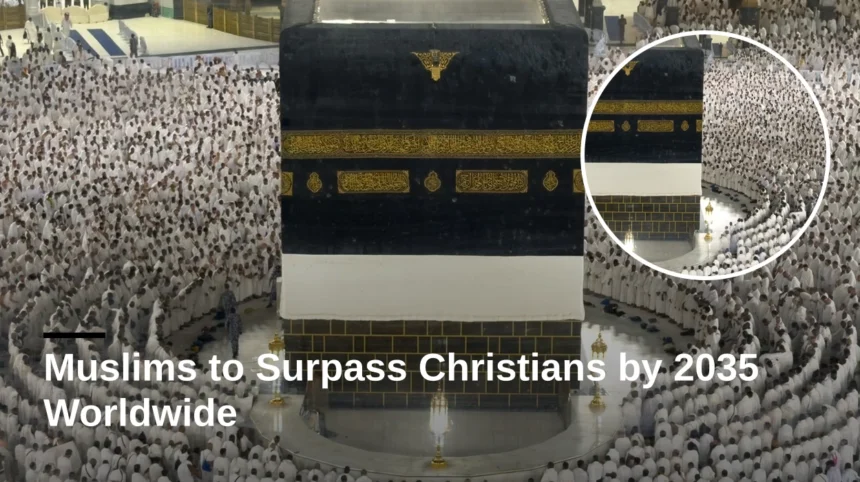
- Muslims are projected to surpass Christians as the world’s largest religious group by 2035.
- Pew Research Center says Muslim population growth is being driven mainly by higher fertility and a younger age profile.
- Both Muslim and Christian populations are expected to grow through 2070, although Muslims are projected to grow faster.
- Religious switching is projected to have a much smaller effect than births and deaths.
- Pew projects substantial growth for religiously unaffiliated people in several Western countries.
Inverted pyramid: Cardiff (Cardiff Daily) November 18, 2026 – Muslims are expected to outnumber Christians worldwide by 2035, according to new projections from the Pew Research Center. The study models population changes across 201 countries and territories between 2020 and 2070, using fertility, mortality, age structure, migration and religious switching. It says both groups will continue to grow, but the Muslim population will increase more rapidly.
- Key Points
- Why are Muslims projected to become the world’s largest religious group?
- How will the two populations change by 2070?
- What does the study project for Western countries?
- What are the demographic implications for Muslims and Christians?
- Background: How were the projections produced?
- What could this mean for Muslim communities by 2035?
Why are Muslims projected to become the world’s largest religious group?
As reported by the Pew Research Center, Muslims are projected to overtake Christians because Muslim populations are younger and have higher fertility rates. The analysis says Muslims are expected to gain about 1.6 billion people through natural population change between 2020 and 2070, compared with an increase of about 792 million among Christians.
Pew said religious switching is expected to have limited influence on the overall result. Its projections estimate that about 9.2 million Muslims could become Christian, while approximately 9 million Christians could become Muslim. The difference is therefore considerably smaller than the effect of births and deaths.
How will the two populations change by 2070?
Pew projects that the global Muslim population will exceed 3.6 billion by 2070, while the Christian population will be just under 3 billion if current demographic trends continue. The organisation says Christians are expected to grow by about 30 per cent between 2020 and 2070, while Muslims are projected to grow by about 80 per cent.
Much of the projected growth is expected in sub-Saharan Africa, where populations are expanding and both Christianity and Islam have large established communities. Pew projects that more than half of the world’s Christians could live in sub-Saharan Africa by 2070.
What does the study project for Western countries?
Pew projects that the Christian share of the United States population could fall below half by 2070, while the share of religiously unaffiliated people could rise to about 41 per cent. In Canada, Christians are projected to fall below half by 2030, with people who identify with no religion also increasing.
The projections also indicate that Europe’s Christian population could decline as the region’s total population falls. At the same time, the Muslim share of Europe’s population is projected to increase from about 6 per cent in 2020 to 13 per cent by 2070.
What are the demographic implications for Muslims and Christians?
The figures describe population change rather than a transfer of religious affiliation from Christianity to Islam. Pew Research Center says most growth for both groups is expected in countries where they already form majorities. The organisation has also cautioned that the findings should not be presented as a conflict between Muslims and Christians.
Religious demographers have highlighted the importance of interfaith education and personal contact as religious populations change. The projections do not determine future religious identity, because fertility, mortality, migration, affiliation and social conditions may develop differently from current trends.
Background: How were the projections produced?
Pew Research Center’s study examines seven broad religious categories from 2020 to 2070. It covers 201 countries and territories representing nearly all of the world’s population. Researchers project each population by adding expected births, subtracting deaths and accounting for migration and religious switching. The results describe what could happen if recent demographic patterns continue rather than offering a certainty about the future.
What could this mean for Muslim communities by 2035?
If the projections hold, Muslim communities could become the largest global religious audience by 2035, increasing their demographic significance in education, public policy, media and interfaith relations. The change would occur alongside continued Christian population growth rather than through a simple replacement of one faith by another. Population totals would not by themselves indicate changes in religious practice, political influence or individual beliefs. Governments, institutions and community organisations would still need to account for substantial regional differences in age, fertility, migration and religious affiliation.