

Key Points
- Home Secretary Shabana Mahmood told police to “leave the politics to the politicians”.
- A new impartiality standard will bring guidance on fair policing into one framework.
- About 200 local police commands are planned across England and Wales.
- Up to 200 recruits a year will enter a fast-track route to superintendent.
- Police leaders said impartiality must be balanced with operational discretion.
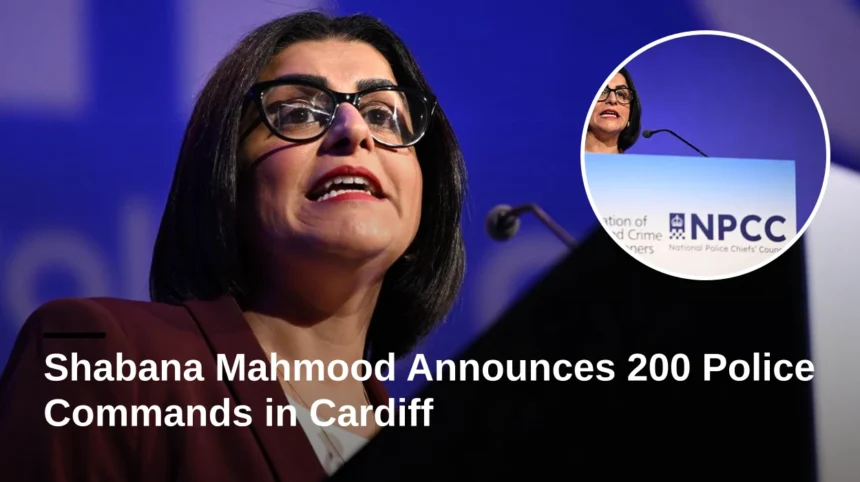
Cardiff (Cardiff Daily) November 18, 2026 – Home Secretary Shabana Mahmood has instructed police officers in England and Wales to avoid political activity as the Government prepares a new impartiality standard. Speaking to policing leaders, she said community engagement should focus on residents’ concerns rather than activist groups promoting political campaigns.
Ms Mahmood said the standard, which is being developed by the College of Policing and will be subject to consultation, would bring key principles together and help officers treat people fairly regardless of race, faith or other characteristics. She also announced plans for about 200 local police commands, each broadly comparable in size to a unitary authority and led by a named commander.
What did Shabana Mahmood tell police officers?
As reported by the Evening Standard, Ms Mahmood said: “When it comes to political groups, leave the politics to the politicians, and we will leave the policing to you.” She said community engagement could include residents’ association meetings, but should not involve activist groups or campaigners pursuing their own political agenda.
The Home Secretary said most officers already police impartially, but acknowledged that examples of differential treatment had damaged confidence and allowed claims of two-tier policing to gain traction. She rejected the claim that police forces routinely operate a two-tier system.
What reforms did the Home Secretary announce?
The Government said the new impartiality standard would provide guidance on issues including symbols displayed on badges and lanyards and officers’ conduct at community-led events. It is intended to give officers greater confidence when handling cases and reassure the public that the law will be applied fairly.
Ms Mahmood also announced a fast-stream programme expected to bring in up to 200 recruits each year from inside and outside policing. The recruits will follow a five-to-10-year route towards becoming superintendents, according to the Home Office.
Separate Government plans will create around 200 local police commands across England and Wales. The commands are intended to strengthen local accountability and support a consistent standard of everyday policing.
How did police leaders and political opponents respond?
National Police Chiefs’ Council chairman Gavin Stephens said officers needed tolerance because emergency calls often involved limited information and complex circumstances. He said impartiality required the fair use of police powers, while discretion meant that apparently similar situations could be handled differently because of their underlying details.
Shadow Home Secretary Chris Philp said police should not treat people differently because of the colour of their skin. Reform UK leader Nigel Farage said the Home Secretary’s acknowledgement that differential treatment had occurred supported his party’s previous claims about two-tier policing.
What events shaped the debate?
The Evening Standard reported that the debate intensified after the murder of Henry Nowak, who was handcuffed while dying after his killer falsely accused him of racist abuse. The case was followed by renewed allegations of unequal policing and far-right protests.
Ms Mahmood also referred to concerns about racial representation in policing. She said it was shameful that, decades after the murder of Stephen Lawrence, the proportion of black officers remained virtually unchanged. A More in Common poll cited in the report found that 33 per cent of Britons believed police treated ethnic-minority people more favourably than white people.
What could the changes mean for the public?
The impartiality standard could give the public clearer expectations about how officers should handle politically sensitive issues, community events and cases involving protected characteristics. The proposed local commands may make responsibility for neighbourhood policing easier to identify, while the recruitment programme is intended to strengthen police leadership over time.
The changes may also increase scrutiny of police decisions. Gavin Stephens’ comments indicate that forces will continue to rely on professional discretion during unpredictable incidents, meaning equal treatment will not necessarily produce identical responses in every case.

