
Key Points
- Prime Minister Andy Burnham said rejoining the European Union without a referendum would be “unthinkable”.
- He made the commitment while answering Conservative Member of Parliament Sir Bernard Jenkin in the House of Commons.
- Burnham said the government’s latest European Union agreement was not a prelude to a second referendum.
- The prime minister said there was no fixed destination for talks on closer United Kingdom-European Union ties.
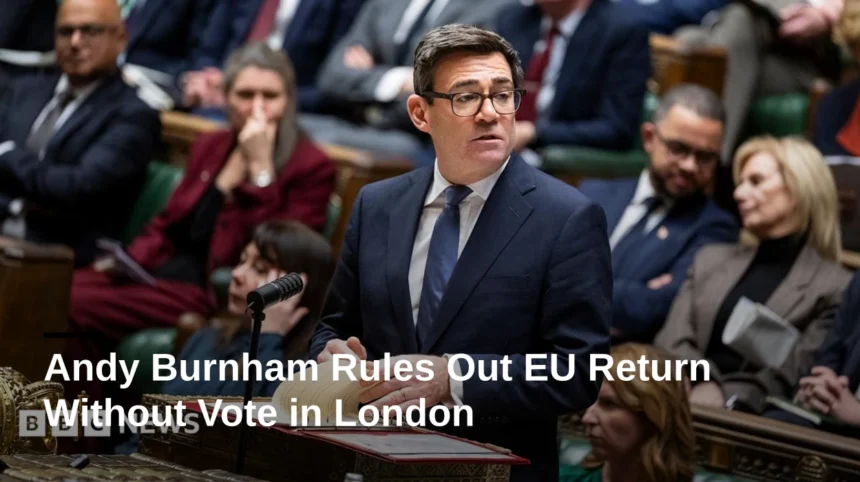
London (Bristol Expess News) November 23, 2026 – Prime Minister Andy Burnham has said it would be unthinkable for the United Kingdom to rejoin the European Union without a public referendum. He made the statement in the House of Commons as lawmakers questioned his government’s latest agreement aimed at resetting relations with the bloc. Burnham said the agreement was not intended to commit the country to rejoining the European Union.
What did Andy Burnham tell MPs about rejoining the European Union?
As reported by BBC News, Conservative Member of Parliament Sir Bernard Jenkin asked Burnham for a “clear and unequivocal statement” that any decision to take the United Kingdom back into the European Union without a referendum would be unthinkable. Burnham replied: “Yes, it would be unthinkable.”
The Independent reported that Burnham denied the new agreement with the European Union was a “prelude” to a second vote on membership. The report said his comments represented the clearest indication yet of how his Labour administration could approach any future decision on the country’s relationship with the bloc.
What is included in the latest United Kingdom-European Union approach?
BBC News reported that Burnham described his approach as pragmatic and said there was “no fixed destination” for discussions exploring closer ties with the European Union. He said both sides would examine possible options for their long-term relationship.
Coverage by The Telegraph said Burnham’s statement came as he presented the government’s European Union reset agreement to the House of Commons. The newspaper reported that he had promised the public a referendum before Britain could rejoin the bloc.
What is the background to the development?
The United Kingdom left the European Union after the 2016 referendum, in which voters supported leaving. Burnham has supported closer relations with the bloc while rejecting the suggestion that current negotiations automatically lead to membership. The latest agreement concerns the future relationship between the United Kingdom and the European Union rather than an immediate application to rejoin. Burnham’s parliamentary answer established that any return to membership would require a separate public vote.
How could the statement affect the United Kingdom’s European policy?
Burnham’s position leaves closer cooperation with the European Union open while setting a referendum as a condition for any future decision to rejoin. It may reassure lawmakers who oppose membership being restored without direct public approval, while also allowing the government to continue discussions on practical areas of cooperation. The statement does not establish that a referendum will take place or that the United Kingdom intends to seek membership. Any such decision would depend on future negotiations, government policy and public approval.