Key Points
- Dismissal of a Policeman: Police Constable Christopher Bonney of South Wales Police was sacked without notice after being subjected to a rapid misconduct hearing on September 7, 2026.
- Description of the Event: On February 1, 2026, Bonney stopped the car of a vulnerable lady known as Ms A.
- Vulnerability Overlooked: Database checks done by the police and observed by Bonney indicated that Ms A had indications of self-harm, violence, suicide, and mental health problems.
- Improper Communication: Bonney used his official police mobile phone to exchange text messages with Ms A from 6:34 PM to 9:39 PM on the same day of her stop.
- Flirtation: The investigation panel determined that the text messages were “increasingly familiar and flirtatious in nature,” indicating that the aim was to engage in a relationship with her.
- Detection of Anti-Corruption Violation: The text message communication was discovered as part of the routine monitoring performed by South Wales Police anti-corruption unit.
- Officer’s Defense: Bonney acknowledged that he violated the appropriate professional boundaries and apologized, according to Ellie Gosley of Wales Online, and said that he “deeply regrets his lapse.”
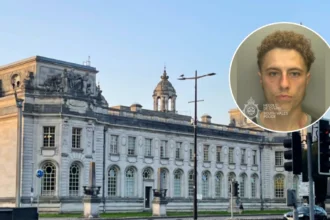
Cardiff (Cardiff Daily) September 23, 2026 – A serving police constable has been dismissed from South Wales Police without notice after a misconduct panel found him guilty of gross misconduct for contacting a vulnerable motorist. Police Constable Christopher Bonney exchanged phone numbers with a female driver following a traffic stop and subsequently sent text messages designed to pursue a personal relationship. The independent panel determined his actions breached professional standards, leading to his immediate termination following an accelerated hearing held earlier in the month.
How did the investigation into PC Christopher Bonney begin?
As reported by Ellie Gosley of Wales Online, the case against Police Constable Christopher Bonney stemmed from an incident that took place on February 1, 2026. While on duty at approximately 4:30 PM, the officer conducted a check on a motor vehicle registered to a female member of the public, identified in official proceedings only as Ms A.
As reported by Ellie Gosley of Wales Online, Bonney recorded the reason for the vehicle check on police systems as “02 moving vehicle” and subsequently required Ms A, who was the sole occupant of the automobile, to bring the vehicle to a halt. Later that same day, Bonney conducted a secondary check on Ms A via police databases. This check revealed critical background information designating her as a vulnerable person.
As reported by Ellie Gosley of Wales Online, the hearing was informed that Ms A had active warning markers logged on the system for self-harm, violence, suicide, and mental health challenges—markers that the officer would have directly viewed during his database inquiry.
What was the nature of the messages sent to Ms A?
Following the traffic stop, the internal monitoring mechanisms of South Wales Police swung into action. As part of their routine monitoring responsibilities, South Wales Police’s anti-corruption unit identified that Bonney had utilized his official police-issued mobile phone to initiate contact with Ms A.
As reported by Ellie Gosley of Wales Online, records presented to the panel showed that Bonney and the vulnerable woman exchanged a series of text messages between 6:34 PM and 9:39 PM on the exact same day the traffic stop occurred. The misconduct panel concluded that these communications revealed intentions by the officer to pursue “some form of personal or emotional relationship” with the motorist.
Furthermore, as reported by Ellie Gosley of Wales Online, the texts transmitted via Bonney’s police-issued device—before he eventually shared his personal telephone number with her—were characterized as being “progressively over-familiar and of a flirtatious nature.”
Explore more Cardiff Crime News:
Major Designer Perfume Theft at Cardiff Industrial Estate 2026
Police Search for Woman After Large Fight in Canton Cardiff 2026
What defense did PC Christopher Bonney offer at the hearing?
Confronted with the findings of the anti-corruption unit, the officer did not contest the core mechanics of his communication with the civilian. As reported by Ellie Gosley of Wales Online, the officer accepted that he had crossed the boundaries of professional behavior and acknowledged that he failed to maintain the strict standards expected of police officers.
However, during the proceedings, Bonney offered a defense regarding his underlying motivations. As reported by Ellie Gosley of Wales Online, Bonney claimed that he did not actually want to form any romantic or personal relationship with the woman. Instead, he argued that he was genuinely worried for the woman’s welfare following the roadside interaction.
Despite this defense, the accelerated misconduct hearing held on September 7, 2026, dismissed his explanations in light of the explicit content of the messages and his knowledge of her vulnerabilities. The panel ruled his actions constituted gross misconduct. Consequently, as reported by Ellie Gosley of Wales Online, the officer was sacked without notice, concluding with the admission from the disgraced constable:
“I deeply regret this failure.”
Background of the Particular Development
This dismissal occurs against a backdrop of intensified scrutiny regarding police standards and professional boundaries across United Kingdom police forces. In recent years, inspectorates and independent bodies have demanded zero tolerance for officers who abuse their position of power to form improper emotional or sexual relationships with members of the public, particularly those identified as vulnerable.
South Wales Police, like other forces nationwide, has enhanced its internal anti-corruption monitoring systems to proactively flag unusual digital communications originating from official police-issued devices. Accelerated misconduct hearings have become the standard mechanism for swiftly addressing clear-cut breaches of public trust, ensuring that officers who compromise professional integrity are removed from service with minimal delay to restore public confidence.
The dismissal of Police Constable Christopher Bonney is expected to have a significant ripple effect on local communities and the internal culture within South Wales Police. For the particular audience—comprising local residents, vulnerable individuals relying on emergency services, and serving police personnel—this development reinforces both accountability and vigilance.
Vulnerable groups and community advocates will likely view the swift intervention of the anti-corruption unit as a positive sign that internal safeguards are functioning to protect citizens from predatory behavior. Conversely, it underscores ongoing concerns regarding trust between marginalized or vulnerable citizens and law enforcement officers. For fellow officers within South Wales Police, the ruling serves as a stark reminder that digital communications on duty phones are heavily monitored, reinforcing strict adherence to professional boundaries and likely reducing instances of inappropriate fraternization.