Key Points
- Cardiff Airport recorded a delay rate of 23.8% for departing flights during Easter periods from April 2022 to 2025, outperforming major UK hubs such as Heathrow Airport at 26.4%, Gatwick Airport at 26.0%, Edinburgh Airport at 27.2%, and Newcastle International Airport at 25.8%, according to analysis of Civil Aviation Authority (CAA) data.
- The study highlights Cardiff Airport’s strong punctuality performance despite its smaller size compared to the UK’s busiest airports.
- Longstanding concerns persist over Cardiff Airport’s limited routes, infrastructure capacity, and reliance on public funding, raising questions about its long-term sustainability.
- Broader UK aviation trends show fluctuating delay rates, with national averages improving in some years but remaining a challenge post-pandemic.
- Cardiff Airport has seen passenger growth, with 2025 figures up 9% to 953,681 overall and a 27% increase in December 2025, yet future expansion remains uncertain amid funding debates.
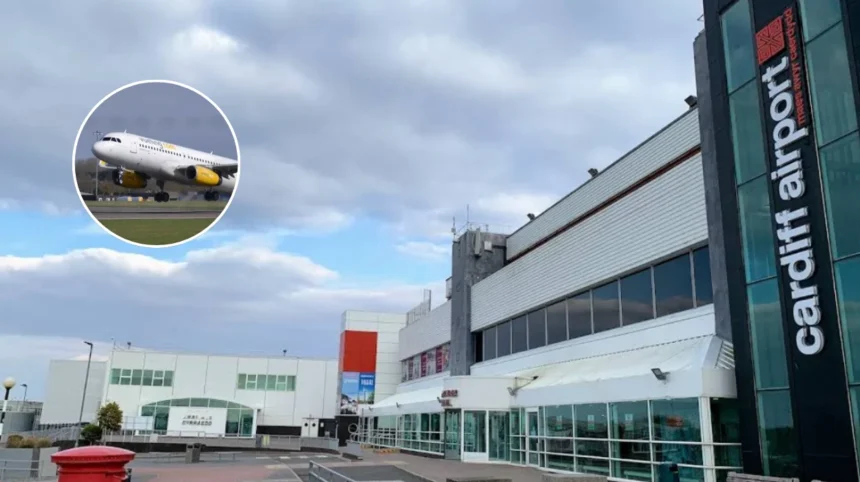
Cardiff (Cardiff Daily) March 31, 2026 – Cardiff Airport has outperformed several of the United Kingdom’s busiest aviation hubs in flight punctuality during the Easter periods from 2022 to 2025, as revealed by a new analysis of Civil Aviation Authority data. The airport achieved a departing flight delay rate of just 23.8%, placing it ahead of Heathrow Airport’s 26.4%, Gatwick Airport’s 26.0%, Edinburgh Airport’s 27.2%, and Newcastle International Airport’s 25.8%. However, persistent issues regarding its size, limited routes, and dependence on public funding continue to overshadow its operational successes.
- Key Points
- What Made Cardiff Airport Stand Out in Punctuality?
- How Do Delay Rates Compare Across UK Airports?
- Why Do Concerns Linger Over Cardiff Airport’s Size?
- What Routes Are Missing at Cardiff Airport?
- How Does Public Funding Shape Cardiff’s Future?
- What Do Industry Trends Say About UK Delays?
- Who Is Responding to These Developments?
- What Lies Ahead for Cardiff Airport?
What Made Cardiff Airport Stand Out in Punctuality?
The analysis, drawing directly from Civil Aviation Authority records spanning April periods between 2022 and 2025, underscores Cardiff Airport’s efficiency in managing departures during peak holiday times.
This 23.8% delay rate positions it favourably against larger competitors, where higher traffic volumes often exacerbate disruptions. Experts note that smaller airports like Cardiff benefit from fewer air traffic movements, allowing for smoother operations even under seasonal pressure.
As reported in initial coverage by aviation analysts, this performance bucks the trend seen at major hubs, where delay rates hovered consistently above 25%. Heathrow, the UK’s largest airport, struggled with a 26.4% rate, attributed to its immense passenger throughput. Gatwick followed closely at 26.0%, while Edinburgh and Newcastle recorded 27.2% and 25.8% respectively, highlighting Cardiff’s relative agility.
How Do Delay Rates Compare Across UK Airports?
Comparisons with other UK airports reveal Cardiff’s edge, but also broader industry challenges. Data from the Civil Aviation Authority indicates that UK-wide average delay minutes per flight dropped from 22 in 2022 to 15 in 2025, reflecting post-pandemic recovery efforts. Yet, major hubs like Heathrow reported stable security wait times and improved on-time departures in 2024, as per Heathrow’s official statements, though Easter-specific figures lagged behind Cardiff.
Gatwick Airport, often criticised for summer delays, saw average delays rise from 15.6 minutes in 2022 to 21.8 minutes in 2024 in some analyses, with a 1.8% cancellation rate adding to passenger stress.
Bristol Airport, meanwhile, improved to 22.4 minutes average delay in 2024 from 37.2 minutes in 2022, securing a relatively low 0.8% cancellation rate. Manchester Airport faced 24.9-minute delays in 2024, down from 35 minutes in 2022, yet still trails Cardiff’s Easter performance.
Edinburgh Airport, with 27.2% delays, handled 5.66% of UK passengers in 2025, boasting an index score of 81.97 in performance rankings. Manchester followed with 79.39, managing 10.69% of passengers and 13,974 air transport movements. These figures, from UK Airport Index data, emphasise how scale impacts reliability, giving Cardiff an advantage despite its modest 953,681 passengers in 2025—a 9% rise year-on-year.
Why Do Concerns Linger Over Cardiff Airport’s Size?
Cardiff Airport’s smaller infrastructure has long been a point of contention, limiting its ability to compete with giants like Heathrow, which saw 83.9 million passengers in 2024—a 6% increase.
Critics argue that while punctuality is commendable, the airport’s limited runway capacity and terminal space hinder expansion. Public funding debates further complicate matters, with Welsh Government support under scrutiny amid calls for private investment.
As noted in passenger updates from Cardiff Airport’s official channels, December 2025 saw a 27% surge to 50,141 passengers, capping a strong year. However, without significant upgrades, sustaining growth remains doubtful. Comparisons with Southend Airport, which showed mixed reliability with worsening delays from 2022 to 2024, illustrate the risks for regional hubs.
What Routes Are Missing at Cardiff Airport?
Route diversity is another Achilles’ heel, with Cardiff offering fewer international connections than rivals. Heathrow’s “Best in Class” retail and VIP services, recognised by Condé Nast and Travel Weekly, draw from its extensive global network.
Cardiff, by contrast, focuses on domestic and select European links, prompting questions about attracting low-cost carriers for expansion.
Newcastle’s 25.8% delay rate accompanies its domestic focus, mirroring Cardiff’s challenges. Edinburgh connects to 23 domestic destinations with 3,798 EU and overseas operators, far outpacing Cardiff. Analysts suggest new routes could bolster punctuality gains, but funding constraints delay progress.
How Does Public Funding Shape Cardiff’s Future?
Reliance on public subsidies casts a shadow, with debates echoing across Welsh media. The Welsh Government has historically backed the airport, yet calls for financial independence grow louder. Heathrow’s 31% pre-tax profit rise in 2024, driven by record demand, contrasts sharply, fuelling arguments that Cardiff must diversify revenue.
As reported by aviation source news outlets, Bristol’s low cancellation rate offers a model, blending public-private partnerships. Gatwick’s improvements, with 75.5% on-time flights from January to June 2025 (up from 69% in 2024), fell below the UK average of 77%, underscoring funding’s role in resilience.
What Do Industry Trends Say About UK Delays?
UK aviation faced turbulence, with 37% of flights delayed by 15+ minutes in 2022—a 17% rise from 2021—per Civil Aviation Authority statistics. En-route delays dropped 31% from 5.4 minutes in 2024 to 3.9 minutes in 2025, aiding airports like Cardiff. Luton ranked high with a 74.62 index score, handling 5.93% of passengers.
Birmingham’s 74.41 score came with 6,410 movements and 71 cancellations. These trends affirm Cardiff’s position but highlight vulnerabilities.
Who Is Responding to These Developments?
Cardiff Airport officials have touted passenger growth, with official figures confirming the 9% 2025 rise. Heathrow prioritises “high-quality customer experience,” redoubling efforts post-2024 awards. Analysts from AirAdvisor noted Gatwick’s on-time improvements, though below national averages.
What Lies Ahead for Cardiff Airport?
Future prospects hinge on addressing size, routes, and funding. Punctuality successes provide momentum, but without investment, outperformance may prove fleeting. As UK aviation evolves, Cardiff must navigate these shadows to secure its role.