Key Points
- Freight Systems Express Wales (FSEW) has officially launched Wales’ first dedicated heavy goods vehicle (HGV) electric charging facility, known as the eFreight Hub.
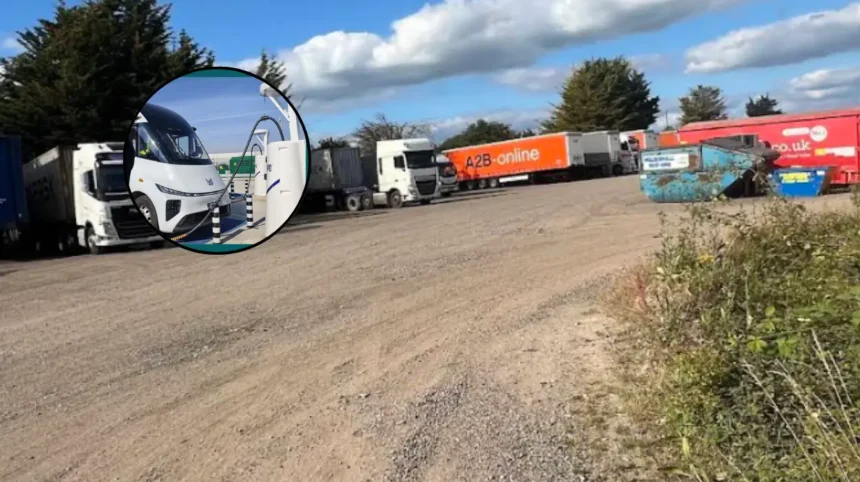
- Located on a 2.5-acre site at the Old Ely Transport Yard on Lamby Way Industrial Estate in Cardiff, the project represents a major milestone in zero-emission freight transport.
- The operational site currently features eight 480kW double-gun DC chargers capable of providing up to 190 miles of range to a heavy electric truck within one hour.
- The high-power charging infrastructure was financed, designed, and installed in partnership with EV fleet and battery storage specialist Zenobē, with civil and electrical engineering delivered by ADDCharge.
- The development will support a driver recruitment drive for up to 50 new staff as FSEW targets expanding its electric vehicle fleet to 70 trucks by 2027.
- While primarily built to serve FSEW’s expanding electric fleet—including Volvo FM and Mercedes-Benz eActros 600 models—the hub is open for third-party commercial vehicle charging.
- The project received partial funding from the UK Government’s Depot Charging Scheme.
Cardiff (Cardiff Daily) August 15, 2026 — Freight Systems Express Wales (FSEW) has officially launched Wales’ first dedicated heavy goods vehicle electric charging hub at the Old Ely Transport Yard on Lamby Way Industrial Estate, Cardiff, establishing a vital operational base for zero-emission logistics across South Wales.
- Key Points
- What Infrastructure Has Been Installed at the Lamby Way eFreight Hub?
- Who Will Have Access to the New High-Power Charging Infrastructure?
- What Does Leadership Say About the Commercial Viability of Electric HGVs?
- How Does the Development Connect to Regional Job Creation and Green Freight Frameworks?
- Background of the Development
- Industry Prediction: Impact on Freight Operators and Logistics Supply Chains
What Infrastructure Has Been Installed at the Lamby Way eFreight Hub?
As reported by Sustainable Business Magazine, the newly operational eFreight Hub spans 2.5 acres and hosts eight 480kW double-gun DC chargers. The ultra-rapid units deliver up to 190 miles of range to a heavy electric truck in approximately 60 minutes.
According to technical case study details released by ADDCharge, the engineering firm delivered the integrated electrical engineering, high-voltage/low-voltage (HV/LV) installation, groundworks, and charger installation over a 12-week construction window. The infrastructure provides 16 dedicated HGV charging bays and has been planned with dynamic load management and physical capacity for further expansions as fleet demands grow.
As reported by Business Live, EV fleet and battery storage specialist Zenobē acted as the primary infrastructure partner, financing, designing, and installing the charging systems through a structured charging services agreement to reduce initial capital outlay. The overall development was further supported by funding from the UK Government’s Depot Charging Scheme.
Who Will Have Access to the New High-Power Charging Infrastructure?
According to reporting from Forwarder Magazine, the site is designed to accommodate the heaviest electric trucks on the market. The charging hub will predominantly power FSEW’s growing electric fleet, including newly acquired Volvo FM electric trucks and Mercedes-Benz eActros 600 tractor units.
However, as stated by the Society of Motor Manufacturers and Traders (SMMT), FSEW is making the site available for third-party charging. Agreed external operators running compatible light commercial vans and heavy articulated vehicles will be permitted to access the chargers, offering a competitively priced open-access option in a region previously lacking dedicated heavy-vehicle charging points.
What Does Leadership Say About the Commercial Viability of Electric HGVs?
As reported by Forwarder Magazine, Geoff Tomlinson, Managing Director at FSEW, stated:
“The eFreight Hub is a personal and professional milestone. We are proving that the electrification of heavy freight is not just possible, but commercially viable. By providing accessible, high-power charging, we are removing one of the biggest barriers facing operators today: ‘range and charging anxiety.’ This hub isn’t just about trucks; it’s about better air quality for our communities and a complete shift in how the industry thinks about energy”.
Regarding financial backing, Geoff Tomlinson added:
“Up until this point everything we have done has been self-funded, but we have now secured a grant from the Government’s Depot Charging Scheme which is accelerating our plans”.
As documented in initial project announcements from Zenobē, Steven Meersman, Co-Founder and Director at Zenobē, stated:
“FSEW’s Low Carbon Freight Hub will be a flagship site for fleet operators here in Wales and we are looking forward to working with them on this significant project. We share their vision to provide end-to-end decarbonisation solutions for transport operators. Wales has set ambitious carbon reduction targets, and we are excited to work with one of the leading Welsh businesses in the low carbon space to work towards achieving this”.
How Does the Development Connect to Regional Job Creation and Green Freight Frameworks?
As covered by Business Live, the launch of the Cardiff hub coincides with an employment recruitment drive by FSEW, which intends to recruit up to 50 new drivers as part of its operational growth. The company aims to expand its total electric fleet to 70 vehicles by 2027.
According to Sustainable Business Magazine, the hub will serve as the physical foundation for FSEW’s GreenFlow initiative, a multi-modal freight framework designed to assist clients in establishing net-zero supply chains across road, rail, air, and sea. Building product manufacturer Siderise, based in Maesteg, has already utilised the GreenFlow framework to ship export containers from Wales to Dubai with a zero-carbon footprint.
Background of the Development
FSEW (Freight Systems Express Wales) was founded in July 2002 by Managing Director Geoff Tomlinson after identifying market demand for a customer-focused global freight forwarding venture. In 2005, the Cardiff-headquartered firm was named the fastest-growing indigenous business in the Wales Fast Growth 50 index. Today, FSEW employs 90 people and operates a fleet of over 40 trucks.
The company has maintained a history of early adoption in transport decarbonisation. In 2021, in partnership with retail supermarket chain Tesco, FSEW launched the UK’s first commercial-use heavy electric trucks. Five years ago, FSEW set a corporate target to eliminate diesel completely from its haulage fleet by 2025. That objective was achieved ahead of schedule in December 2024, when the business formally transitioned its remaining fleet to a combination of battery-electric vehicles and 100% biomethane trucks.
The development of the Old Ely Transport Yard site began after planning consent was granted, leading to Zenobē’s appointment as infrastructure partner. Construction work on the eFreight Hub took 12 weeks to complete alongside adjacent civil works on the Lamby Way estate, culminating in the live, operational facility now open in Cardiff.
Explore More Local Cardiff News
Hollywood Vampires Deliver Thrilling Rock Show at Cardiff Castle 2026
Police Officer Hospitalised After E-Bike Crash in Caerau, Cardiff 2026
Industry Prediction: Impact on Freight Operators and Logistics Supply Chains
The opening of Wales’ first dedicated eFreight Hub in Cardiff is likely to accelerate the decarbonisation of heavy road transport across South Wales and the broader UK freight corridor.
For logistics operators and commercial transport fleets, the availability of 480kW charging infrastructure addresses one of the primary operational hurdles to electric vehicle adoption: range anxiety and extended down-time. By providing reliable rapid charging capable of replenishing up to 190 miles in an hour, the facility establishes a template for commercial fleet duty cycles, allowing heavy trucks to maintain delivery schedules comparable to traditional diesel operations. Furthermore, by offering agreed third-party access, smaller hauliers and third-party logistics providers can initiate their own fleet transitions without immediately incurring the capital expenditure required to construct private depot charging networks.
For industrial shippers and corporate clients operating in South Wales, the development will expand access to audited zero-emission supply chain routes. As regulatory mandates and corporate Scope 3 emissions targets tighten, access to local zero-emission haulage infrastructure will allow regional manufacturers to reduce the carbon intensity of their outbound logistics.
Finally, the deployment of high-capacity depot charging in South Wales creates a regional precedent for energy grid integration and private-public funding models. Success at the Lamby Way site will likely encourage surrounding local authorities and highway agencies to prioritize high-voltage grid connections and dedicated heavy-vehicle charging corridors along major freight routes such as the M4 corridor.