Key Points
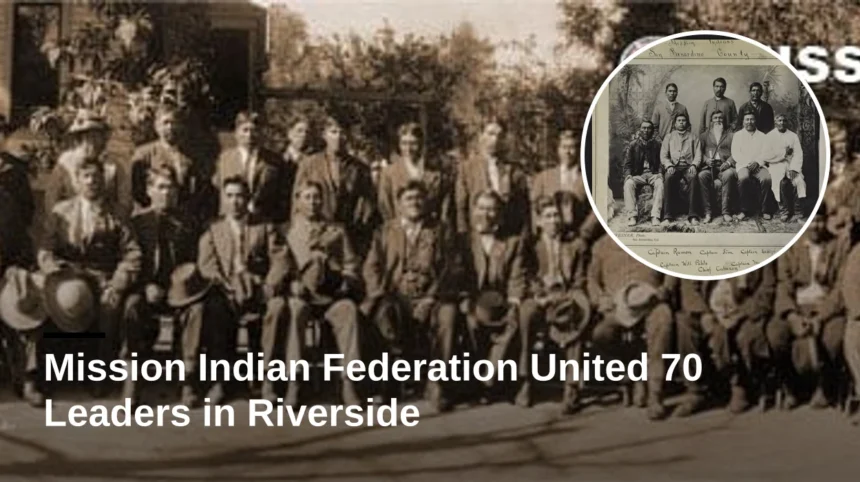
- The Mission Indian Federation was formed in 1919 by about 70 Native leaders representing roughly 2,000 Southern California tribal people.
- Its motto was “Human Rights and Home Rule”, and its campaigns addressed land, water, citizenship and federal administration.
- Earlier leaders, including Olegario Calac and William Pablo, challenged dispossession and government control.
- The California Indians Jurisdictional Act of 1928 enabled a federal land-claims case but limited Indigenous control over the litigation.[1]
- The federation’s legacy remains relevant to debates about Native self-government and land rights.
Riverside (Cardiff Daily) November 18, 2026 – The Mission Indian Federation emerged in 1919 as a major Southern California Native political organisation, bringing together about 70 leaders representing approximately 2,000 tribal people. Its members opposed federal allotment policies, defended land and water rights, and investigated alleged abuses by government agents and reservation police. The organisation adopted the motto “Human Rights and Home Rule” and pursued political and legal action while asserting Native authority over community affairs.
How did the federation emerge?
As reported by Born in Riverside, the Mission Indian Federation Fought for ‘Human Rights and Home Rule’, the organisation developed after decades of pressure created by forced labour, land encroachment, boarding schools, missionisation and federal efforts to control Native communities. The article identifies hereditary leaders Olegario Calac, Payomkawish; William Pablo, Cahuilla; and Leonicio Lugo, Cahuilla, as important figures in the earlier struggle for Southern California Native rights.
Olegario Calac travelled to Washington, D.C., in 1875 to raise concerns about white settlement on Payomkawichum lands. In December that year, President Ulysses S. Grant signed an executive order establishing nine reservations in areas now covering parts of Riverside, San Bernardino and San Diego counties. Calac died suddenly in 1877; the article states that some people believed he had been poisoned, while the investigation found no evidence of foul play.
What issues did Native leaders raise before 1919?
William Pablo attended the Western Mohonk Conference in Riverside in April 1908. The gathering included Native leaders such as Santos Manuel, Juan Lugo, Lupe Lugo, Jim Pine, Ignacio Costo and Juan De La Cruz Norte. Discussions covered land and water rights, reservation liquor sales and relationships between Native communities and public institutions.
The article also quotes the Riverside Daily Enterprise as reporting that General Samuel Baldwin Marks Young described the treatment of Native people as a serious historical wrong. That statement reflected a broader debate over federal policy and the treatment of Indigenous communities.
What did the Mission Indian Federation campaign for?
Between 1919 and 1965, the federation opposed allotment plans, defended reservation resources and sought investigations into alleged misconduct by Indian agents and their police. Some members called for the Bureau of Indian Affairs to be abolished on reservations, while others differed over assimilation, United States citizenship and separation from government institutions.
The federation appointed tribal police, judges and headmen and continued legal and political campaigns despite opposition from federal officials and disagreements within Native communities. The article links its work to debates surrounding the Indian Citizenship Act of 1924, the California Indians Jurisdictional Act of 1928, the Claims Commission measures of 1928 and 1946, and the Indian Reorganisation Act of 1934.
What was the significance of the 1928 jurisdictional law?
The California Indians Jurisdictional Act of 1928 authorised California’s attorney general to bring a claim against the federal government in the United States Court of Claims for compensation relating to lands taken from California Indian people.[1] The legislation was significant but restricted Indigenous control by denying communities authority over the litigation and the selection of their legal representatives.[1]
Background: why does this history matter?
The federation’s history grew from sustained Native resistance to land loss, forced labour, administrative control and attempts at cultural assimilation. Its leaders used diplomacy, public meetings, legal claims and community institutions alongside other forms of resistance. The movement did not represent a single view: Native people differed over citizenship, assimilation, independence and the role of federal government. Its stated aim of “Human Rights and Home Rule” nevertheless provided a common framework for campaigns over sovereignty, resources and justice.
What could this mean for Born in Riverside readers?
For the audience of Born in Riverside, the Mission Indian Federation Fought for ‘Human Rights and Home Rule’, the development provides historical context for current discussions about Native land claims, tribal authority and public memory in Riverside and surrounding areas. It also shows why the 1928 law is viewed both as a route to compensation and as a measure that limited Indigenous legal control.[1] The federation’s record may encourage closer examination of local archives, Native leadership and the continuing effects of earlier federal policies. Any modern interpretation should distinguish documented outcomes from claims that remain disputed.