Key Points
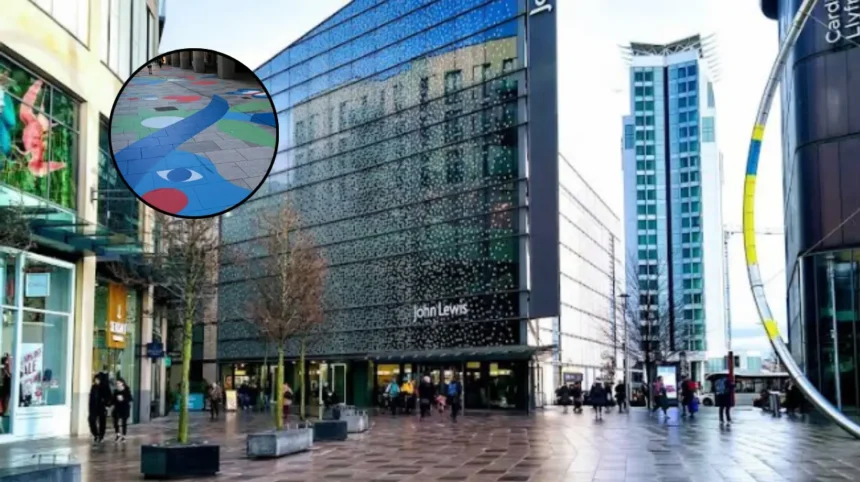
- A massive street art mural has been unveiled in central Cardiff, stretching across Hill Street and The Hayes to transform a major pedestrian walkway.
- The artwork spans 72 metres in length and over 12 metres in width, making it equivalent to the length of six double-decker buses.
- Three local Welsh artists designed the piece: Suzanne Carpenter of Patternistas, Bethan Richards, and Matt Joyce.
- Virtual Reality (VR) technology was utilised during the creation process to overlay digital designs directly onto the physical space.
- The project was commissioned by St David’s Cardiff as part of an initiative to celebrate local creative talent and enhance public spaces.
- The temporary installation features interactive elements, including a continuous thread motif designed for children to follow along the pathway.
Cardiff (Cardiff Daily) August 12, 2026 — A sweeping wave of vibrant colour has transformed one of Cardiff’s busiest central pedestrian areas following the installation of a massive new outdoor street art mural commissioned by St David’s Cardiff.
The large-scale temporary artwork stretches across Hill Street and The Hayes, converting a routine city walkway into an immersive visual experience for shoppers, residents, and visitors. Covering an impressive surface area, the installation extends 72 metres in length—equivalent to six double-decker buses parked end-to-end—and measures more than 12 metres in width.
The project was brought to fruition through a collaboration between St David’s and three prominent Cardiff-based Welsh artists: Suzanne Carpenter, founder of Patternistas, alongside Bethan Richards and Matt Joyce. The trio, recognized for their application of bold patterns and transformative visual imagery, designed the installation to bring an energetic and uplifting atmosphere to the urban environment.
Beyond its physical scale, the mural incorporates interactive visual elements. The design features a playful, cheerful aesthetic with distinctive motifs, including a continuous visual thread running through the entirety of the piece, specifically crafted to encourage children and families to follow and explore as they traverse the site.
How Was Virtual Reality Used to Create the Hill Street Mural?
The execution of the ambitious 72-metre artwork relied on innovative modern methods, combining traditional painting techniques with digital technology.
To map out the intricate, large-scale design accurately onto the pavement, artist Matt Joyce utilised Virtual Reality (VR) technology during the initial layout stage. Wearing a VR headset that superimposed the pre-designed digital artwork directly over the physical real-world environment, Joyce was able to trace the outlines of the mural onto the ground with exact precision.
Following the initial VR-assisted outline phase, artists Suzanne Carpenter and Bethan Richards worked alongside Joyce to fill in the complex patterns with vibrant, weather-resistant paint. This tech-driven workflow allowed the creative team to maintain exact proportions across the vast surface area without relying on traditional grid mapping or disruptive physical markers.
What Did the Project Leaders and Artists Say About the Installation?
Organisers and creators involved in the initiative highlighted the role of public art in revitalising urban spaces and fostering community engagement.
Helen Morgan, Centre Director of St David’s Cardiff, emphasised the positive disruption the artwork brings to everyday city life, stating:
“This new mural injects colour and creativity into a bustling city space, bringing something that’s both joyful and unexpected. We’re proud to collaborate with local artists to bring this area to life and celebrate the city’s vibrant creative spirit.”
Suzanne Carpenter, founder of The Patternistas, reflected on the local significance of the project and the intent behind its aesthetic design, noting:
“This part of the city is a popular walkway associated with recreation and relaxation, so we created a playful design that we felt would add the right level of friendliness, fun and colour, while also bringing energy and flow.
“Our ultimate goal, as always, is to bring life to spaces and put smiles on faces. As part of the Cardiff community, it’s been a joy to work together to create a collaborative piece for our home city.”
Background of Public Art and Urban Redevelopment in Cardiff
The unveiling of the Hill Street and The Hayes mural marks the latest addition to Cardiff’s evolving public art landscape, which has seen an increasing number of temporary and permanent visual installations integrated into commercial districts over recent years.
St David’s Cardiff, one of the premier shopping and leisure destinations in Wales, regularly hosts cultural and visual projects to enhance pedestrian experiences around its retail premises. The Hayes and Hill Street corridors serve as vital foot-traffic arteries, connecting historical shopping arcades, modern retail complexes, and public transport links.
The incorporation of local Welsh artists—Suzanne Carpenter, Bethan Richards, and Matt Joyce—aligns with a broader civic push across South Wales to support regional creative industries. Carpenter’s studio, Patternistas, has built a reputation across the UK for using bold, repetitive patterns to humanise commercial environments, healthcare facilities, and educational institutions.
Additionally, the adoption of VR technology in street art application marks a growing trend in urban design. By integrating augmented and virtual reality tools into physical painting processes, artists are increasingly capable of executing massive, complex geometric installations in high-density pedestrian areas within significantly reduced operational timeframes.
Prediction: How Will This Development Affect Local Businesses, Residents, and Visitors?
The arrival of this 72-metre installation is poised to generate measurable impacts across several key groups within Cardiff city centre:
1. Increased Footfall for Nearby Retailers and Hospitality Outlets
Large-scale, visual street art installations frequently act as “placemaking” catalysts. For business owners along Hill Street and The Hayes, the temporary installation is expected to increase dwell time and foot traffic. Pedestrians who might otherwise pass quickly through the thoroughfare are more likely to linger, take photographs, and engage with adjacent retail shops, cafes, and restaurants.
2. Enhanced Pedestrian Experience for Residents and Families
For local residents and regular commuters, the transformation converts a standard concrete walkway into an interactive public space. The inclusion of the dedicated visual thread for children provides an educational and engaging activity for families visiting the city centre, transforming a routine shopping trip into a family-friendly recreational activity.
3. Boost to Cardiff’s Tourism and Digital Footprint
In an increasingly digital economy, “instagrammable” public installations drive organic destination marketing. The striking imagery and massive scale of the mural make it highly shareable on social media platforms, likely drawing regional tourists from across South Wales and the wider UK to visit central Cardiff.
4. Template for Future Tech-Driven Public Art Commissions
The successful deployment of VR technology to execute an artwork of this magnitude provides a proven framework for future municipal and commercial commissions. City planners and private developers are likely to reference this project as evidence that technology can streamline public art creation, paving the way for further collaborative, tech-assisted installations across urban spaces in Wales.