Key Points
- Prime Minister’s Stance: British Prime Minister Andy Burnham has officially ruled out holding a referendum on Irish unification, declaring the constitutional issue “off the table.”
- First Official Visit: The statement was made during Burnham’s inaugural official trip to Northern Ireland as Prime Minister.
- Focus on Immediate Challenges: Burnham urged Northern Ireland’s political leaders and public to focus on pressing social and economic priorities rather than constitutional debates.
- Lessons from Past Votes: He highlighted the lingering societal divisions caused by previous referendums as a primary reason for avoiding a border poll.
- Commitment to Collaboration: Despite ruling out a vote, Burnham emphasized his intention to maintain a collaborative, listening-based approach to governance in the region.
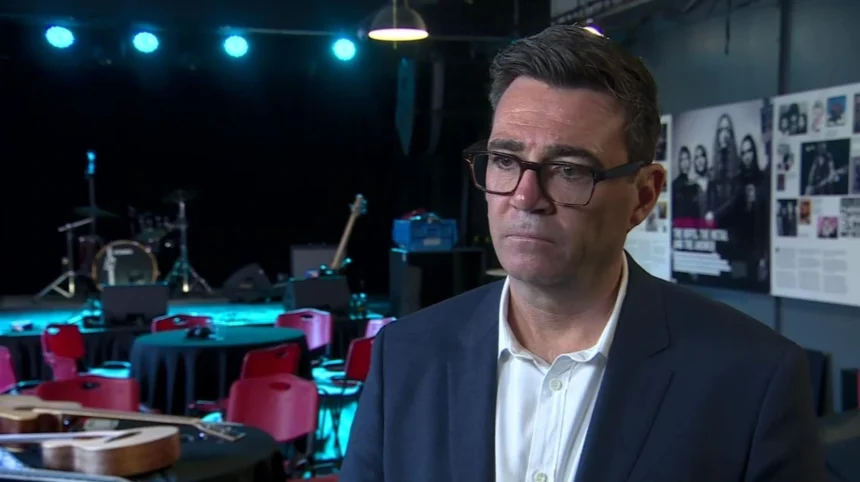
London, UK (Cardiff Daily) August 27, 2026 – British Prime Minister Andy Burnham has formally ruled out holding a referendum on Irish unification, stating that the issue is firming excluded from his government’s agenda while calling on Northern Ireland’s leaders to prioritize immediate economic and social issues. Speaking to journalists during his first official visit to Northern Ireland since taking office, Burnham made clear that his administration would not sanction a border poll, arguing that the nation must move past the deep political polarizations sparked by past national votes.
- Key Points
- Why Has Prime Minister Andy Burnham Ruled Out a Border Poll?
- What Are the Immediate Priorities for Northern Ireland According to the UK Government?
- How Have Political Leaders and Observers Reacted to Burnham’s Statement?
- Background of the Irish Unification Debate
- What Does This Decision Mean for the Future of Northern Ireland and Its People?
Why Has Prime Minister Andy Burnham Ruled Out a Border Poll?
During his press conference in Belfast, Prime Minister Andy Burnham addressed questions regarding Northern Ireland’s constitutional future by stating that a vote on unification would not take place under his stewardship. Burnham emphasized that the deep societal divisions created by previous referendums across the United Kingdom demonstrated the long-term friction such public votes can cause.
Burnham stated that
“Well obviously I’m here as I said earlier to listen and I will take a collaborative approach, but some issues will be off the table and that is one issue that will be off the table,”
when asked directly whether his administration would entertain a border poll during his term.
He explained that his primary objective in visiting Belfast was to engage with local political representatives, community leaders, and business figures to tackle pressing daily governance concerns, rather than reopening fundamental questions regarding the Good Friday Agreement’s constitutional mechanism.
What Are the Immediate Priorities for Northern Ireland According to the UK Government?
Rather than focusing on constitutional change, Burnham argued that political momentum in Northern Ireland should be directed toward addressing core public services, infrastructure, economic development, and local healthcare improvements.
The Prime Minister indicated that his visit was designed to establish a fresh working dynamic between Westminster and Stormont. By setting a boundary around the unification question, Burnham signaled his administration’s preference to stabilize local governance and concentrate resources on practical socio-economic recovery.
How Have Political Leaders and Observers Reacted to Burnham’s Statement?
The Prime Minister’s decisive stance has drawn varied reactions across the political spectrum in Northern Ireland and the wider United Kingdom.
What is the Reaction from Unionist Parties?
Unionist figures generally welcome firm commitments to maintaining the United Kingdom’s territorial integrity. For unionist leaders, ruling out a border poll provides stability and removes persistent political uncertainty, allowing Northern Ireland’s local institutions to focus on public sector performance and trade stability without the immediate prospect of a constitutional campaign.
What is the Reaction from Nationalist Parties?
Nationalist representatives, conversely, consistently view the provision for a border poll as a core component of the Good Friday Agreement. Critics of Burnham’s stance argue that under the terms of the 1998 peace agreement, the Secretary of State for Northern Ireland is obligated to call a referendum if it appears likely that a majority of voters would favor a united Ireland. Critics argue that ruling out such a vote prematurely disregards demographic shifts and democratic mechanisms established during the peace process.
Background of the Irish Unification Debate
The constitutional framework of Northern Ireland is governed by the 1998 Good Friday Agreement (Belfast Agreement), which brought an end to three decades of conflict known as the Troubles. Under the agreement, Northern Ireland remains part of the United Kingdom until a majority of its citizens, and a majority of citizens in the Republic of Ireland, vote otherwise.
The treaty explicitly states that the British Secretary of State for Northern Ireland shall exercise the legal power to order a referendum if, at any time, it appears likely that a majority of those voting would express a wish that Northern Ireland should cease to be part of the United Kingdom and form part of a united Ireland.
In recent years, debate over a potential border poll has intensified due to several key factors:
- Post-Brexit Dynamics: The UK’s exit from the European Union altered political and economic arrangements, with Northern Ireland remaining aligned with certain EU single market rules under specific trade protocols, creating friction between Belfast and Westminster.
- Demographic and Electoral Shifts: Recent census data and local election outcomes have reflected significant shifts, with nationalist parties securing historic gains in Stormont elections, increasing political pressure for discussion around long-term constitutional planning.
- Public Services and Economic Debates: Persistent challenges within healthcare, public transport, and regional infrastructure have led to competing arguments over whether public administration is better served within the UK framework or a combined Irish economy.
What Does This Decision Mean for the Future of Northern Ireland and Its People?
The Prime Minister’s firm refusal to entertain an Irish unification referendum carries direct implications for several key groups across Northern Ireland, the UK, and the Republic of Ireland.
Impact on the General Public in Northern Ireland
For the broader electorate in Northern Ireland, removing a border poll from the near-term political horizon shifts the focus of public discourse entirely onto local governance issues. Citizens facing long NHS waiting lists, rising living costs, and underfunded municipal infrastructure may see local politicians forced to concentrate on immediate service delivery rather than high-stakes constitutional campaigning. However, for those who view self-determination as a fundamental right, the decision may cause frustration and deepen disillusionment with Westminster’s oversight.
Impact on Stormont and Local Political Stability
By taking a unification vote “off the table,” the UK government seeks to de-escalate tensions between power-sharing partners in the Northern Ireland Assembly. Removing the immediate prospect of a border poll removes a key source of friction between nationalist and unionist parties, potentially encouraging smoother operational cooperation within the Stormont Executive on day-to-day administrative budgets and policy choices.
Impact on Anglo-Irish Relations
This stance sets a clear boundary for diplomatic discussions between London and Dublin. While the Irish government consistently advocates for adherence to all aspects of the Good Friday Agreement, Burnham’s explicit exclusion of a referendum signals that Westminster intends to prioritize bilateral economic cooperation, cross-border infrastructure, and regional security over joint constitutional planning.