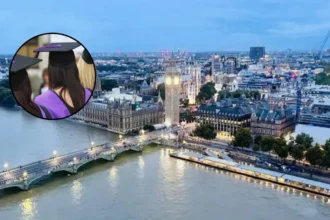
Cardiff City represents both the capital city of Wales and its primary professional football club, Cardiff City Football Club. As a geographical entity, Cardiff became the official Welsh capital in 1955 and serves as the country’s chief commercial, cultural, and administrative hub. As a sporting entity, Cardiff City Football Club, founded in 1899, remains the only team from outside England to have won the English FA Cup. The dual identity of Cardiff City shapes the modern economic, cultural, and athletic landscape of the United Kingdom.
- What is the History and Origin of Cardiff City?
- The Roman and Medieval Foundations of the Settlement
- The Industrial Revolution and Urban Expansion
- The Foundation and Evolution of Cardiff City Football Club
- How is the Governance and Geography of Cardiff City Structured?
- The Local Government and Administrative Framework
- Geographical Boundaries and Topography
- Neighborhoods and Key Urban Districts
- What are the Major Economic Drivers of Cardiff City?
- Financial and Professional Services
- Public Sector and Government Administration
- Creative Industries, Media, and Tourism
- What is the Significance of Cardiff City Football Club?
- The 1927 FA Cup Victory and Historical Achievements
- Team Identity, Colors, and the Bluebirds Moniker
- The South Wales Derby Rivalry
- Where does Cardiff City Football Club Play its Matches?
- The Transition from Ninian Park to the Modern Stadium
- Stadium Infrastructure and Multi-Purpose Use
- Transportation Access and Matchday Logistics
- Who are the Owners and Key Personnel of Cardiff City Football Club?
- The Vincent Tan Era and Corporate Ownership
- Executive Management and Football Operations
- The Academy and Youth Development System
- What is the Statistical Record of Cardiff City Football Club?
- League Position Trends and Historical Performance
- Individual Player Records and Milestone Appearances
- European Competition History
- What are the Future Projections for Cardiff City?
What is the History and Origin of Cardiff City?
Cardiff City originated as a Roman fort established around 75 AD, transitioning into a medieval trading port before expanding rapidly during the nineteenth-century coal boom. The football club emerged in 1899 as Riverside AFC, renaming to Cardiff City in 1908.
The Roman and Medieval Foundations of the Settlement
The physical origins of Cardiff City date to the first century AD when the Roman Empire constructed a fort near the River Taff. This strategic military outpost provided maritime access and administrative control over the local Silures tribe. Following the departure of the Roman military, the settlement underwent centuries of stagnation until the Norman conquest of Wales. In 1081, Robert FitzHamon began construction on Cardiff Castle within the perimeter of the original Roman fort walls. The castle served as the nucleus for a medieval market town, establishing Cardiff as a regional center for trade and governance.
The Industrial Revolution and Urban Expansion
The transformation of Cardiff into a major urban center occurred during the nineteenth century due to the global demand for Welsh coal. The Second Marquess of Bute financed the construction of the Bute West Dock, which opened in 1839. This infrastructure allowed the Taff Vale Railway to transport coal directly from the Rhondda Valley to the Cardiff docks for global export. Between 1801 and 1901, the population of Cardiff grew from 1,870 residents to over 164,000 residents. King Edward VII granted Cardiff city status on October 28, 1905, in recognition of its industrial prominence. The British government officially declared Cardiff the capital city of Wales on December 20, 1955.
The Foundation and Evolution of Cardiff City Football Club
Cardiff City Football Club began as Riverside AFC in 1899, founded by Bartley Wilson to provide cricket players with a winter sporting activity. The club played its initial matches in the Cardiff Sophia Gardens recreation ground before joining the South Wales League in 1902. In 1908, the club changed its name to Cardiff City Football Club to reflect the city status granted three years prior. The club moved into its first permanent stadium, Ninian Park, in 1910 and gained admission into the English Southern League. In 1920, the Football League elected Cardiff City into the Second Division, beginning the club’s long-standing integration within the English football league system.
How is the Governance and Geography of Cardiff City Structured?
Cardiff City functions under a unitary authority governance system managed by the County Council of the City and County of Cardiff. Geographically, the city occupies a flat coastal plain in South East Wales, bordered by Glamorgan hills and the Severn Estuary.
The Local Government and Administrative Framework
The County Council of the City and County of Cardiff administers the local government services for the capital. The council consists of 79 elected councillors representing 28 electoral wards, such as Cathays, Canton, and Butetown. The council headquarters sit within County Hall at Atlantic Wharf in Cardiff Bay. Political leadership stems from an elected Council Leader and a cabinet system, while the ceremonial head of the city is the Lord Mayor. Cardiff also houses the Senedd, which is the Welsh Parliament building located in Cardiff Bay, making the city the center of national legislative power for Wales.
Geographical Boundaries and Topography
Cardiff City covers a total land area of 140 square kilometers in the historic county of Glamorgan. The topography consists of a low-lying coastal plain surrounded by Pennant Sandstone ridges to the north, including the Garth Mountain and Caerphilly Mountain. Three main river systems intersect the urban geography: the River Taff, the River Ely, and the River Rhymney. These rivers drain directly into the Severn Estuary at Cardiff Bay. The city sits approximately 240 kilometers west of London and 72 kilometers east of Swansea, positioning it within the M4 industrial corridor.
Neighborhoods and Key Urban Districts
The urban layout of Cardiff features distinct districts categorized by architectural history and socio-economic function. The City Centre contains the retail sectors, Cardiff Castle, and the Principality Stadium. Cardiff Bay, formerly known as Tiger Bay, represents the revitalized waterfront district housing the Wales Millennium Centre and the Welsh Government buildings. Suburban residential areas developed during the Victorian and Edwardian eras include Roath, Penylan, and Pontcanna, which feature expansive parklands. Industrial and commercial zones occupy the southern and eastern peripheries, specifically around Splott and Wentloog.
What are the Major Economic Drivers of Cardiff City?
The economy of Cardiff City relies primarily on the service sector, financial institutions, public administration, creative media, and tourism. The city generates approximately twenty percent of the total Welsh Gross Domestic Product through its diverse commercial enterprises.
Financial and Professional Services
Cardiff serves as the principal financial services hub for Wales, anchoring the regional economy. Major corporate employers operate significant administrative operations within the city center and the Cardiff Business Technology Park. Organizations such as Admiral Group plc, Legal & General, and Principality Building Society maintain corporate headquarters or major regional offices in Cardiff. The sector employs over 30,000 professionals, specializing in insurance, risk management, and corporate banking.
Public Sector and Government Administration
As the capital city, Cardiff hosts the largest concentration of public sector employment in Wales. The Welsh Government employs thousands of civil servants across offices in Cathays Park and Cardiff Bay. The National Health Service Wales manages major medical facilities, including the University Hospital of Wales, which functions as one of the largest teaching hospitals in the United Kingdom. Cardiff University, Cardiff Metropolitan University, and the University of South Wales employ thousands of academic and administrative personnel.
Creative Industries, Media, and Tourism
Cardiff has developed into a primary production center for television, film, and digital media in the United Kingdom. BBC Cymru Wales operates its headquarters at Central Square, while the independent production facility Wolf Studios Wales records global television franchises in the city. The tourism sector relies heavily on major event infrastructure, including the 74,500-capacity Principality Stadium. The city attracts over 20 million visitors annually, generating revenue for retail districts like the St David’s Centre and the historic Victorian shopping arcades.
What is the Significance of Cardiff City Football Club?
Cardiff City Football Club holds immense significance as the sole non-English club to win the FA Cup, achieving this milestone in 1927. The club acts as a cultural symbol for Welsh athletic identity within the English football league.
The 1927 FA Cup Victory and Historical Achievements
The peak historical achievement for Cardiff City Football Club occurred on April 23, 1927, at Wembley Stadium. Cardiff City defeated Arsenal 1–0 in the FA Cup Final, with center-forward Hughie Ferguson scoring the winning goal in the 74th minute. This victory marked the first and only time the prestigious trophy left England. Captain Fred Keenor accepted the trophy from King George V. The club also reached the FA Cup Final in 1925 and 2008, and won the Welsh Cup 22 times between 1912 and 1995.
Team Identity, Colors, and the Bluebirds Moniker
Cardiff City Football Club traditionally competes in blue shirts, white shorts, and blue socks, which earned the team the nickname “The Bluebirds.” The club crest features an image of an Eastern Bluebird alongside a traditional Welsh dragon. In 2012, Malaysian owner Vincent Tan altered the home kit color to red and changed the primary crest symbol to a dragon to appeal to international markets. Following prolonged fan protests and declining attendances, the club reverted to its traditional blue kit and restored the bluebird emblem prior to the 2015–2016 season.
The South Wales Derby Rivalry
The primary sporting rivalry for Cardiff City Football Club is with Swansea City Football Club, a fixture known as the South Wales Derby. The first competitive match between the two clubs took place on September 7, 1912, ending in a 1–1 draw. The rivalry involves intense cultural and geographical competition between the two largest cities in Wales. Matches require strict security measures implemented by South Wales Police due to historical incidents of crowd disruption. The derby remains one of the most fiercely contested fixtures in British football.
Where does Cardiff City Football Club Play its Matches?
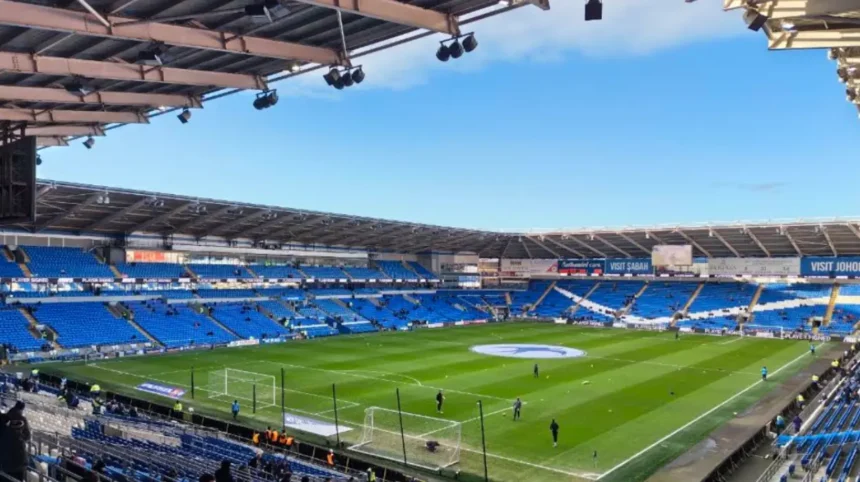
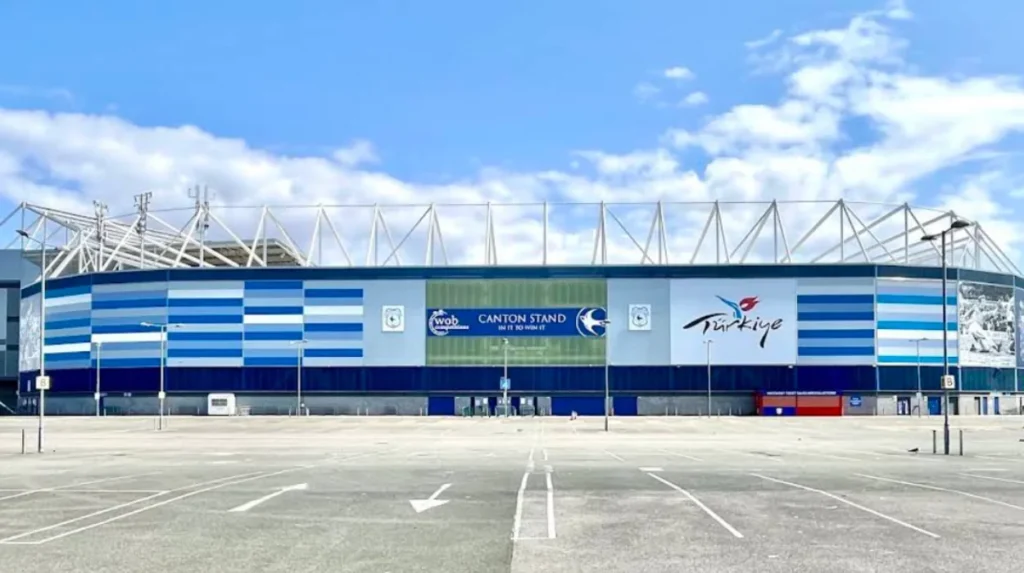
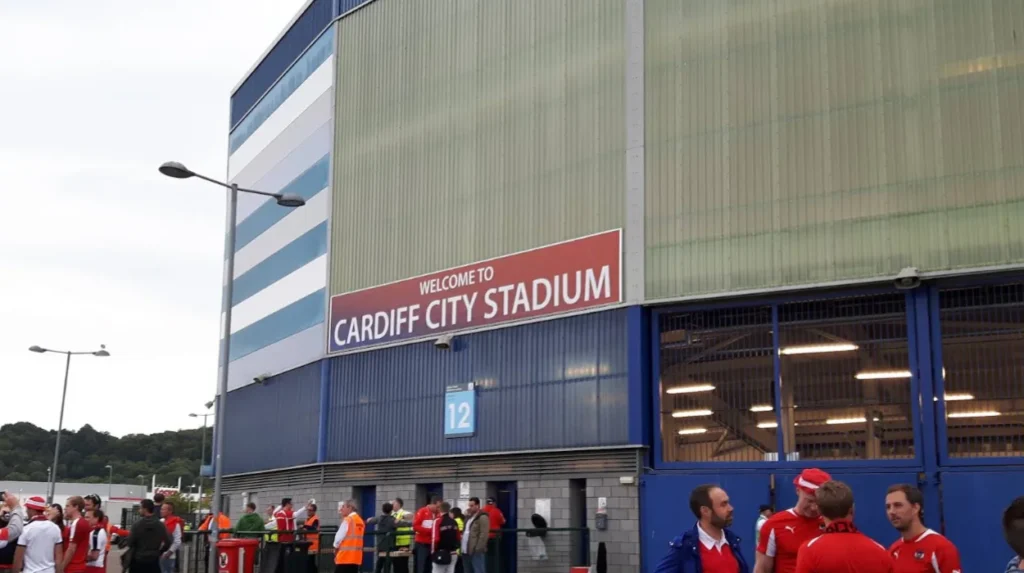
Cardiff City Football Club plays its home matches at the Cardiff City Stadium, an all-seater sports venue located in the Leckwith area of the city. The stadium possesses a current seating capacity of 33,280 spectators.
The Transition from Ninian Park to the Modern Stadium
For 99 years, Cardiff City played its home fixtures at Ninian Park, located in the Canton district. Opened in 1910, Ninian Park featured terraced stands and hosted its record crowd of 57,893 spectators during an international match between Wales and England in 1953. To comply with the Taylor Report mandating all-seater stadia for modern safety standards, the club commenced construction on a new facility in 2007. Cardiff City Stadium officially opened on July 22, 2009, with a friendly match against Scottish club Celtic.
Stadium Infrastructure and Multi-Purpose Use
The Cardiff City Stadium consists of four main stands: the Ninian Stand, the Canton Stand, the Grange Stand, and the Grandstand. The Grandstand houses premium hospitality suites, media boxes, and player changing rooms. The pitch utilizes a hybrid grass system combining natural turf with synthetic fibers to withstand heavy usage. In addition to Cardiff City league matches, the stadium serves as the primary home venue for the Wales National Football Team during international qualification tournaments.
Transportation Access and Matchday Logistics
The stadium is located two kilometers west of Cardiff Central railway station, making it accessible for regional commuters. The closest railway station is Ninian Park Halt, situated on the City Line, while Grangetown station services the Penarth and Barry lines. The local local government implements matchday road closures along Sloper Road and Leckwith Road to facilitate safe pedestrian movement. Dedicated park-and-ride bus services operate from the peripheral business parks to reduce city-center traffic congestion during matches.
Who are the Owners and Key Personnel of Cardiff City Football Club?
Cardiff City Football Club is owned primarily by Malaysian billionaire Vincent Tan, who acquired a majority stake in May 2010. The corporate structure includes an international board of directors that manages day-to-day operations and football administration.
The Vincent Tan Era and Corporate Ownership
Vincent Tan, the founder of Berjaya Group, holds the controlling interest in Cardiff City Football Club through various holding companies. His ownership period brought substantial financial investment, which cleared historical debts and funded promotions to the English Premier League in 2013 and 2018. However, his tenure also experienced periods of friction with supporters regarding branding changes and managerial appointments. Mehmet Dalman serves as the club’s Chairman, managing financial sustainability and board meetings.
Executive Management and Football Operations
The executive management structure ensures the club complies with the English Football League Profitability and Sustainability rules. The Chief Executive Officer oversees the commercial departments, ticketing operations, and community outreach programs. The football operations department features a sporting director or recruitment head who coordinates player transfers, scouting networks, and contract negotiations. This department serves to align the youth academy infrastructure with the requirements of the first-team squad.
The Academy and Youth Development System
Cardiff City operates a Category Two football academy based at the USW Sports Park in Treforest. The academy aims to develop domestic talent for the first team and the Welsh national squad. Notable graduates who transitioned through the youth system include Aaron Ramsey, who debuted for the senior team at age 16 before transferring to Arsenal. The academy fields competitive teams across multiple age groups, including the Under-18 and Under-21 squads competing in the Professional Development League.
What is the Statistical Record of Cardiff City Football Club?
Cardiff City Football Club has spent 17 seasons in the top tier of English football, with its highest league finish being runners-up in the First Division during the 1923–1924 season. The club has experienced multiple promotions and relegations across the top four divisions.
League Position Trends and Historical Performance
The historical league performance of Cardiff City shows distinct eras of competitive success and decline. The club remained a consistent force in the First Division during the 1920s and experienced a resurgence in the 1950s. The 1980s and 1990s represented a period of decline, during which the club fell into the Fourth Division. A steady ascent began in the 2000s, culminating in winning the Championship title in the 2012–2013 season to secure entry into the Premier League.
| Era / Season | Primary League Division | Key Achievement or Placement |
| 1923–1924 | Football League First Division | Runners-up (Lost title on goal average) |
| 1926–1927 | Football League First Division | FA Cup Winners |
| 1967–1968 | Football League Second Division | European Cup Winners’ Cup Semifinalists |
| 1992–1993 | Football League Third Division | Champions (Promotion to Second Division) |
| 2012–2013 | Football League Championship | Champions (Promotion to Premier League) |
| 2017–2018 | EFL Championship | Runners-up (Promotion to Premier League) |
Individual Player Records and Milestone Appearances
The individual records of Cardiff City Football Club highlight the long-term service of domestic and international athletes. Billy Hardy holds the record for the most competitive appearances for the club, playing 585 matches between 1911 and 1932. Len Davies remains the all-time leading goalscorer, scoring 179 goals in all competitions between 1919 and 1931. In the modern era, Peter Whittingham scored 96 goals in 457 appearances, establishing himself as one of the club’s most influential modern midfielders.
European Competition History
Cardiff City qualified for continental competition on 14 separate occasions via the European Cup Winners’ Cup by winning the Welsh Cup. The club’s most successful European campaign occurred during the 1967–1968 season. Managed by Jimmy Scoular, Cardiff City defeated Shamrock Rovers, NAC Breda, and Torpedo Moscow to reach the semifinals. The club ultimately lost 4–3 on aggregate to German side Hamburger SV. In 1971, Cardiff City achieved a famous 1–0 home victory over Real Madrid at Ninian Park in the quarterfinal first leg of the same tournament.
What are the Future Projections for Cardiff City?
The future of Cardiff City involves large-scale urban regeneration projects alongside attempts by the football club to establish long-term financial stability. Urban development initiatives focus on expanding public transportation links and decarbonizing the city’s infrastructure.
Urban Transformation and Smart City Initiatives
The Cardiff Council has implemented the “Cardiff 2030” vision, a strategic plan targeting sustainable economic growth and carbon neutrality. Key projects include the Core Valley Lines transformation, which integrates regional rail networks into the South Wales Metro system to enhance commuting efficiency. The expansion of Cardiff Bay continues via the construction of a new 15,000-capacity indoor arena at Atlantic Wharf. This development intends to attract international musical acts and conventions, expanding the hospitality sector.
Long-Term Objectives for the Football Club
For Cardiff City Football Club, the primary future objective centers on returning to the English Premier League while adhering to strict financial regulations. The club focuses heavily on reducing dependency on owner financing by expanding global commercial partnerships and increasing stadium utilization on non-matchdays. Continued investment in the Leckwith training facilities and the youth academy aims to produce domestic players, reducing the reliance on expensive transfer fees. The club remains an anchor institution for the identity, economy, and global visibility of the Welsh capital.