Key Points
- Banned Phrase: Cardiff City boss Brian Barry-Murphy disclosed that he has banned the phrase “what if” in order to put a definitive end to the frustrating summer transfer window.
- Shortfall in Transfer: Cardiff did not manage to sign all the targets they wanted before the deadline expired, thereby finding themselves short in some departments seven games into the Championship without any win in the league.
- Omari Kellyman Shortfall: The biggest disappointment is that they did not manage to get Omari Kellyman back, a player who has performed impressively during his loan spell last season.
- Strasbourg Move: In fact, Omari Kellyman made a permanent switch to French club Strasbourg (sister club of Chelsea).
- Less Participation in French League: So far, Kellyman has not managed to play any minute of football in Ligue 1 and has been in one matchday squad as a substitute.
- Culture Change at Club Level: Barry-Murphy has insisted on moving forward with optimism and utilizing present squad.
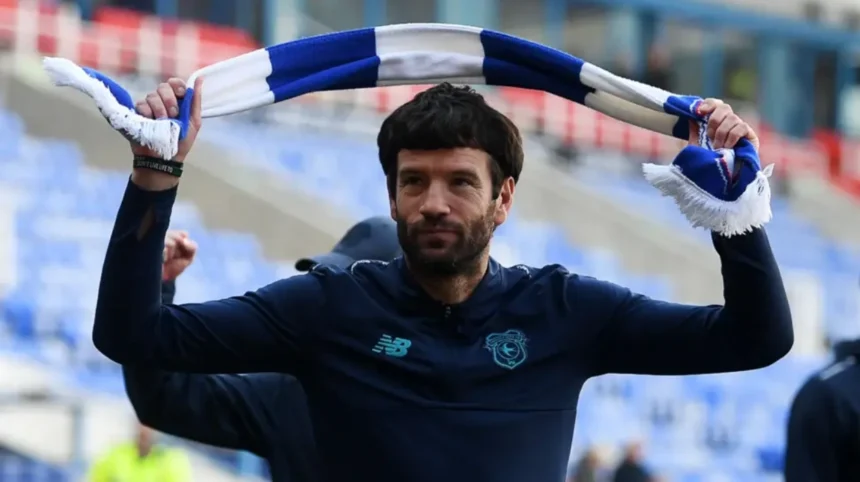
Cardiff (Cardiff Daily) September 17, 2026 — Cardiff City manager Brian Barry-Murphy has officially banned the phrase “what if” at the club’s training ground as he draws a definitive line under a difficult and frustrating summer transfer window. The Bluebirds experienced a challenging period leading up to the deadline, failing to land all of their priority targets and leaving the squad visibly short in key areas seven matches into a Championship season where they are still searching for their maiden league victory. Among the most notable setbacks was the club’s unsuccessful pursuit to bring midfielder Omari Kellyman back to South Wales following a successful previous loan spell.
Why Did Cardiff City Fail to Secure Omari Kellyman During the Summer Transfer Window?
The inability to re-sign Omari Kellyman proved to be one of the summer’s biggest disappointments for the Bluebirds’ faithful. As reported by Glen Williams of Wales Online, Kellyman enjoyed an exceptional loan spell in League One during the previous campaign, establishing himself as an integral component of the side that secured promotion. Beyond his goals and overall performances, Kellyman offered Cardiff tactical versatility by possessing the capability to operate seamlessly across three distinct positions at the top end of the pitch.
For a period, positive indicators suggested that a reunion and continuation of his development in South Wales was a distinct possibility. However, those hopes were dashed when Strasbourg—operating as a sister club to Chelsea—stepped in to complete a permanent deal for the young midfielder instead. This turn of events intensified supporters’ frustrations, a feeling further compounded by Kellyman’s sparse involvement since relocating to France, where he has featured in only one Ligue 1 matchday squad and remained an unused substitute.
Despite viewing Kellyman as an ideal candidate to inject crucial depth and competition into his ranks, Brian Barry-Murphy has firmly refused to dwell on missed recruitment targets. When questioned by Glen Williams of Wales Online regarding whether he felt frustrated that Kellyman opted for Strasbourg rather than continuing his development at Cardiff, the manager articulated a strict forward-looking stance.
As reported by Glen Williams of Wales Online, Brian Barry-Murphy stated that:
“I know, because it’s pretty much in line with where we are as a club, there’s no point looking back.”
He further expanded on the internal culture he has cultivated since arriving at the club:
“When I first came in 14 months ago, from the training room, I banned talk of ‘what if’, ‘we haven’t got this’, ‘we haven’t got that’. Where the club was at… this is the best club you could wish to be at, followed by the biggest support you could wish to have. We can only look forward.”
Explore more Cardiff Sports News
Steffan Emmanuel Named Wales Young Player of the Year Cardiff 2026
Cian Ashford Earns Maiden Wales Call-Up After Cardiff City Switch Cardiff 2026
How is Brian Barry-Murphy Shaping the Mental Culture at Cardiff City Amid Incomplete Squad Depth?
The overarching message conveyed by the manager remains especially pertinent given the widespread disappointment regarding Cardiff’s lack of activity during the closing stages of the window. Although club hierarchy officials had intended to bolster both attacking and defensive departments, those targeted additions did not materialize, prompting ongoing debates regarding whether the squad possesses sufficient depth to navigate a grueling Championship campaign.
Nevertheless, Barry-Murphy maintains that spending energy on what might have been serves no functional purpose. Having arrived 14 months ago as the club prepared for a League One campaign following relegation from the Championship, the manager inherited an environment he felt was trapped in a negative, downward spiral. To combat this psychological barrier, he embedded an uncompromising rule prohibiting defeatist dialogue among the playing staff and coaching personnel.
Reinforcing this philosophy, Brian Barry-Murphy reiterated to Wales Online journalist Glen Williams: “Any sense of ‘we haven’t got this, we haven’t got that’ or ‘what if’ is banned.” Elaborating on the broader atmosphere at the club, Barry-Murphy added:
“When I first came here, I had a sense the supporters were only looking forward and were excited by the challenge that was provided in League One, and the players were the same. Granted, some players may have wanted to leave because they were being relegated, but really from within the club there was this sense, I felt, of the club being on a downward spiral. It’s quite a negative cycle. And really, once you’re here, you see this is a brilliant club and brilliant people, and really we have to be in the moment and look forward really positively because the possibilities of what we can achieve are endless.”
Prior to these remarks, speaking to Hayters reporter following a 2-1 defeat against Queens Park Rangers, Barry-Murphy also addressed the board’s backing and the realities of the market. As reported by Hayters, Barry-Murphy stated:
“It’s in the past and there’s nothing I can do now. I thought we would be able to bring players in but it wasn’t the case. We had a clear idea of who we wanted to bring into the club. I never felt anything but great backing from the club, but it wasn’t possible.”
Addressing supporters directly on recruitment strategy and player value, Barry-Murphy told Hayters:
“I would always respond to our supporters with the truth – we had an idea of what players we wanted to bring in. It wasn’t possible. I think we still have a lot of very talented young players, very talented young Welsh players predominantly, and any player we do want to bring into the club always has to be with the intention of improving the squad and team. If that’s not possible, I am not a great believer in bringing in players just for the sake of it.”
Background of the Development
The context behind Brian Barry-Murphy’s strict internal policy stems from the turbulent transitional phase Cardiff City has experienced over the past year. Following their relegation from the Championship into League One, the club appointed Barry-Murphy 14 months ago to stabilize operations, rebuild squad morale, and navigate an immediate promotion push. Although that mission proved successful—partly aided by productive temporary acquisitions like Omari Kellyman—the subsequent step up back into the Championship exposed lingering structural and financial constraints within the squad planning. When late-window targets, including Kellyman’s permanent move to French outfit Strasbourg instead of a return to South Wales, failed to materialize, public and internal pressure mounted. By proactively banning defeatist rhetoric like “what if,” Barry-Murphy has sought to insulate his young squad from external negativity and maintain psychological resilience amid a winless start to the current league campaign.
This psychological and operational stance directly impacts Cardiff City supporters, the playing squad, and club management as the season progresses. By publicly dismissing regrets over missed transfer targets like Omari Kellyman and enforcing a strict policy against dwelling on squad limitations, Barry-Murphy aims to shield his roster—heavily reliant on talented young Welsh prospects—from sinking into a defeatist mentality during a challenging start in the Championship. For supporters, this approach signals transparent communication coupled with a demand for collective patience, shifting expectations away from immediate multi-player reinforcements. However, if results on the pitch do not improve and the squad continues to look thin through the autumn months, maintaining this morale-driven stance will test the endurance of both the dressing room and the fanbase until the January transfer window opens.