Key Points
- Pauline Hanson has proposed cutting Australia’s annual humanitarian intake from 20,000 to 2,000 places.
- One Nation claims Australia has the world’s second-highest refugee resettlement rate per capita, behind Canada.
- Comparisons vary because resettlement figures do not include all asylum claims processed at national borders.
- Foreign Minister Penny Wong said Australia contributes only a small share of global refugee intake.
- Humanitarian advocates said Australia’s record of resettlement should not become a political football.
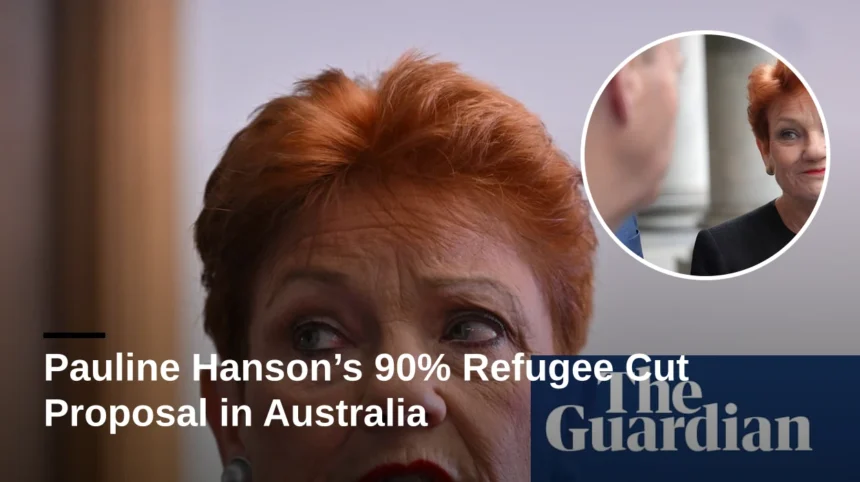
Canberra (Cardiff Daily) November 18, 2026 – One Nation leader Pauline Hanson has proposed reducing Australia’s humanitarian intake by 90 per cent, from 20,000 to 2,000 places a year, while abolishing permanent parent visas. Hanson said the changes would prioritise Australians and save the federal budget billions of dollars over a decade. Her claim that Australia has the world’s second-most generous refugee scheme, behind Canada, depends on which measure is used. International comparisons of refugee resettlement and asylum applications produce different rankings.
- Key Points
- Is Australia really the world’s second-most generous refugee resettlement country?
- What does Pauline Hanson’s proposal include?
- How have officials and refugee advocates responded?
- What is the background to Australia’s refugee intake debate?
- What could the proposal mean for readers following Australia’s refugee policy?
Is Australia really the world’s second-most generous refugee resettlement country?
As reported by The Guardian in its analysis of Does Australia really have the world’s second most generous refugee scheme?, Australia ranks second for refugee resettlement places per capita under figures covering refugees processed through the United Nations High Commissioner for Refugees system. The same analysis said Canada, Australia and the United States accounted for 84 per cent of global refugee resettlements in 2025.
The Guardian reported that Australia remains among the top 10 countries offering refugee pathways when broader Organisation for Economic Co-operation and Development data are considered. On that comparison, Australia ranks below Canada, Germany, France and New Zealand on a per-capita basis.
The distinction matters because many asylum claims are made and processed at national borders. Australia’s ocean geography means those claims are not directly comparable with countries that receive large numbers of asylum seekers over land borders.
What does Pauline Hanson’s proposal include?
Hanson wants the humanitarian program reduced to 2,000 places a year. She also wants to end permanent parent and grandparent visa pathways. Australian media reports said the current parent and aged-parent visa cap is 8,500 places, compared with 7,060 the previous year.
Hanson said her proposal would retain temporary visa options for parents who could meet their own costs. Reports also said parents already in Australia on bridging visas could receive refunds of application fees but might have to leave unless they secured another pathway.
One Nation has cited internal modelling that estimates the lifetime cost of a humanitarian entrant at about $523,000. Reports placed the claimed decade-long budget saving at between $100 billion and $140 billion, depending on the calculation used.
How have officials and refugee advocates responded?
Foreign Minister Penny Wong challenged One Nation’s presentation of Australia’s role, saying Australia contributes a “very small share” of the global refugee intake, according to Australian Broadcasting Corporation reporting.
The Asylum Seeker Resource Centre criticised the proposed reduction. Deputy chief executive Jana Favero said Australia’s history of welcoming people from Vietnam, Sri Lanka, Ukraine, Iran, Afghanistan and the former Yugoslavia should be a source of national pride rather than a political dispute.
Other reports said humanitarian groups warned that cutting the intake would damage Australia’s long-standing resettlement role. No national government decision to adopt One Nation’s proposal has been reported.
What is the background to Australia’s refugee intake debate?
Australia’s humanitarian program has been set at about 20,000 places a year in the figures cited by Hanson and Australian media reports. Refugee resettlement is only one component of international protection, alongside asylum applications made after arrival or at a border.
International Migration Outlook data reported that Australia received about 19,000 resettled refugees in 2025, an increase of 9 per cent from the previous year. UN refugee statistics also show that resettlement totals fell globally in 2025.
Countries use different legal categories and admission systems, making per-capita comparisons difficult. The distinction between resettlement places and broader asylum claims is central to assessing whether Australia is genuinely the world’s second-most generous refugee scheme.
What could the proposal mean for readers following Australia’s refugee policy?
If adopted, the proposal would sharply reduce the number of refugees able to receive permanent resettlement through Australia’s humanitarian program. It would also change how migrant families bring parents and grandparents to the country.
For refugee communities, sponsors and advocacy organisations, the policy could mean fewer available places and longer uncertainty for people seeking protection. For taxpayers and migration applicants, its effect would depend on whether the claimed savings and administrative changes were achieved.
The debate is likely to continue because the headline ranking changes according to whether it measures UNHCR resettlement, broader asylum applications or OECD pathways. The available figures therefore support a narrower claim: Australia is a major refugee resettlement country, but the description of it as the world’s second-most generous scheme is not universally supported by all measures.