Key Points
- Major replacement and remediation works approved for the external cladding at Ocean Reach, an 11-floor residential tower block in Cardiff Bay.
- Approval granted by Cardiff Council following a comprehensive review and a fire risk appraisal of external walls (FRAEW) report that identified “several deficiencies” in the overall structure.
- Deficiencies include a glass spandrel panel bonded with combustible insulation, balcony bracket penetrations through spandrel panels, and an aluminium spandrel panel consisting of polyisocyanurate (PIR) in its frame.
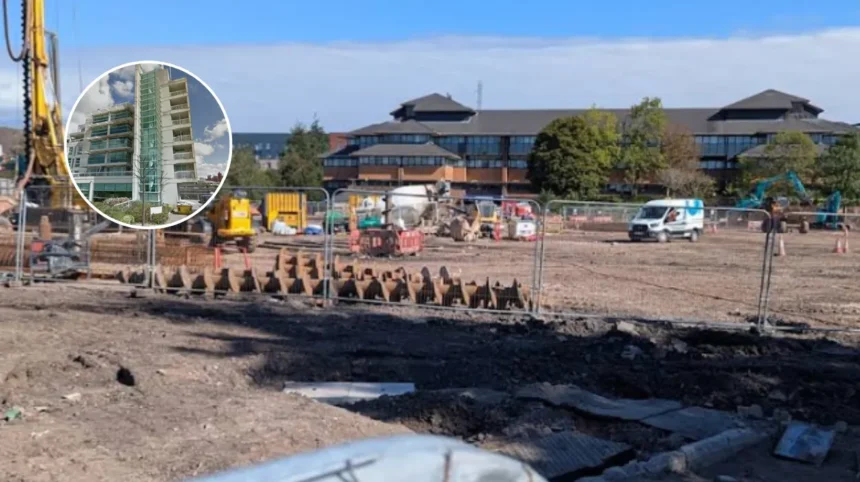
- The building houses 49 apartments and penthouses on the upper floors, located in the revitalised docklands area of Cardiff Bay, south of the city centre.
- Works aim to replace damaged, unsightly, and non-compliant materials with environmentally safe, durable, and regulation-compliant systems while preserving the building’s original architectural character and contribution to the streetscape.
- No changes to existing access arrangements, routes into or out of the site, neighbouring buildings, or parking expected from the scheme.
- The external façade will retain glass spandrel panels where possible, replacing non-compliant elements behind them to match the current build-up and comply with building regulations.
Cardiff Bay (Cardiff Daily) March 29, 2026 – Cardiff Council has approved major cladding replacement and remediation works at Ocean Reach, an 11-floor tower block, after a fire risk appraisal revealed several structural deficiencies posing potential safety risks. The decision addresses longstanding concerns over the building’s external façade, ensuring compliance with current fire safety regulations without altering its architectural appearance. Residents and officials anticipate enhanced safety and visual appeal from the comprehensive upgrades.
- Key Points
- What Triggered the Cladding Investigation at Ocean Reach?
- Why Was Remediation Approved by Cardiff Council?
- What Specific Deficiencies Were Found in the Structure?
- How Will the Remediation Works Preserve the Building’s Appearance?
- What Is the Profile of Ocean Reach Tower Block?
- Who Are the Key Stakeholders Involved?
- When and How Will the Works Impact Daily Life?
- Why Does This Matter in the Context of UK Fire Safety?
- What Happens Next for Ocean Reach Residents?
- Broader Implications for Cardiff Bay Developments
What Triggered the Cladding Investigation at Ocean Reach?
A thorough review of Ocean Reach’s existing façade prompted the cladding remediation, incorporating findings from a fire risk appraisal of external walls (FRAEW) report. As reported by Kieran Molloy, Local Democracy Reporter of Nation.Cymru, the FRAEW report explicitly states
“that the overall structures had several deficiencies”.
These issues encompass critical elements such as a glass spandrel panel bonded with combustible insulation, which fails modern standards, alongside balcony bracket penetrations through spandrel panels and an aluminium spandrel panel incorporating polyisocyanurate (PIR) in its frame.
The application submitted to Cardiff Council detailed that these shortcomings necessitated immediate action to mitigate fire risks, echoing broader post-Grenfell scrutiny on high-rise buildings across the UK. According to the planning documents cited in the Nation.Cymru article, the review aimed to identify all non-compliant materials systematically.
Why Was Remediation Approved by Cardiff Council?
Cardiff Council greenlit the works to rectify the identified deficiencies, prioritising resident safety in line with national building regulations. The officer’s report, as quoted by Kieran Molloy of Nation.Cymru, emphasises:
“The external façade would be maintained to keep the existing architectural character by retaining the glass spandrel panel where possible and replacing elements behind that do not comply with current building regulations with similar to fit with the existing build-up of the current façade”.
Furthermore, the proposal guarantees that all new materials in the external wall construction will meet or surpass fire performance criteria, while matching the existing colour scheme to preserve architectural integrity, according to coverage in WalesOnline. This approval follows a detailed assessment ensuring no disruption to site access or neighbouring properties.
What Specific Deficiencies Were Found in the Structure?
The FRAEW report pinpointed multiple flaws in Ocean Reach’s façade, as detailed in the planning application. Kieran Molloy of Nation.
Cymru reports that key issues include the glass spandrel panel bonded with combustible insulation, which poses a fire spread risk, and balcony bracket penetrations compromising compartmentation. An additional concern is the aluminium spandrel panel containing PIR, a material known for its poor fire performance.
WalesOnline’s coverage aligns, noting these findings emerged from a “comprehensive” evaluation of the façade.
Historical context from a 2019 Residential Property Tribunal document on Ocean Reach references prior waterproofing failures, such as mastic, expandable foam, and silicon compounds, though not directly tied to the current cladding issues. No further structural weaknesses beyond the façade were highlighted in recent reports.
How Will the Remediation Works Preserve the Building’s Appearance?
The remediation strategy focuses on minimal visual disruption, retaining core aesthetic features. As per the application cited by Nation.Cymru,
“By replacing damaged, unsightly, and non-compliant materials with environmentally safe, durable, and regulation compliant systems, the proposal will enhance the visual appearance and safety of the building, while preserving its original character and contribution to the streetscape”.
Behind-the-scenes replacements will use materials akin to the current build-up, ensuring the glass spandrel panels remain visible where feasible. Cardiff Council’s officer report, referenced in WalesOnline, confirms:
“all new materials will correspond with the existing color scheme to preserve the building’s original look and architectural integrity”.
This approach balances safety upgrades with the tower’s role in Cardiff Bay’s waterfront aesthetic.
What Is the Profile of Ocean Reach Tower Block?
Ocean Reach comprises 11 floors with 49 residential flats, including penthouses on upper levels, situated in Cardiff Bay’s revitalised docklands south of the city centre. Kieran Molloy of Nation.Cymru describes it as a residential block integral to the area’s waterfront development. Its prominence underscores the importance of the remediation for local safety standards.
Earlier coverage by WalesOnline on 14 March 2026 highlighted resident concerns, stating the block is one “where people aren’t safe,” linking to serious fire safety worries predating the approval. The Fire Protection Association noted proposed recladding works around 22 March 2026, aligning with the council’s timeline.
Who Are the Key Stakeholders Involved?
Cardiff Council serves as the approving authority, with residents of Ocean Reach as primary beneficiaries. The planning application, though not attributing a specific developer or managing agent in available reports, outlines resident-focused outcomes. Kieran Molloy’s reporting for Nation.Cymru credits council officers for the detailed assessment.
Broader context from Welsh Cladiators on X (formerly Twitter) on 28 March 2026 critiques the “toxic developer and building industry,” referencing the Nation.Cymru story without naming individuals.
No direct quotes from residents or council officials appear in the primary sources, though the application’s language implies leaseholder or freeholder initiation. Herald.Wales echoed the deficiencies on 26 March 2026, attributing to anonymous council documentation.
When and How Will the Works Impact Daily Life?
The approved scheme ensures continuity for occupants and neighbours. Nation.Cymru reports:
“The works will not alter the existing access arrangements to the site. All current routes into and out of the site and the neighbouring buildings would not be affected or altered by the proposed works”.
Parking remains unaffected, minimising disruption.
No specific timeline for commencement is detailed in the sources, but approval on or around 27-28 March 2026 suggests imminent planning for execution. WalesOnline’s 26 March piece on “deficiencies discovered” precedes approval, indicating rapid council response. Residents can expect phased external works focused on façade replacement.
Why Does This Matter in the Context of UK Fire Safety?
This remediation reflects ongoing national efforts post-Grenfell to address cladding risks in high-rises. Ocean Reach’s issues mirror those at other sites, like the 2024 WHQ-reported Celestia complex in Cardiff Bay, where Redrow offered repairs after 2019 tests revealed fire barrier and insulation flaws. The FRAEW process, mandated for buildings over 18 metres, underscores regulatory evolution.
Kieran Molloy of Nation.Cymru positions the approval as a proactive step amid “several deficiencies”. Coverage by the Fire Protection Association on proposed works highlights industry vigilance. For Cardiff Bay’s 49 households, it promises restored compliance and peace of mind.
What Happens Next for Ocean Reach Residents?
Post-approval, focus shifts to implementation, with materials procurement and scheduling ahead. The application’s emphasis on durable, compliant systems suggests long-term benefits. Monitoring by Cardiff Council will likely ensure adherence to fire standards.
Facebook posts by Nation.Cymru on 28 March 2026 reiterated the story, amplifying public awareness. While no resident statements are directly quoted, WalesOnline’s earlier alarm over unsafety implies relief following approval. Neutral observers await execution without hitches.
Broader Implications for Cardiff Bay Developments
Cardiff Bay’s waterfront, featuring multiple residential towers, faces similar scrutiny. Ocean Reach’s case parallels Celestia’s developer-funded fixes, welcomed by residents per WHQ in 2024. Herald.Wales and WalesOnline coverage signals a pattern of post-audit remediations.