Key Points
- Capacity Expansion: The brand-new multi-storey car park at Mermaid Quay has officially opened, expanding its capacity from 372 to 679 spaces to ease visitor parking in Cardiff Bay ahead of the busy summer season.
- Project Delay: Originally scheduled to launch in April 2026, the facility completed its nine-month construction phase slightly later than anticipated following the demolition of the former structure in March 2025.
- Modern Infrastructural Amenities: The updated four-storey, 10.5-metre building introduces a dedicated cycle hub for up to 70 bicycles, 33 accessible parking bays, 29 parent-and-child spaces, ticketless entry, and cashless payment methods.
- Environmental & Community Features: Built by Goldbeck Group with designs from Studio Response and Austin-Smith:Lord, the site integrates wildlife-friendly green walls and a large mural by local artist Aidan Myers to balance historical regional concerns about urban expansion.
- Economic Strategy: Supported by Schroder UK Real Estate Fund, local businesses including Techniquest, Wagamama, and Fabulous Welshcakes backed the development as crucial for meeting tourism demands and future municipal projects like the new Indoor Arena.
Cardiff (Cardiff Daily) June 20, 2026 – A brand-new multi-storey car park has officially opened at Mermaid Quay in Cardiff Bay, providing 679 parking spaces to accommodate millions of annual tourists right before the surge of peak summer events, dining, and family attractions. The modern transport infrastructure, which was structurally transformed over a multi-million-pound redevelopment campaign, replaces a decades-old, two-tier park to significantly upgrade regional transit logistics, accessibility, and modern green travel alternatives.
- Key Points
- How Did the Redevelopment Project Progress From Demolition to Completion?
- What Distinct Architectural and Technological Upgrades Have Been Introduced?
- Who Supported the Expansion and What Were the Past Controversies?
- Background of the Mermaid Quay Infrastructure Development
- Future Predictions: How This Development Will Affect Local Commuters and Residents
How Did the Redevelopment Project Progress From Demolition to Completion?
The newly minted facility represents the culmination of an intensive construction cycle that officially commenced over a year ago. As outlined in regional architectural briefs, the previous iteration of the Mermaid Quay car park was a two-level framework constructed concurrently with the primary commercial waterfront estate twenty years ago.
Anticipating the long-term expansion of the Welsh capital’s leisure sector, engineers initially laid foundations capable of supporting future vertical growth.
According to reports published by Sion Barry, Business Editor for BusinessLive, the original 372-space car park ceased operations on Sunday, March 2, 2025, to clear the way for immediate structural demolition. Following an intensive three-month clearance phase, construction crews initiated a nine-month assembly window aimed at erecting a contemporary four-storey, 10.5-metre perimeter block.
While early projections issued by management teams slated an official public reopening for April 2026, minor adjustments shifted the operational debut to mid-June. Journalistic coverage by Bryana Francis of WalesOnline confirmed that during the brief spring delay, a representative for Mermaid Quay reassured the public that the development was moving along steadily to ensure full integration with regional infrastructure before the seasonal tourism spike.
The completed development effectively doubles the parking availability on Stuart Street, ensuring that incoming vehicular traffic can be processed efficiently.
What Distinct Architectural and Technological Upgrades Have Been Introduced?
The new layout moves away from traditional municipal parking systems by installing automated digital networks and sustainable urban design elements. Built with direct project delivery support from the German engineering and construction firm Goldbeck Group, the site incorporates ticketless entry mechanisms alongside automatic number plate recognition (ANPR) systems. Motorists entering the Stuart Street facility have their vehicle registrations scanned automatically, paying via cashless kiosks or digital payment paths prior to exit.
Journalist Rhys Gregory of Wales 247 reported that alongside its functional transport mechanics, the multi-storey facility includes deep structural considerations for inclusive access, micro-mobility, and biodiversity. The spatial internal breakdown of the 679 spaces includes:
- 33 dedicated ground-floor accessible parking bays (an increase from the previous 17 available).
- 29 widened parent-and-child spaces (up from 10 in the historical layout).
- An array of high-speed electric vehicle (EV) charging terminals.
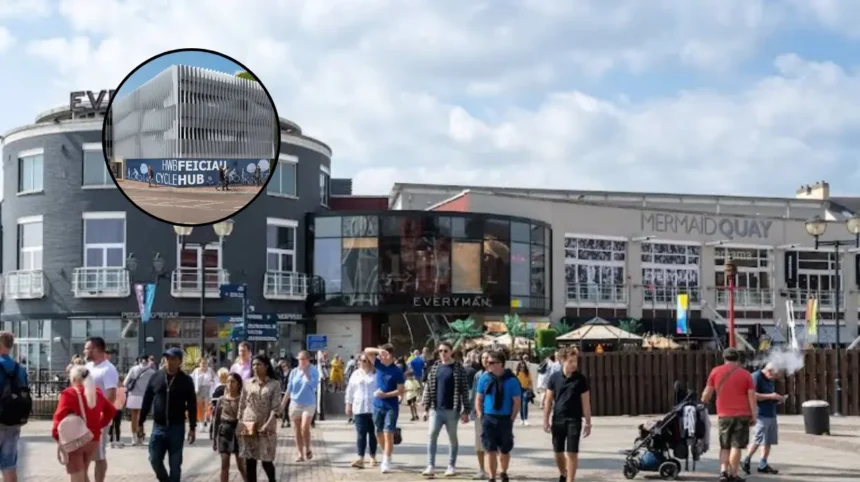
- A secured eco-travel cycle hub accommodating up to 70 bicycles, featuring specialized Sheffield cycle hoops and localized repair bays.
Visually, the structure transitions from plain concrete blocks to a contemporary waterfront aesthetic designed by the Cardiff office of Austin-Smith:Lord and design collective Studio Response. The exterior façade utilizes undulating, shaped aluminium fins meant to mirror maritime movements.
To counter the stark lines of multi-storey infrastructure, the developers added green wall cladding across two prominent stairwells to promote localized urban biodiversity. A large, site-specific public mural painted by contemporary artist Aidan Myers finishes the ground-level approach.
Who Supported the Expansion and What Were the Past Controversies?
The financial underpinnings of the multi-million-pound car park expansion rest on investments managed by the Schroder UK Real Estate Fund (SREF), the primary owner of the 150,000-square-foot Mermaid Quay mixed-use zone.
Plans for the vertical extension were originally brought before Cardiff Council’s planning committee in April 2019, securing formal planning consent in 2021 following rigorous public reviews surrounding environmental impacts.
The developmental pathway faced notable resistance from adjacent residential pockets. Records from historic planning tribunals indicate that local residents, supported by Butetown ward councillor Saeed Ebrahim, voiced concerns regarding potential reductions in residential privacy, structural overshadowing, increased localized carbon emissions, and traffic congestion near Mount Stuart Primary School.
A formal public petition opposing the multi-storey expansion gathered 214 signatures during the statutory consultation phases.
Conversely, the commercial sector strongly defended the expansion as an existential necessity for the waterfront’s survival. Major regional stakeholders—including the interactive science museum Techniquest, restaurant chain Wagamama, and independent boutique Fabulous Welshcakes—provided formal testimonies to the council, stressing that the existing 372 spaces frequently hit maximum capacity during regular weekends, stifling commerce.
In the final planning assessments, Cardiff Council’s committee concluded the structural design handled the impact on surrounding buildings appropriately.
The local authority approved the expansion after securing specific financial contributions from Schroders to offset traffic impacts on surrounding roads.
Harry Pickering, Head of UK Retail at Schroders Capital, highlighted the fund’s strategic vision during the developmental phase:
“The redevelopment of the Mermaid Quay car park outlines Schroder UK Real Estate Fund’s commitment to the Cardiff Bay area. This car park provides parking for visitors to the waterfront, including Mermaid Quay, and the wider Cardiff Bay area attractions, including Techniquest, the Wales Millennium Centre, and Roald Dahl Plass. It is well used and often reaches capacity.”
Background of the Mermaid Quay Infrastructure Development
The expansion of the Mermaid Quay car park is part of a larger master plan to transform Cardiff Bay from an old industrial port into a leading European waterfront destination.
The regeneration of the area originally gained momentum following the completion of the Cardiff Bay Barrage in 1999, which created a 500-acre freshwater lake and opened up miles of waterfront real estate for commercial redevelopment.
When Mermaid Quay opened its doors over two decades ago, it was designed primarily as a localized dining district. However, recent investments have fundamentally shifted the area’s purpose toward high-density cultural and entertainment venues.
In December 2019, Schroders introduced an Everyman boutique cinema, alongside major restaurant expansions like Cosy Club and Hubbox, which dramatically prolonged the area’s evening operating hours and altered daily parking requirements.
Furthermore, Cardiff Council has pursued an ambitious vision to position the bay as an international events hub. This includes extensive public realm refurbishments, pedestrianization projects across the inner wharves, and the highly anticipated construction of a new 15,000-capacity indoor arena at nearby Atlantic Wharf.
Because these mega-projects are expected to draw thousands of extra visitors per hour to the waterfront, upgrading the existing parking assets at Mermaid Quay became an immediate logistical priority for both private investors and city planners.
Explore More Cardiff Bay News
Welsh Dragon Series Youth Sailing Regatta Concludes at Cardiff Bay 2026
Police Seek Owner of Mystery Ring Found in Cardiff Bay 2026
Future Predictions: How This Development Will Affect Local Commuters and Residents
The opening of the 679-space multi-storey facility will directly alter the daily routines, transport choices, and living conditions of residents and commuters across the Butetown and Cardiff Bay sectors.
For local business commuters, workers, and hospitality employees, the expanded capacity should immediately reduce the time spent searching for parking spaces during peak hours.
The inclusion of the 70-capacity cycle hub and dedicated EV charging stations will likely encourage more sustainable travel habits among staff who travel from outer Cardiff suburbs.
However, for the residential community living along Stuart Street and the immediate Butetown periphery, the effects are more complex.
While the ticketless, automated ANPR technology and redesigned multi-lane exit layouts are built to streamline vehicle processing, doubling the physical parking spaces will naturally pull a higher volume of vehicles directly into residential corridors during summer weekends.
Residents living nearest to the site can expect noticeable shifts in localized traffic patterns. While the green wall installations and acoustic aluminium fins are designed to absorb sound and reduce visual bulk, the increased influx of vehicles could challenge local air quality management and exacerbate rush-hour queues near Mount Stuart Primary School.