Key Points
- Housing Market Displacement: Jennifer Lewis, a 55-year-old grandmother of two, has been forced out of the private rental market in Cardiff due to soaring rental costs, leaving her with no option but to live in shared student housing.
- Prolonged HMO Residency: Ms Lewis has resided in a House of Multiple Occupancy (HMO) in the student-dominated Cathays district of Cardiff for eight years, sharing communal spaces with four other tenants.
- Surging Rental Costs: Market data indicates the average cost of renting in Cardiff reached £1,157 in April 2026, marking a near doubling of average rental prices within a ten-year span.
- Employment and Health Toll: Despite working full-time in a supermarket five days a week and assisting with childcare, Ms Lewis suffers from arthritis, which medical professionals state is severely exacerbated by the stress and hyper-vigilance of shared living.
- Council Housing Waitlist: Ms Lewis has spent three years on Cardiff Council’s social housing waiting list, but local authorities have classified her under a “medium priority” band, stating that age alone does not dictate accelerated placement.
- Demands for Local Policy Reform: The 55-year-old worker has publicly challenged the council to build more municipal homes and reform their assessment criteria to evaluate the physical and psychological safety impacts of HMO living more dynamically.
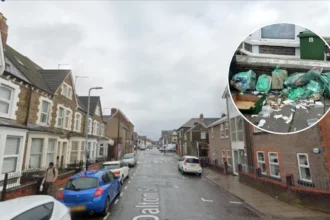
Cathays (Cardiff Daily) July 11, 2026 — A 55-year-old grandmother who works full-time five days a week has revealed she has been left with no choice but to “live like a student” after skyrocketing property costs effectively excluded her from the local rental market. As reported by Kieran Molloy of WalesOnline, Jennifer Lewis, a grandmother of two, has spent the last eight years residing in a House of Multiple Occupancy (HMO) situated in the dense student district of Cathays, Cardiff. The accommodation choice was born out of financial necessity after rental prices in the Welsh capital scaled what she characterized as “unachievable” levels for individual working professionals.
- Key Points
- Why Is Private Rental Accommodation Deemed Unachievable For Sole Earners In Cardiff?
- How Does House Of Multiple Occupancy Living Impact The Health And Safety Of Older Residents?
- What Is The Council’s Stance On Social Housing Allocation Priority?
- Background of the Cardiff Housing Market Evolution
- Prediction: How This Development Will Affect Older Single-Income Workers
Why Is Private Rental Accommodation Deemed Unachievable For Sole Earners In Cardiff?
The economic strain confronting single-income households in the region is heavily underlined by long-term regional data trends. Ten years ago, the baseline cost of securing an independent flat or house in the capital was significantly lower.
However, by April 2026, the average monthly cost to rent a property in Cardiff surged to £1,157. This shift represents a near doubling of rental prices within a single decade, creating a steep financial barrier for residents relying exclusively on a single salary.
Ms Lewis, who is employed full-time at a local supermarket, explained that the broadening gap between retail wages and property market demands has limited her housing options to a single room in a shared five-person house. In an interview with WalesOnline, Ms Lewis stated that:
“The prices have just gone up, especially in the housing market, and with that increasing cost [it] is unachievable for myself as a sole earner. There’s low-end and high-end, but that increase has been right across the board. It’s unachievable for myself and lots of other people.”
The continuous climb in property values across all segments of the market has meant that even baseline, entry-level studio apartments require a financial layout that consumes an unsustainable proportion of a retail worker’s net monthly earnings.
How Does House Of Multiple Occupancy Living Impact The Health And Safety Of Older Residents?
Living in high-density student areas when out of the typical student demographic brings distinct psychological and physiological challenges.
According to the reporting by Kieran Molloy, the structural realities of sharing a domestic property with four rotating tenants have subjected Ms Lewis to ongoing personal strain. Ms Lewis described the emotional weight of her environment, noting that living in a house of multiple occupancy
“brings a certain level of fear” because she does not know “what to expect from each tenant and what could happen at any time.” She further detailed that this constant uncertainty creates
“quite a high level of alertness which isn’t good for your health overall.”
Beyond the psychological strain of hyper-vigilance, the living arrangement has directly interacted with chronic physical health conditions.
Ms Lewis suffers from arthritis, a painful joint condition that both she and her medical doctors confirm is being actively exacerbated by the physical conditions and stress associated with her current housing structure. Describing her daily routine, Ms Lewis remarked:
“I have pain every day, although I just think of how I can help myself with stretching and trying to keep my stress levels low. That’s where it’s very difficult in a shared house because you’re always on a high alert to protect yourself – it’s a form of self protection.”
The compounding demands of maintaining a five-day work week at a supermarket, coping with chronic arthritic pain, and providing routine childcare for her grandchildren who live with her daughter in North Cardiff have led to severe fatigue.
Reflecting on the intersection of her work, family duties, and domestic environment, she added that “every angle is exhausting.”
What Is The Council’s Stance On Social Housing Allocation Priority?
Seeking an exit from the private rental market, Ms Lewis turned to the local municipality for assistance. She has now spent three consecutive years on Cardiff Council’s social housing waiting list.
Given her extended stay in temporary shared accommodation and her worsening health issues, she has openly questioned why she has not been moved into a higher priority category to accelerate her rehousing.
Expressing her frustration with the administrative framework, Ms Lewis argued that the local authority must transition away from rigid bureaucratic metrics. She asserted:
“I understand the council has got procedures in place but I am saying now, eight years in shared housing, I am a priority. I don’t feel that the council are looking at people’s cases more personally, because I keep pushing the health, social and safety issues in shared housing and I don’t feel the council are listening and looking at that fully.”
She further raised questions regarding how tax-paying, working older citizens are classified within the welfare system, asking:
“I am claiming a pension, I’m paying my taxes, I am child-caring and at what point do they think it’s acceptable to class a 55-year-old female living in a shared house a low priority?”
Ms Lewis concluded that the council needs to significantly expand its municipal house-building programs and allocate properties more flexibly,
“rather than putting people into strict pigeon holes, whether it’s for medical reasons or other.”
In response to these criticisms, a representative for Cardiff Council outlined the legal parameters governing the distribution of public housing.
The council confirmed that the housing queue operates via a strict, multi-tiered points system designed to channel resources toward those in the most urgent distress. A Cardiff Council spokesperson stated that:
“Ms Lewis joined the housing waiting list in 2023 and was awarded a medium housing need priority. Her application has been reviewed on a number of occasions and her assessment remains unchanged. Priority for social housing is not awarded on the basis of age alone, although some housing schemes are designated for specific age groups.”
The local authority maintained that its allocation policy must remain strictly bound to objective need metrics, which include clear evidence of immediate homelessness, acute medical or welfare emergencies, or verified proof that a citizen’s current physical structure is causing a significant, measurable impact on their direct health or wellbeing.
The council clarified that while they acknowledge the difficulties faced by single workers in the private market, they must balance allocations across thousands of applicants facing similarly challenging circumstances.
Background of the Cardiff Housing Market Evolution
The structural crisis within the Cardiff housing sector has developed over a prolonged period, driven by a widening imbalance between housing supply and population growth.
Over the last ten years, Cardiff has experienced steady urban expansion, fueled by its status as an administrative, educational, and economic hub.
This growth has triggered an influx of students and young professionals, placing immense pressure on the city’s housing stock. Concurrently, the volume of social housing builds has not kept pace with the rate at which older municipal properties have left the market, creating a substantial shortfall in subsidized housing.
In the private rental sector, the widespread conversion of traditional family terrace houses into Houses of Multiple Occupancy (HMOs)—particularly in centrally located neighborhoods like Cathays and Roath—has fundamentally reshaped local demographics.
While HMO conversions maximize yields for private landlords catering to the high-turnover student market, they have steadily reduced the availability of affordable, self-contained long-term lets for permanent residents.
This trend, combined with broader inflation, rising mortgage interest rates for landlords, and increased regulatory compliance costs in Wales, has driven average private rental fees up to the current level of £1,157 per month.
Consequently, middle-aged and older single earners who do not qualify for immediate social housing are increasingly squeezed out, finding themselves caught between an expensive private market and an overburdened municipal system.
Explore More Cathays News
Cardiff Student Recycling Scheme Breaks Records in Cathays 2026
Viral Video Exposes Severe Seagull Swarm in Cathays 2026
Prediction: How This Development Will Affect Older Single-Income Workers
This structural shift in the capital’s housing market is poised to accelerate a demographic transformation within shared housing, expanding it from a temporary student arrangement into a long-term reality for older, single-income workers.
In the coming years, individuals aged 50 and over who rely on single, working-class wages—such as retail, hospitality, or administrative support staff—will likely face an increasing likelihood of displaced residency.
As private one-bedroom flats become economically non-viable, a growing segment of this demographic will be forced to remain in or enter HMOs, sharing communal facilities with much younger, transient populations.
For this specific audience, the long-term consequences are expected to manifest in two distinct areas: public health and social services.
The prolonged psychological stress of living in high-alert environments, combined with the physical challenges of managing age-related health conditions like arthritis in shared spaces, will likely lead to an increase in housing-related health presentations at local NHS facilities.
Furthermore, as an increasing number of aging citizens reach retirement age without owning a home or holding a secure, independent tenancy, local authorities like Cardiff Council will face mounting pressure. This will likely necessitate a structural revision of social housing allocation frameworks, forcing municipal bodies to place greater emphasis on the safety and health risks inherent to long-term shared living for older applicants.