Key Points
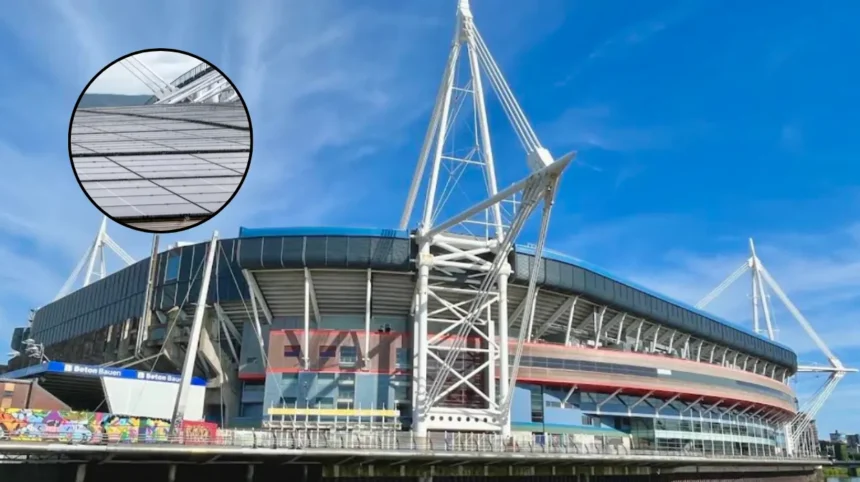
- Cardiff’s Principality Stadium has had 3,296 solar panels fitted across the two fixed halves of its roof during the 2025 off-season.
- The panels have been operational since February, although the Welsh Rugby Union only publicised the project in June.
- The installation has been described as the largest rooftop solar deployment at a UK sports venue.
- The system is expected to generate about 1.24GWh to 1.25 million kWh of electricity a year.
- The WRU says the project could save between £300,000 and £400,000 a year in energy costs, following an investment of about £1 million.
- The stadium can now run largely off-grid on the sunniest days and may even export power back to the grid.
- The project is part of the WRU’s wider drive to decarbonise Welsh rugby operations.
Cardiff (Cardiff Daily) July 25, 2026 – Cardiff’s Principality Stadium has quietly completed one of the largest renewable-energy upgrades seen at a UK sports venue, after 3,296 solar panels were installed across the roof and brought into operation earlier this year. The Welsh Rugby Union’s decision to reveal the project only in June has now drawn attention to an installation that officials say can supply the stadium with substantial clean power and cut long-term costs.
- What exactly has been installed?
- When did the project happen?
- How much power will it produce?
- What does the WRU say the savings will be?
- How was the installation done?
- Why is the WRU doing this now?
- What does it mean for the stadium?
- Which media reported it?
- Background of the development
- What could this mean for Welsh rugby?
What exactly has been installed?
The core of the project is a solar array fitted across the two fixed halves of the stadium roof, with panels spread over around 6,000 square metres.
According to the WRU and project partner EvoEnergy, the installation has been designed to mirror both sides of the roof for visual balance, despite being largely invisible from ground level.
The full system is described as the largest rooftop solar deployment at any sports stadium in the UK. The WRU says the panels were lifted into place using a crane after being moved through the stadium’s access tunnel and across the covered pitch, a process that took several months to complete.
When did the project happen?
The panels were fitted during the 2025 off-season and the system was completed in September 2025, before commissioning and switch-on followed later.
The array has been generating electricity since February, but the WRU did not make a major public announcement until June 2026.
That timeline matters because it shows the project was not simply announced as a plan; it was already working before the public learned the scale of what had been done.
The stadium website said the switch-on marked a key step in the WRU’s decarbonisation plans, with a broader sustainability strategy still to come later this year.
How much power will it produce?
The reported annual output is around 1.24GWh to 1.25 million kWh, depending on the source. The stadium itself says that is enough electricity to power more than 50 matchdays, while EvoEnergy has said the system can meet the equivalent of 50 match days.
During the recent heatwave, the system reportedly generated more than 800 kilowatts at times, leaving the stadium “essentially off-grid” for much of the day and even exporting surplus electricity.
That suggests the site can make meaningful use of solar generation even when sunlight conditions are not perfect.
What does the WRU say the savings will be?
The WRU has said the installation should reduce annual electricity bills by about £300,000 to £400,000, after an investment of roughly £1 million.
It has also suggested the payback period could be shorter than first expected, with one estimate moving from three to four years down to two to three years.
Those numbers make the project notable not only as an environmental measure but also as a financial one. The WRU has framed the savings as money that can be redirected into Welsh rugby rather than being spent on energy costs.
How was the installation done?
The panels were brought into the stadium through the access route known as the Dragon’s Mouth, then transported over the pitch and hoisted onto the roof by crane.
The physical challenge of the project appears to have been significant, given the size of the venue and the shape of the roof structure.
EvoEnergy, which delivered the system, said the installation had to be arranged carefully so the panels could be fitted across the stadium’s iconic roof without affecting the appearance of the building from street level. The firm also said the stadium had been designed to achieve an orderly, mirrored layout on both sides.
Why is the WRU doing this now?
The solar scheme is part of a wider sustainability programme aimed at reducing the stadium’s dependence on grid electricity and lowering its carbon output.
The WRU has linked the project to its broader plans to decarbonise Welsh rugby, including work with RSK Group on sustainable practices across facilities and operations.
The stadium website said the solar installation forms part of a wider package of sustainability measures. The WRU’s messaging suggests this is intended to be one element of a longer-term approach, rather than a one-off environmental gesture.
What does it mean for the stadium?
On practical days with strong sunshine, the stadium can now cover much of its own electricity demand and potentially feed power back into the grid.
That gives the venue more resilience against energy price swings and reduces reliance on external supply at a time when large public buildings face pressure to improve efficiency.
The project also gives the stadium a rare distinction in UK sport: one of the most visible sporting buildings in Wales is now also one of the most significant renewable-energy sites in the sector. The WRU has presented that as a “win-win” for both supporters and operations.
Which media reported it?
BBC News reported that the WRU said the panels would save up to £400,000 a year in energy costs, while also noting the project’s scale and the fact that it had been completed quietly before being publicly highlighted.
Specialist energy outlet Solar Power Portal said the installation had been completed in September 2025 and later commissioned, while Principality Stadium’s own site described it as the largest solar panel installation at a UK sports venue and said it supported the WRU’s decarbonisation plans.
Background of the development
The Principality Stadium project fits into a wider trend of major venues trying to cut operating costs and carbon emissions through on-site renewable energy.
The WRU had already signalled a stronger sustainability direction through its collaboration with RSK Group in 2025, which focused on renewable energy, water management, infrastructure design and waste reduction across Welsh rugby.
In that sense, the solar array was not an isolated move but the most visible part of a broader strategy. The scale of the installation also reflects how stadium operators are increasingly looking at their roofs, service areas and utility systems as assets that can generate power rather than just consume it.
What could this mean for Welsh rugby?
For Welsh rugby audiences, the most immediate effect is financial: lower energy bills at the national stadium may free up more money for operations and wider rugby priorities.
The WRU has explicitly said the savings will be invested back into Welsh rugby, which means the benefits could extend beyond the stadium itself.
For supporters and event-goers, the change is less visible but still relevant, because a venue that can generate more of its own electricity is less exposed to energy market pressures. Over time, that could support a more stable operating model for one of Wales’s most important sporting and entertainment venues.