Key Points
- Sixty Days Without Rain: Large swathes of England and Wales have experienced up to 60 days without significant rainfall, triggering official drought conditions.
- Persistent Fire Severity: Despite incoming rain, the Fire Severity Index is projected to drop only to low or moderate levels, leaving dry organic matter vulnerable.
- Prolonged Ground Recovery: Forecasters indicate that weeks of above-average autumn rainfall will be required to restore soil moisture to normal levels.
- Severe Wildfire Impact: The Environment Agency has logged 110 wildfires on Sites of Special Scientific Interest (SSSIs) in 2026.
- Midlands Fire Outbreak: Six distinct wildfires erupted across the West Midlands on 14 August 2026, damaging or destroying residential properties across five counties.
- Record Subsidence Payouts: According to the Association of British Insurers (ABI), home insurers paid out £72 million in subsidence claims during the second quarter of 2026.
- Escalating Settled Costs: The average settled subsidence claim reached a record high of £20,000 in Q2 2026.
London, UK (Cardiff Daily) August 17, 2026 – The arrival of cooler temperatures and light rainfall across the United Kingdom marks the transition into a secondary, highly complex phase of property risk rather than the end of summer environmental exposure. While meteorological forecasts indicate an abatement of extreme heat, property insurers and insurance brokers are facing converging operational threats driven by deep-seated soil desiccation and persistent vegetation dryness. Data from official environmental monitors and industry trade bodies confirm that despite immediate atmospheric shifts, the structural impact on UK real estate will continue to generate significant commercial and residential insurance liabilities through the autumn months.
- Key Points
- Why Does Autumn Rain Fail to Immediately Eliminate UK Wildfire and Subsidence Hazards?
- How Has the 2026 Wildfire Season Impacted British Residential Property?
- What Do the Latest Industry Figures Reveal About Escalating Subsidence Claims?
- Background of Property Risk Dynamics in Drought Conditions
- Prediction: How Will These Converging Risks Affect Property Insurance Brokers and Policyholders?
Why Does Autumn Rain Fail to Immediately Eliminate UK Wildfire and Subsidence Hazards?
The primary driver behind the ongoing exposure is the severe deficit in subterranean and surface moisture built up over two months of heat. Large areas of England and Wales have endured up to 60 consecutive days without meaningful rainfall.
This extended period of atmospheric dryness has desiccated subsoil layers—particularly reactive clay soils common in southern and central England—while reducing surface vegetation to extremely low moisture content.
According to meteorological analyses, light precipitation and lower ambient temperatures do not instantly alter the underlying risk profiles. The Fire Severity Index, which assesses the susceptibility of land to wildfire propagation, is projected to decrease only to low or moderate thresholds upon the arrival of initial rain.
Because the deeper layers of peat, turf, and dense undergrowth remain dry, a single short-period rain event is insufficient to fully damp down rural and semi-urban ground fuels.
Furthermore, hydrologists and weather forecasters caution that it will take weeks of sustained, above-average autumn rainfall to replenish subsoil moisture levels to seasonal norms.
For insurance underwriters and risk intermediaries, the temporal gap between the onset of cooler weather and the genuine restoration of soil stability represents a critical risk window.
During this period, existing ground shrinkage remains at its peak, while surface vegetation retains sufficient dryness to sustain ignition under specific localized conditions.
How Has the 2026 Wildfire Season Impacted British Residential Property?
Historically viewed as a peripheral or secondary exposure within the United Kingdom general insurance market, wildfire has rapidly shifted into a primary peril demanding dedicated underwriting consideration. Environmental tracking shows a marked increase in both the frequency and geographic spread of uncontained fires during the summer of 2026.
The Environment Agency has officially recorded 110 separate wildfires on Sites of Special Scientific Interest (SSSIs) across the country over the course of 2026.
These incidents have not been confined to unpopulated moorlands or distant national parks; rather, they have increasingly encroached upon the rural-urban fringe, placing residential dwellings and commercial infrastructure in direct path of thermal damage and flying embers.
The systemic nature of the threat was demonstrated on 14 August 2026, when a series of six major wildfires broke out almost simultaneously across the West Midlands within a span of several hours.
The rapid spread of the blazes affected communities across a broad geographic arc, causing structural damage to or total destruction of homes in Stourbridge, Stoke-on-Trent, Birmingham, Warwickshire, and Worcestershire.
The multi-county nature of the outbreak highlighted the operational pressures placed on local fire and rescue services, as well as the immediate concentration of property loss claims faced by personal lines insurers.
What Do the Latest Industry Figures Reveal About Escalating Subsidence Claims?
While wildfire presents an acute and immediate threat to physical structures, soil subsidence operates as a continuous, high-severity financial drain on the British property insurance sector. The prolonged lack of rainfall throughout mid-2026 has accelerated soil contraction, particularly in areas where properties are built on shrink-swell clay foundations.
Data published by the Association of British Insurers (ABI) demonstrates the vast scale of ground movement claims registered during the height of the dry spell.
Home insurers in the United Kingdom paid out a total of £72 million in subsidence-related claims in the second quarter of 2026 alone.
Alongside the volume of notifications, the financial severity of individual incidents has increased significantly. The ABI recorded that the average settled subsidence claim reached a record figure of £20,000 during the second quarter of 2026.
Industry experts attribute this increase to a combination of broader macroeconomic factors—including elevated material costs and specialist labor rates within the construction and underpinning sectors—and the physical severity of structural movement resulting from rapid clay desiccation.
Because tree root systems continue to draw moisture from deep within the ground well into the autumn season, structural engineers anticipate that claims notifications for foundation cracking, wall displacement, and internal cosmetic damage will remain elevated despite the return of surface rain.
Explore More UK News
UK Heatwave: NHS Nurses Facing Inhumane Conditions (London 2026)
Record UK School Leavers Accepted on Degree Courses: UCAS Report London 2026
Background of Property Risk Dynamics in Drought Conditions
The dynamic between extended drought conditions, soil mechanics, and property loss exposure in the United Kingdom is governed by long-term environmental and structural factors.
The UK contains vast regions—particularly across Greater London, the South East, East Anglia, and parts of the Midlands—where residential properties are constructed atop highly reactive soils, predominantly London Clay and Gault Clay.
These clay types undergo substantial volume changes based on water content, expanding during wet periods and contracting significantly during droughts.
When precipitation ceases for extended periods, the upper soil profile dries out, causing the ground beneath shallow building foundations to settle unevenly.
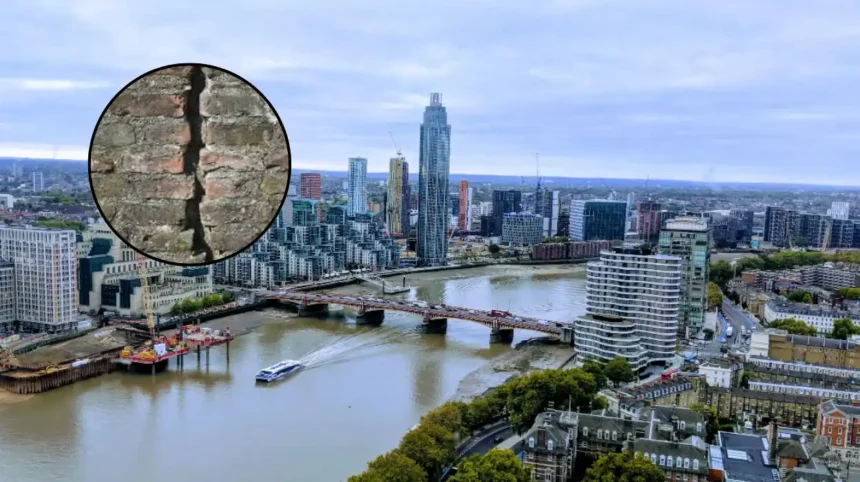
This process, known as differential subsidence, subjects building frames to shear stress, resulting in structural cracking, door frame misalignment, and compromised utility connections.
Major UK subsidence “event years”—such as those recorded in 1976, 1995, 2003, 2018, and 2022—demonstrate a historical pattern where dry summers trigger multi-million-pound loss spikes that take several quarters to fully adjust and settle.
Concurrently, the changing profile of UK wildfires reflects broader shifts in land management, vegetation density, and urban development patterns. Historically, British property policies treated fire primarily as an internal structural risk caused by electrical faults, heating systems, or accidental ignition.
However, the expansion of the wildland-urban interface (WUI)—where residential developments directly border natural vegetation, woodlands, or agricultural land—has exposed domestic property to external vegetation fires.
The combination of prolonged heatwaves, desiccated surface biomass, and high wind speeds creates conditions where fires spread rapidly across fences, outbuildings, and roof structures, shifting wildfire from an agricultural concern into a mainstream property insurance loss driver.
Prediction: How Will These Converging Risks Affect Property Insurance Brokers and Policyholders?
The convergence of persistent wildfire risk and record-setting subsidence claims will exert direct, structural pressure on the UK property insurance ecosystem, fundamentally affecting insurance brokers, property owners, and underwriting capacity.
Insurance brokers will face an increasingly complex market environment characterized by tighter underwriting criteria and heightened technical scrutiny from insurance carriers.
Brokers operating in high-risk postcodes—particularly those with reactive clay geology or proximity to heathland and unmanaged green spaces—will need to navigate reduced capacity for standard home and commercial property lines.
Risk intermediaries will be required to collect more granular property data during renewals and new business placements, including arboricultural surveys, historical foundation monitoring, and proximity to flammable vegetation.
Furthermore, brokers will play a crucial role in managing client expectations regarding rising deductibles (excesses), specifically for subsidence, where standard policy excesses of £1,000 could be adjusted upwards by risk-averse underwriters.
For homeowners and commercial property managers, the immediate consequence of the 2026 drought conditions will be a noticeable upward pressure on premium rates during upcoming renewal cycles.
As insurers absorb the £72 million Q2 subsidence payout alongside severe losses from localized wildfire events, risk capital will become more expensive.
Policyholders in designated clay belts may encounter stricter policy conditions, including mandatory tree management programs and delayed coverage inception for structural alterations.
Additionally, properties affected by structural movement may face temporary valuation adjustments or complications during real estate transactions, as mortgage lenders typically demand comprehensive engineer reports and guaranteed insurance coverage before approving finance on properties with active or historical subsidence.