Key Points
- Continuous Works: Roadworks are ongoing on Castle Street in Cardiff city centre, at the junction of Westgate Street, with motorists warned to expect delays.
- Scope & Duration of the Project: The current works are part of a larger 52-week project which started in February 2026 to make temporary road layout and cycle ways permanent, carried out by Knights Brown contractors on behalf of Cardiff Council.
- Impact on Traffic & Access: Castle Street and the current pop-up cycle way remain accessible in both directions during all construction stages with two traffic lanes remaining the same.
- Active Travel Infrastructure: Features a permanent cycle way, fully segregated according to Active Travel, carriageway surfacing, improvement of footways and paving, as well as improved facilities for bus stops.
- Improvement of Air Quality: This project develops the previous temporary measures implemented after breaching the 2018 European Ambient Air Quality Directive that decreased the nitrogen dioxide level from $45 \mu g/m^3$ to $29 \mu g/m^3$.
- Specific Features of Junctions: New pedestrian crossings, yellow box markings, traffic lights, bus only right turn lane onto Castle Street and North Road at Kingsway junctions, as well as local landscape work and bus shelters with green roofs.
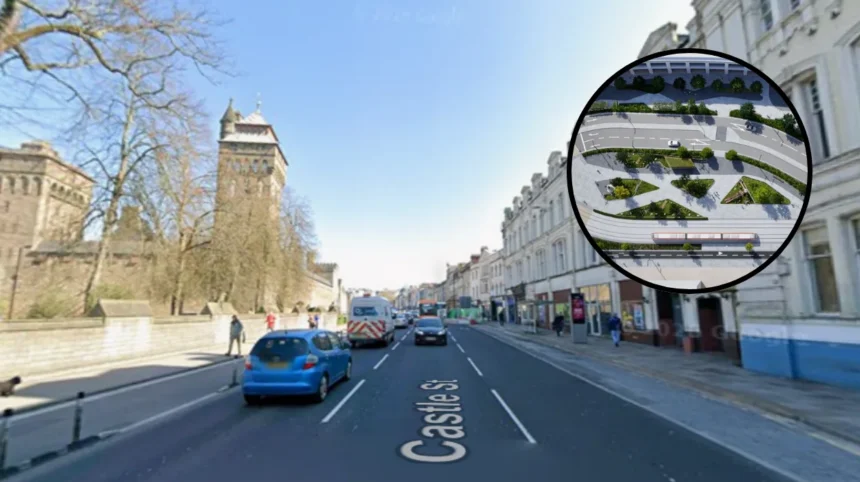
Cardiff (Cardiff Daily) September 22, 2026 – Motorists and public transport users navigating the Welsh capital are being urged to budget extra time for their travels as extensive, year-long road improvements press ahead on a vital urban artery. Cardiff Council has released a fresh operational update confirming that infrastructural upgrades along Castle Street, crucially intersecting with Westgate Street, are maintaining their scheduled trajectory. The enterprise encompasses comprehensive carriageway resurfacing, the targeted removal of obsolete traffic islands, and the installation of modernized pedestrian crossings engineered to bolster overall public safety and accessibility across the central district.
- Key Points
- What are the core objectives behind the ongoing Castle Street regeneration scheme?
- How does the permanent design support active travel and public transport?
- What historical and environmental factors triggered the redesign of Castle Street?
- What specific junction modifications are underway across the city centre corridor?
- Background of the particular development
What are the core objectives behind the ongoing Castle Street regeneration scheme?
As reported by Rhys Gregory of Wales 247, the active site operations form an integral component of a broader, long-term municipal initiative designed to transition temporary roadway adjustments into permanent fixtures. Main construction operations commenced in February, with a projected delivery window spanning approximately 52 weeks. Cardiff Council officially appointed civil engineering contractors Knights Brown to execute the multi-faceted development framework.
Throughout the duration of the principal construction phases, municipal authorities have reiterated that Castle Street and the adjacent cycleway will generally remain open to bidirectional movement, restricting full closures strictly to specialized resurfacing windows. Furthermore, transport planners confirmed that the baseline volume of general traffic lanes will be preserved permanently under the finalized layout.
How does the permanent design support active travel and public transport?
As detailed in updates covered by Wales 247, the master blueprint incorporates a fully segregated permanent cycleway constructed in strict alignment with national Active Travel standards. Alongside comprehensive surface renewal for the main carriageway, pedestrians will benefit from upgraded footways and enhanced paved precincts. Significant adjustments are similarly mapped out for bus stop infrastructure along Kingsway and North Road, integrated alongside supplementary environmental landscaping.
The architectural blueprint integrates targeted provisions aimed at fostering superior urban air quality. These additions feature enhanced public transport infrastructure complemented by specialized green-roof bus shelters designed to mitigate urban heat island effects and capture particulate matter.
Explore more City Centre News
Gambit and Acuity Law Move Offices in Cardiff 2026
Acuity Law Expands Headquarters at Callaghan Square in Cardiff 2026
What historical and environmental factors triggered the redesign of Castle Street?
As highlighted in reports by Nation.Cymru, the transformation of Castle Street’s layout originated from serious environmental compliance failures. In 2018, atmospheric air pollution measurements along the corridor breached legal thresholds stipulated by the European Ambient Air Quality Directive. This breach compelled the Welsh Government to formally direct Cardiff Council to formulate and implement a comprehensive Clean Air Plan.
The initial interim response involved compressing general traffic lanes from three down to two, preserving a dedicated westbound bus corridor, and establishing a temporary two-way pop-up cycle lane. According to data released by Cardiff Council and cited across regional media, these experimental interventions yielded measurable success, dropping local nitrogen dioxide concentrations from $45 \mu g/m^3$ down to $29 \mu g/m^3$, successfully pulling the route back within statutory clean air compliance limits.
What specific junction modifications are underway across the city centre corridor?
As documented by Wales 247, current engineering efforts at the Westgate Street junction mark the physical establishment of the new segregated cycle pathway, supported by modernised pedestrian crossing points, updated stone paving, and fresh yellow box markings governed by dedicated cycle-phase traffic signals.
Additional construction milestones are scheduled along the remainder of Castle Street as well as the High Street and Kingsway junctions. These forthcoming phases will introduce supplemental cycle parking stands, modernized bus stopping points, integrated pedestrian-cyclist hybrid crossings, and refreshed landscaping elements. Specifically at Kingsway, structural plans dictate the introduction of a dedicated buses-only right-turn lane facilitating direct access onto Castle Street and North Road. While these adjustments necessitate the removal of two established trees, municipal landscape plans mandate equivalent replacement planting within the immediate vicinity.
Background of the particular development
The structural evolution of Castle Street represents one of Cardiff’s most fiercely debated urban planning transformations over the past decade. Following its temporary pedestrianisation and subsequent adaptation into a mixed-use pop-up corridor during the post-lockdown recovery period, the local authority weighed multiple long-term futures for the route. Public consultations demonstrated significant public engagement regarding how the core thoroughfare should balance private vehicular traffic, mass transit efficiency, and burgeoning active travel demands. Because arterial alternatives such as the Butetown Tunnels and Gabalfa Roundabout frequently operate near peak capacity, transport planners determined that completely pedestrianising or closing Castle Street would export unsustainable congestion into surrounding residential and commercial districts. Consequently, the current 52-week engineering programme was commissioned to permanently institutionalise an equilibrium between low-emission public transport, protected cycle infrastructure, and essential general traffic movement.
The ongoing roadworks and subsequent permanent layout changes carry distinct implications for local motorists, bus commuters, cyclists, and city centre businesses. For regular drivers, the retention of two traffic lanes means baseline capacity will not diminish further, though short-term delays—such as those prompted by temporary traffic management signals at Westgate Street—will periodically stretch journey times. Public transport users, particularly patrons of Cardiff Bus, face transitional delays as junction configurations are rebuilt, requiring proactive schedule management. Conversely, regular cyclists and pedestrians stand to gain long-term safety dividends from fully segregated, permanent active travel pathways. For local retail and hospitality enterprises, the revitalised streetscape, enhanced air quality, and improved pedestrian connectivity are anticipated to foster a more welcoming, accessible urban core once the comprehensive engineering schedule reaches its conclusion.