Key Points
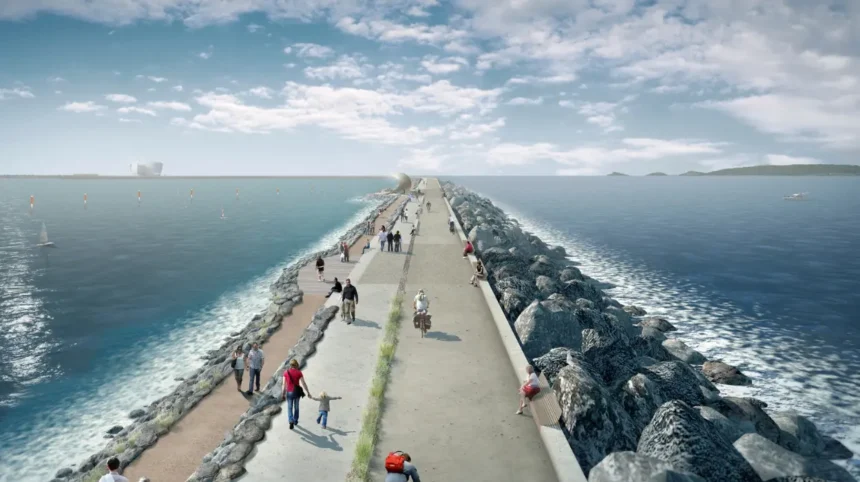
- The Cardiff Capital Region (CCR) has given approval to development explorations for a tidal lagoon to be constructed in the Severn Estuary.
- A total of up to £6.4 million is going to be invested in the next three years via City Deals to support the first significant phase of the project.
- The first phase will include a lot of explorations, which will include environmental analysis, engineering design, modeling, and business evaluations.
- According to the preliminary calculations, the suggested tidal lagoon may produce approximately 600 megawatts (MW) of energy enough to provide power to about half a million households for over 120 years.
- This project will generate up to £3.5 billion worth of economic benefits, create numerous job opportunities, and offer protection against sea level rising for the future in the coastlines of South Wales.
- Aberthaw and its adjacent area in Vale of Glamorgan have been proposed as the potential site of choice for the demonstration of the commercial project.
- The project is a result of the collaboration between CCR and WECA, based on recommendations by the independent Severn Estuary Commission.
Cardiff (Cardiff Daily) September 23, 2026 — The Cardiff Capital Region has officially approved a multi-million-pound funding package to advance exploratory development studies for a landmark tidal lagoon prospect within the Severn Estuary. Committing up to £6.4 million over the next three years through City Deal resources, the regional body aims to unlock one of the United Kingdom’s most significant untapped renewable energy resources. The decision paves the way for comprehensive environmental, engineering, and commercial modelling centered around Aberthaw on the Vale of Glamorgan coast, marking a pivotal step in regional green infrastructure strategy.
What are the key details of the Cardiff Capital Region’s Severn tidal lagoon plan?
As reported by business editor Sion Barry of BusinessLive Wales, the initiative is designed to assess the viability of what is intended to be the first in a new generation of tidal lagoons in the Severn Estuary. The funding allocation will support rigorous investigation into environmental factors, engineering configurations, predictive modeling, and commercial assessments.
As detailed in official announcements by the Cardiff Capital Region, initial estimates indicate that a completed lagoon at the site could provide approximately 600MW of predictable renewable electricity. This output would be sufficient to supply electricity to roughly half a million homes while maintaining operational capabilities for more than 120 years. Furthermore, economic evaluations suggest the development could inject around £3.5 billion in economic value into the region, supporting thousands of jobs and creating extensive supply chain opportunities for local enterprises.
Why was Aberthaw chosen as the preferred location?
The selection of Aberthaw stems from joint collaborative efforts between the Cardiff Capital Region and the West of England Mayoral Combined Authority (WECA), following strategic recommendations issued by the independent Severn Estuary Commission. The site, a former coal-fired power station acquired by CCR in 2022, possesses established industrial and logistical assets, including existing National Grid infrastructure and proximity to transport links.
As reported by Cardiff Capital Region communications, Cllr Mary Ann Brocklesby, Chair of the Cardiff Capital Region and Leader of Monmouthshire Council, stated that:
“This represents a potentially game changing moment for renewable energy generation in the UK. The Severn Estuary has one of the highest tidal ranges in the world, with the potential to generate predictable, homegrown renewable energy that complements existing wind and solar power.”
Adding to this perspective, Helen Godwin, Mayor of the West of England Combined Authority (WECA), emphasized the cross-border scale of the initiative, noting as reported by regional media outlets that:
“The Severn Estuary is an extraordinary natural asset and now is the time to let our tides power new jobs and growth in both England and Wales.”
Godwin further highlighted that working alongside Welsh partners ensures that unique coastal environments remain at the center of development strategies.
How does this project fit into national climate and energy goals?
Ministers from both the UK Government and devolved administrations have welcomed the progression of the Severn tidal lagoon blueprint. The framework aligns directly with broader national objectives concerning energy security and the transition toward net-zero carbon emissions.
As stated by Katie White OBE MP, Minister for Climate Transition, in statements released via Cardiff Capital Region updates:
“The Severn Estuary is one of the UK’s most significant tidal resources. This investment is an important next step in building the evidence, working closely with environmental organisations, and demonstrating how tidal range can deliver large-scale, clean, economic energy while respecting the Severn’s exceptional natural environment.”
Secretary of State for Wales, Stephen Kinnock, also underscored Wales’ ongoing contribution to green engineering. As reported by BusinessLive Wales, Kinnock noted that Wales maintains a robust track record of innovation and partnership, with the Cardiff Capital Region continuing to leverage those strengths to drive economic expansion and clean energy deployment.
Explore more Local Cardiff News:
12-Year-Old Boy Hospitalised After E-Bike and Car Crash in Riverside, Cardiff 2026
Cardiff Bus Warns of Half Marathon Delays in Cardiff 2026
What are the next steps for the exploratory development phase?
The newly approved funding phase will prioritize an environmental and engineering co-design process. This approach is structured to establish the precise scale, structural configuration, and boundary parameters of the lagoon while ensuring that marine, ecological, and environmental data actively inform every stage of maturation.
Administrators have emphasized that the demonstration project at Aberthaw is intended to establish a crucial benchmark. By proving that tidal range infrastructure of this magnitude can operate in an environmentally responsible, technically achievable, and commercially competitive manner, proponents hope to clear a path for a wider series of complementary lagoons across the Severn Estuary over the long term.
Background of the Development
The concept of harnessing the Severn Estuary’s immense tidal range—one of the highest in the world, reaching up to 14.5 metres in certain sections—has a long and complex history. For decades, various proposals ranging from massive multi-billion-pound barrages spanning the entire estuary to standalone lagoon structures have been debated by engineers, economists, and environmentalists. Major previous attempts, most notably the £1.3 billion Swansea Bay Tidal Lagoon proposal, faced significant setbacks when they were rejected by the UK Government in 2018 on strict value-for-money grounds. Similarly, earlier blueprints for full-scale lagoons between Cardiff and Newport stalled during early feasibility stages.
In response to past failures, the independent Severn Estuary Commission and cross-border partnerships recalibrated the strategy toward a phased, commercial demonstration model rather than an immediate, high-risk mega-project. This modern iteration relies on utilizing strategically acquired industrial brownfield assets—such as the Aberthaw power station site purchased by the Cardiff Capital Region in 2022—to build foundational evidence regarding ecological compatibility, financial viability, and engineering execution.
The progression of the Severn tidal lagoon exploratory studies carries profound implications for multiple stakeholders, particularly local communities, regional businesses, and utility consumers across South Wales and the West of England. For local residents and environmental groups along the coastline, the development introduces both potential long-term benefits—such as enhanced coastal defense against rising sea levels and the creation of localized green jobs—and stringent ecological scrutiny regarding the preservation of protected marine habitats.
For regional businesses and the local supply chain, the project signals a multi-year horizon of commercial procurement opportunities, infrastructure contracting, and skills development tailored to the renewable energy sector. However, as the project transitions from early studies toward capital-intensive construction phases requiring billions of pounds, potential funding models—such as regulated asset base frameworks or public-private partnerships involving the National Wealth Fund—could introduce long-term financial commitments or adjustments affecting regional energy infrastructure and consumer billing structures. Ultimately, how transparently environmental and commercial metrics are balanced during this three-year study phase will dictate public trust and the ultimate feasibility of establishing tidal energy as a cornerstone of Britain’s clean power grid.