Key Points
- Two RAF pilots who were lucky enough to survive a crash landing of an aircraft near RAF Valley are now back home and recovering from minor injuries.
- It all began when a Hawk T2 training aircraft took off from RAF Valley at lunchtime on Wednesday, 23rd September.
- Orange smoke was seen coming out of the jet as soon as it took off and then quickly climbed in order for the pilots to control it.
- The two pilots, one trainee and another experienced pilot, managed to eject safely before the aircraft came down near a caravan park on the edge of Pencarnisiog in Anglesey.
- Until now, Hawk T2 jets have been grounded due to the ongoing investigation into the cause of the crash.
- Group Captain Gez Currie from RAF Valley Station Commander said that the aircraft was intentionally steered into an empty field in order to save many lives below.
- The pilots thanked everyone for their support from all around the world, especially from emergency services, RAF members and the residents of Ynys Môn.
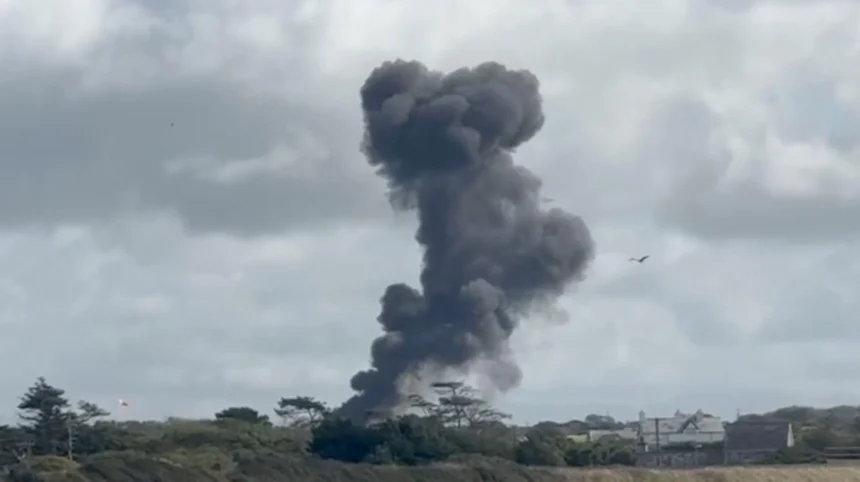
Cardiff (Cardiff Daily) October 1, 2026 – Two Royal Air Force pilots who cheated death after ejecting from a burning training jet that plummeted near a Welsh caravan site have returned home to recover from their ordeal. As reported by Owen Hughes and Lois McCarthy of Wales Online, the two aviators—comprising a trainee pilot and a seasoned instructor—survived the dramatic crash involving a Hawk T2 aircraft that suffered catastrophic engine trouble shortly after departing from RAF Valley on Wednesday, September 23. The incident sparked widespread concern across Anglesey after witnesses captured footage of orange flames erupting from the jet during take-off, culminating in a rapid climb before the crew successfully initiated their ejection sequence moments before the aircraft came down near Pencarnisiog.
- Key Points
- What is the latest update on the RAF pilots who survived the Anglesey plane crash?
- How did the pilots and RAF authorities respond following the incident?
- Why was the aircraft steered away from populated areas?
- What is the current status of the aircraft fleet and the ongoing investigation?
- Background of the particular development
What is the latest update on the RAF pilots who survived the Anglesey plane crash?
As detailed in the report by Owen Hughes and Lois McCarthy of Wales Online, officials at RAF Valley have confirmed that both airmen involved in the dramatic September 23 incident have returned home and are recuperating from minor injuries.
The training flight had set off from the Anglesey base at lunchtime, carrying a dual crew of a student aviator and an experienced instructor. Almost immediately after lifting off, problems became visible from the ground. As highlighted by Wales Online, witnesses spotted “orange flames” streaming from the jet as it struggled to gain altitude.
Despite the intense mechanical failure, the crew managed to force the aircraft into a rapid climb while desperately wrestling the controls to avert a catastrophic disaster over local residential zones. Finding the aircraft uncontrollable, both individuals executed emergency ejections just before the Hawk T2 nosedived into the ground near a caravan park on the outskirts of Pencarnisiog.
Explore More Local Cardiff News
Cardiff Coastal Defence Scheme Faces £10m Overrun Cardiff 2026
Cardiff Council Wins LGC Digital Impact Award for Child Safeguarding Cardiff 2026
How did the pilots and RAF authorities respond following the incident?
In a formal statement released by RAF Valley and published by Wales Online, the two surviving airmen offered their heartfelt thanks to the emergency services and all individuals who came to their aid during the immediate aftermath.
The statement conveyed by Wales Online noted:
“The two RAF pilots involved in last week’s accident near RAF Valley have now returned home and are recuperating. They would like to offer their heartfelt thanks to the emergency services, and all those who supported them in the immediate aftermath of the incident.”
Furthermore, the aviators expressed deep appreciation for the solidarity shown by the public. The statement continued, as reported by Wales Online:
“They are also deeply grateful for the kindness, encouragement and well wishes received from people across the world, and in particular their RAF colleagues and the people of Ynys Môn. The support shown over the past week has meant a great deal to the pilots and their families as they begin their recovery at home.”
Authorities have also requested privacy for the families as the healing process continues. “We kindly ask you to respect the privacy of those involved as they recover. The investigation continues. Thank you for your understanding and continued support,” the statement concluded.
Why was the aircraft steered away from populated areas?
According to statements given to the BBC and cited in coverage by Wales Online, RAF Valley Station Commander Gez Currie revealed that the doomed aircraft was deliberately guided toward an open field to protect residents and prevent mass casualties.
As reported by Wales Online, Group Captain Gez Currie explained the split-second decisions made in the cockpit during the emergency. He stated:
“The aircraft would have been aimed in a direction that the pilot believed was open field, in order to avoid built-up areas and anybody on the ground.”
The strategic steering of the jet away from housing developments and local schools—where pupils reportedly watched the unfolding horror—has drawn widespread praise from local communities and military officials alike. The prompt action of the crew is widely credited with averting a much larger tragedy on the ground in Anglesey.
What is the current status of the aircraft fleet and the ongoing investigation?
As reported by North Wales Live and featured in Wales Online, the entire fleet of Hawk T2 training jets has been grounded while military safety investigators work to determine the exact technical root cause of the engine failure.
Investigators are examining flight data recorders, debris recovered from the Pencarnisiog crash site, and maintenance logs from RAF Valley. While the inquiry proceeds methodically, military officials have emphasized that no definitive conclusions regarding the mechanical fault will be released until the technical analysis is complete. In the interim, training operations utilizing the Hawk T2 platform remain suspended across the board to ensure absolute safety compliance.
Background of the particular development
The incident on September 23 marks a critical moment for the UK military’s fast-jet training pipeline stationed at RAF Valley in Anglesey, Wales. RAF Valley serves as the premier training ground for future fast-jet pilots of both the Royal Air Force and the Royal Navy, utilizing the BAE Systems Hawk T2 advanced jet trainer. The Hawk T2 fleet has been the backbone of modern tactical and combat readiness training, equipping pilots with the skills required to transition to frontline aircraft like the Typhoon and the F-35 Lightning II. Aviation safety and rigorous emergency protocols are paramount at the base, making incidents involving this specific aircraft class exceptionally rare and subject to stringent, independent military air accident investigations.
This development will likely lead to heightened scrutiny over military aircraft maintenance protocols, fleet-wide technical inspections, and safety margins for training flights operating near residential areas across the United Kingdom. For the local community in Anglesey and the broader military families associated with RAF Valley, the safe return of the pilots brings immense relief, yet it also underscores the inherent risks faced by trainee and instructor aircrews daily. In the short term, the grounding of the Hawk T2 fleet will temporarily disrupt advanced flying training schedules, forcing military planners to adjust syllabi while safety boards finalize their findings. Over the long term, recommendations stemming from the official investigation could influence avionics updates, engine reliability checks, and emergency ejection protocols, ultimately reshaping operational safety standards across UK defense aviation.