Key Points
- National Commemoration: Communities, veterans, and serving personnel across Wales gathered at war memorials to observe Remembrance Sunday, paying tribute to those who lost their lives in conflicts.
- Cardiff National Service: A major national service took place at the Welsh National War Memorial in Cardiff, featuring military detachments, cadets, and senior political and civic figures.
- Key Leadership Attendance: Prominent political figures, including First Minister Rhun ap Iorwerth and Secretary of State for Wales Stephen Kinnock, attended the capital’s central service to lay poppy wreaths.
- Organisational Collaboration: The Cardiff commemorations were jointly organised by Cardiff Council and the Welsh Government in partnership with the Royal British Legion.
- Clergy and Musical Tributes: Opening words were delivered by the Reverend Canon Stewart Lisk BEM, alongside performances from the Cardiff Arms Park Choir, Cardiff Military Wives Choir Caerdydd, and The Salvation Army’s Canton Band.
- Spiritual Reflection: Lieutenant Colonel Jonathan Roberts of The Salvation Army highlighted the dual theme of expressing gratitude for service and praying for global peace.
- Closing Proceedings: The solemn event concluded with the sounding of the Last Post, a two-minute silence, national anthems, and a traditional March Past and Salute outside the Glamorgan Building on King Edward VII Avenue.
Cardiff (Cardiff Daily) November 9, 2026 — Communities across Wales united in solemn reflection and public gratitude as thousands of citizens, military veterans, and serving personnel gathered to observe Remembrance Sunday.
As reported by Robert Dalling of Wales Online, the national service held at the Welsh National War Memorial served as the focal point for the nation’s tributes, drawing political leaders, armed forces detachments, and crowds of local residents to honour the fallen.
How did Wales mark Remembrance Sunday 2026?
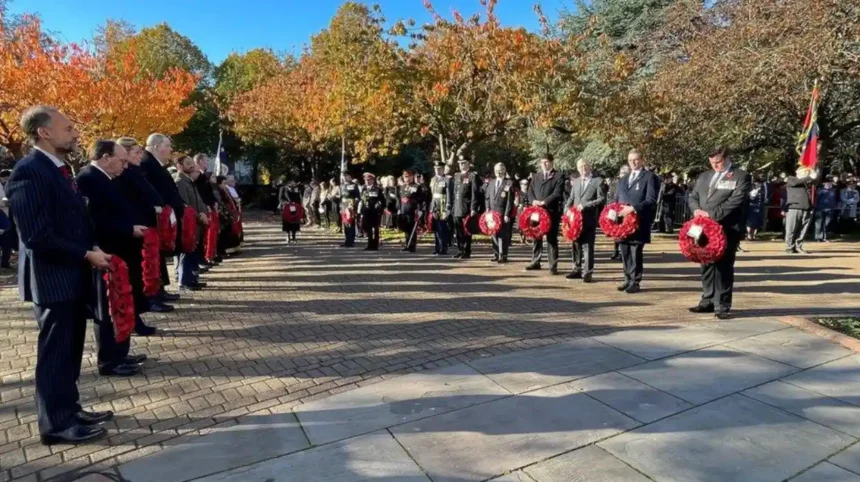
The capital city of Cardiff hosted a poignant national service that brought together detachments from the Royal Navy, the Army, and the Royal Air Force, alongside cadet forces and former service personnel. Beneath the historic autumn trees of Alexandra Gardens, military musicians dressed in striking scarlet uniforms accompanied columns of marching personnel as part of the capital’s tribute.
As observed by Robert Dalling of Wales Online, representatives from various civic sectors stood together holding red poppy wreaths, each serving as a public and deeply personal expression of remembrance. The ceremony was co-organised by Cardiff Council and the Welsh Government in close partnership with the Royal British Legion.
The programme commenced with opening words delivered by the Reverend Canon Stewart Lisk BEM, honorary chaplain to Cardiff Council. His address set a reflective tone for the hundreds gathered at the memorial site, which was followed by the traditional sounding of the Last Post and the Reveille. Musical accompaniment throughout the service was provided by the Cardiff Arms Park Choir and the Cardiff Military Wives Choir Caerdydd, while The Salvation Army’s Canton Band also formed an integral part of the commemorations.
What messages were shared by community and faith leaders?
Speaking ahead of the service, Lieutenant Colonel Jonathan Roberts, leader of The Salvation Army in Wales, emphasised the deeper meaning behind the annual tradition. As reported by Tom Sinclair of The Pembrokeshire Herald, Lieutenant Colonel Jonathan Roberts stated that remembrance brought together
“gratitude for those who had served and reflection on the devastation of war”.
Lieutenant Colonel Jonathan Roberts further noted:
“Remembrance Sunday reminds us of the importance of praying and working for peace”.
Echoing these sentiments, political leaders at the national memorial stressed the enduring obligation to remember the human toll of conflict. As highlighted across regional reports, figures including Rhun ap Iorwerth MS urged the nation to remember the high cost of conflict and to continually renew its collective commitment to fostering peace. The presence of high-ranking officials, including Secretary of State for Wales Stephen Kinnock, underscored the unified cross-party and national backing for the armed forces community and their families.
How did the national service conclude?
The formal proceedings at the Welsh National War Memorial reached their climax with the soaring notes of the national anthems, symbolising national solidarity and shared history. Following the musical tributes, participants and spectators moved toward King Edward VII Avenue for the final stages of the programme.
As detailed by local correspondents, a disciplined March Past and Salute took place outside the historic Glamorgan Building. Uniformed personnel, veterans proudly wearing their service medals, and youth cadets marched in unison past the saluting dais, greeted by respectful applause from the assembled onlookers who lined the route to pay their respects.
Background of the particular development
Remembrance Sunday has long occupied a central place in the cultural and civic calendar of the United Kingdom and Wales, evolving from the immediate aftermath of the First World War into a national institution dedicated to honouring all military personnel who have died in conflicts involving British and Commonwealth forces. The tradition is anchored by the symbolic wearing of red poppies—inspired by the wild poppies that grew across the devastated battlefields of Flanders—and the observation of a two-minute silence at 11:00 AM.
In Wales, national commemorations rotate or anchor around key regional cenotaphs and memorials, with the Welsh National War Memorial in Cardiff serving as the primary site for state-level remembrance. Organised collaboratively by civic authorities, devolved government bodies, and charitable organisations like the Royal British Legion, these events provide a vital space for public mourning, intergenerational education, and community cohesion. Over the decades, the scope of remembrance has broadened to acknowledge not only the veterans of the World Wars but also those affected by contemporary conflicts, peacekeeping missions, and the changing nature of military service in the 21st century.
Prediction
This annual wave of national remembrance is expected to reinforce civic unity and heighten public engagement with veterans’ welfare charities across Wales. By bringing younger generations, cadets, and school groups into direct contact with veterans and historical memorials, the commemorations help ensure that the historical memory of wartime sacrifice is transmitted to future populations.
Economically and socially, heightened awareness during the November remembrance period typically drives a surge in donations for the Royal British Legion’s Poppy Appeal, directly funding vital social, financial, and emotional support services for former service personnel and their families. Furthermore, the strong political and public turnout signals an enduring societal commitment to supporting the armed forces community, ensuring that issues surrounding veteran care, mental health support, and transition assistance remain prominent on the political agenda in Cardiff Bay and Westminster alike.