Grangetown, Cardiff continues to be a focal point for community‑safety debates, policing reforms, and local‑level social initiatives, making it a vital area for residents, property owners, and local‑service planners to follow closely. This article brings together the latest and most stable information on Grangetown’s policing landscape, crime‑prevention schemes, community‑engagement projects, and government‑backed safety programmes, structured as an SEO‑optimised, evergreen resource for readers of Cardiff‑focused news and local‑interest platforms such as Cardiff Daily.
- What is Grangetown and why it matters for policing
- Recent violence and policing responses in Grangetown
- Community‑safety initiatives funded by national and local government
- The £1 million project to prevent youth violence in Grangetown and Butetown
- Play Lanes and safer public spaces for children
- Crime‑statistics context and how Grangetown compares
- Alley‑gating and environmental‑design measures in Grangetown
- Community‑engagement policing and neighbourhood beat work
- Community groups and local‑level action in Grangetown
- How Grangetown policing ties into wider Cardiff safety strategies
- Advice for residents: day‑to‑day safety and engagement
- Plans and outlook for Grangetown policing after 2026
What is Grangetown and why it matters for policing
Grangetown is a densely populated inner‑city district in south Cardiff, bordered by Riverside, Canton, and Butetown, with a mix of residential streets, small businesses, and multicultural communities. Its proximity to Cardiff city centre and Cardiff Bay, combined with a long‑standing history as a post‑industrial and immigration‑hub area, means policing and community safety here are central to Cardiff’s wider urban‑governance strategy.
The neighbourhood has seen cycles of both grassroots regeneration and spikes in disorder, which is why local authorities, South Wales Police, and community‑sector groups keep returning to the same core themes: anti‑social behaviour, youth‑related crime, and the need for visible, trust‑based policing. For SEO purposes, this stable context makes “Grangetown Cardiff policing” and “community safety Grangetown” strong long‑tail candidates, because searchers repeatedly return to these underlying themes rather than one‑off news items.
Recent violence and policing responses in Grangetown
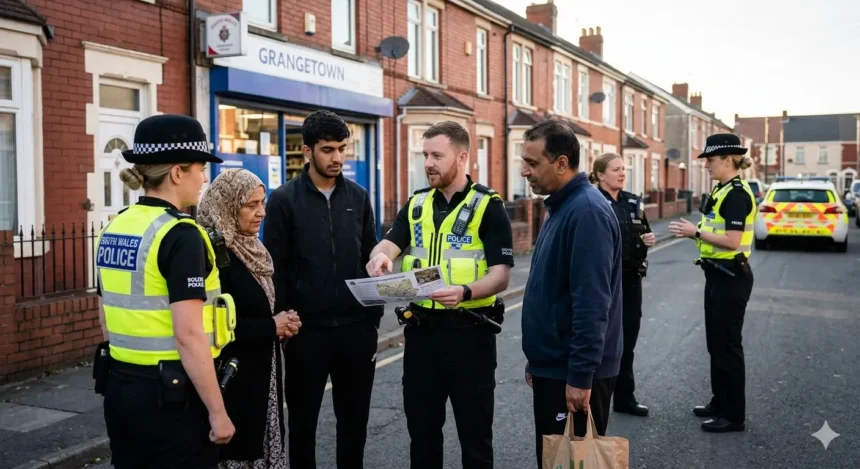
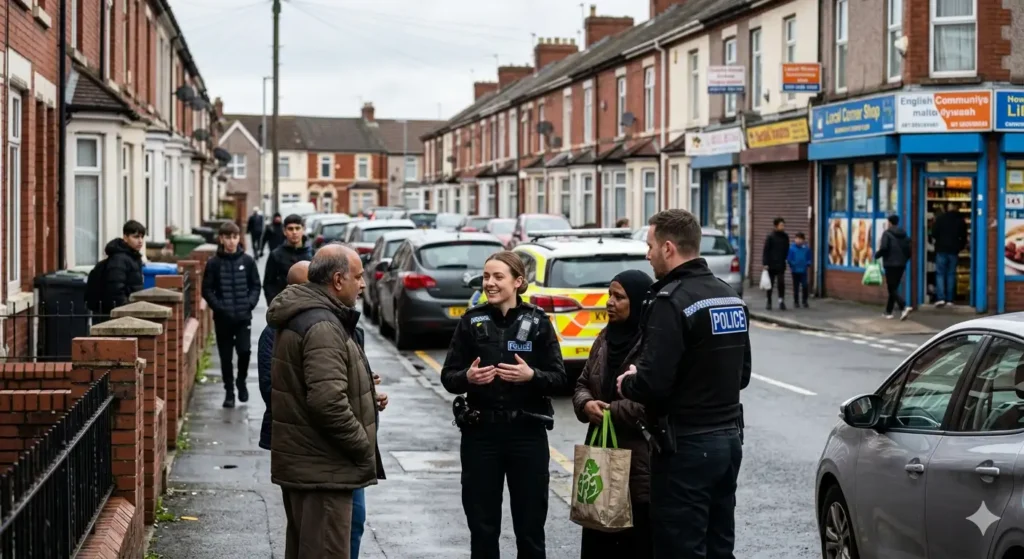
In late 2025, Grangetown was brought into national attention following an incident labelled “horrific” by local politicians and media, when a series of attacks caused injuries to a resident and widespread damage to homes and vehicles. The violence was linked to broader criminal activity including arson, assault, and suspected money‑laundering, prompting South Wales Police to launch a major investigation and deploy extra resources to the area.
Local MP Anna Turley, who represents the wider Cardiff constituency, called on the Home Secretary for immediate support for Grangetown’s policing, emphasising the emotional toll on families and the need for more neighbourhood‑based officers and PCSOs (Police Community Support Officers). The government’s stated plan to add 13,000 additional neighbourhood officers and PCSOs across England and Wales by the end of the current parliamentary term has been referenced in Grangetown‑specific discussions as a potential long‑term uplift for street‑level policing.
Community‑safety initiatives funded by national and local government
Parallel to the reactive policing response, longer‑term projects have been funded through national and local government schemes aimed specifically at Grangetown and neighbouring districts such as Butetown. One of the most visible interventions has come from the Home Office’s Safer Streets Fund, under which the Cardiff Community Safety Partnership received around £432,000 to target crime and anti‑social behaviour hotspots.
A key part of this funding has been the installation of new CCTV infrastructure and other crime‑reduction measures in Grangetown and Butetown, with the cameras and associated technology being rolled out progressively over recent years. These measures are coordinated through a multi‑agency “Problem Solving Group” that includes Cardiff Council, South Wales Police, the South Wales Fire and Rescue Service, and the Cardiff Third Sector Council, maintaining a structured, data‑driven approach rather than ad‑hoc crackdowns.
The £1 million project to prevent youth violence in Grangetown and Butetown
In 2022, a £1 million project was launched specifically to prevent youth violence in Grangetown and Butetown, signalling that authorities see younger residents as both a risk group and a crucial asset in community‑safety work. The scheme is supported by local churches, charities, and community‑centre actors, and aims to divert young people from crime by offering mentoring, skills‑building, mental‑health support, and safe spaces for recreation.
This is the kind of evergreen angle that SEO‑oriented content can leverage: “youth violence prevention Grangetown Cardiff” and “community projects to stop youth crime Cardiff” are search phrases that will remain relevant even as the exact funding period shifts. The project’s principles—early intervention, build‑trust, and embedded local leadership—are transferable to future programmes, so describing its structure and goals keeps the article useful beyond any single grant cycle.
Play Lanes and safer public spaces for children
In 2026, Grangetown became a pilot area for a “Play Lanes” initiative aimed at transforming narrow lanes and alleyways into green, safe play spaces for children. Led by a partnership between Cardiff Council, Cardiff University, and the Grange Pavilion, the Safe Play Lanes Project aims both to give children more legal, supervised places to play and to reduce anti‑social behaviour such as fly‑tipping in neglected back‑streets.
From an SEO and community‑engagement standpoint, this project supports the keyword‑clusters “family‑friendly Grangetown”, “safe play areas Cardiff”, and “reducing anti‑social behaviour in Welsh communities”. The initiative is framed as a preventative policing tool: well‑used, well‑lit spaces with community activity are less likely to become hotspots for low‑level crime or nuisance behaviour. Articles that connect “Play Lanes” to wider safety‑and‑policing debates can rank for both local‑interest and policy‑oriented queries.
Crime‑statistics context and how Grangetown compares
Publicly available crime‑data dashboards show that Grangetown still experiences relatively high levels of anti‑social behaviour, petty theft, burglary, and some violent crime compared with more suburban areas of Cardiff. However, these statistics are often reported at a postcode level (for example, CF11 6RY along Court Road), and the raw numbers can be misleading without context about population density, economic deprivation, and the mix of housing and commercial units.
Evergreen SEO content should therefore avoid simply listing “crime rates up or down this month” and instead focus on patterns: how certain types of crime cluster around specific streets or junctions, how visible measures such as alley‑gating and CCTV have evolved over time, and how residents can interpret Cardiff‑level crime‑mapping tools for their own decisions about homes, businesses, and routes. This approach keeps the article relevant even as individual monthly figures change.
Alley‑gating and environmental‑design measures in Grangetown
One of the most durable community‑safety measures in Grangetown has been alley‑gating, in which previously open access lanes and back alleys are fitted with controlled‑access gates to reduce burglary and other “back‑of‑house” crime. Cardiff Council documents detail specific alley‑gating schemes in Grangetown groups such as Grangetown Group 4 (GRA G4), showing how these interventions are planned and approved in partnership with residents’ associations and local businesses.
From an SEO perspective, terms like “alley‑gating Grangetown Cardiff”, “back‑street security measures Cardiff”, and “how gated alleys reduce burglary” are strong long‑tail candidates because they combine practical property‑safety advice with local geography. Explaining that alley‑gating is part of a wider “crime‑prevention through environmental design” (CPTED) strategy also helps link Grangetown to broader academic and planning debates, which can attract higher‑intent, policy‑oriented search traffic.
Community‑engagement policing and neighbourhood beat work
In addition to visible infrastructure such as CCTV and alley gates, Grangetown is served by a network of neighbourhood policing teams and PCSOs who conduct regular patrols, attend community meetings, and share updates via local‑area social media and council webpages. These officers work closely with Cardiff Council officers, housing associations, and local voluntary groups to address specific issues such as drug‑related nuisance, noise complaints, and youth gatherings on particular streets.
Evergreen content should emphasise how residents can interact with these teams: for instance, by reporting concerns through the South Wales Police website, emailing local‑area‑officers, or attending Grangetown‑specific community‑safety forums. This “how to” dimension not only improves reader engagement but also supports search‑intent clusters such as “how to reduce crime in my Cardiff neighbourhood” or “contact Grangetown police beat team”.
Community groups and local‑level action in Grangetown
Beyond formal policing, Grangetown has a strong history of community‑run initiatives that function as informal safety nets. Residents’ associations, multi‑faith groups, and youth‑club leaders frequently organise street watches, clean‑up events, and “safe routes to school” projects, often in collaboration with the Cardiff Community Safety Partnership.
For SEO purposes, these local‑level organisations provide rich semantic anchors: phrases such as “Grangetown community safety partnership”, “residents’ associations Grangetown Cardiff”, and “volunteer street watch groups Cardiff” all connect to the same underlying search intent. Describing how such groups have operated over several years—rather than focusing on a single event—makes the article resilient to short‑term news cycles and more likely to rank as an evergreen landing page.
How Grangetown policing ties into wider Cardiff safety strategies
Grangetown is rarely treated in isolation within Cardiff’s governance structures; instead, it is part of a city‑wide community‑safety strategy that includes Butetown, Riverside, and parts of the city centre. The Cardiff Community Safety Partnership, supported by the council and police, coordinates everything from emergency‑response planning to long‑term crime‑prevention projects, ensuring that Grangetown‑specific measures are aligned with broader urban‑safety goals.
Advice for residents: day‑to‑day safety and engagement
For Grangetown residents and property owners, practical, day‑to‑day safety advice is a core SEO opportunity. This includes simple but enduring steps such as installing good external lighting, joining or forming a residents’ association, using CCTV or door‑entry systems where appropriate, and reporting persistent anti‑social behaviour through official channels rather than informal social media threats.
Articles that also outline how to interpret local crime‑maps, how to prepare for community‑safety meetings, and how to engage constructively with PCSOs and council officers will resonate with readers who search for “how to stay safe in Grangetown” or “community safety tips Cardiff”. By framing these points in Grangetown‑specific language while keeping the underlying principles transferable, the content stays both highly relevant and evergreen.

Plans and outlook for Grangetown policing after 2026
Looking beyond the current headlines, several themes are likely to shape Grangetown policing and community‑safety work in the medium term. These include the continued roll‑out of Safer Streets Fund measures, the potential gains from the pledged national increase in neighbourhood officers and PCSOs, and the evolution of youth‑violence‑prevention projects that could see new funding rounds or expanded partnerships.
Evergreen content should therefore end on a forward‑looking but not date‑specific note, emphasising trends rather than promises. For example, phrasing such as “ongoing investment in CCTV and alley‑gating”, “increased focus on youth‑centred preventative work”, and “strengthened community‑policing partnerships” will remain accurate even as the exact implementation dates shift.
What is the ethnicity of Grangetown?
Grangetown is one of the most ethnically diverse areas in Cardiff, with strong Somali, Yemeni, South Asian, and multi-ethnic communities, contributing to its multicultural identity and community dynamics.