Key Points
- Election information signs have appeared near the Senedd (Welsh Parliament) building in Cardiff ahead of the Senedd devolved general election on 7 May 2026.
- The election marks the seventh since devolution in 1999 and introduces major changes: expansion to 96 Members of the Senedd (MSs) from 60, 16 new constituencies each electing six MSs, and a closed list proportional representation system using the D’Hondt method.
- Voters aged 16 and over will cast one vote for a party list or independent candidate, replacing the previous two-vote Additional Member System.
- Recent polls show Plaid Cymru leading at around 29-43%, followed closely by Reform UK at 28-30%, with Labour dropping to 14%, Conservatives at 11%, and Greens at 10%; projections suggest no outright majority, potential breakthroughs for Reform UK (up to 30 seats) and Greens (10 seats).
- Cardiff constituencies like Caerdydd Ffynnon Taf (covering northern/eastern Cardiff, Rhondda Cynon Taf areas) and Caerdydd Penarth feature candidates from major parties including Conservatives (e.g., Joel James, Calum Davies), Labour, Plaid Cymru, and others.
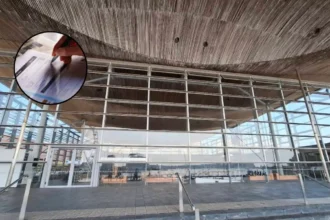
- The image by Reuters photographer Toby Melville captures people walking near these signs on 17 April 2026, highlighting public awareness efforts.[query image]
- Party manifestos propose constitutional changes: Plaid Cymru seeks independence referendum powers and a National Commission; Labour a Constitutional Reform Act; Liberal Democrats a federal UK; Conservatives rule out more powers; Greens want Scotland-level devolution.
Cardiff (Cardiff Daily) May 5, 2026 – Election information signs have been erected near the Senedd (Welsh Parliament) building in Cardiff, drawing attention to the upcoming Senedd devolved general election scheduled for 7 May 2026.[query image]
- Key Points
- What Changes Are Coming to the Senedd Election?
- Why Are Polls Showing a Tight Race?
- Who Are the Candidates in Cardiff Areas?
- How Does This Election Differ from Previous Ones?
- What Do Parties Propose on Devolution?
- Background of the Senedd Election Developments
- Prediction: How This Development Can Affect Welsh Voters
These signs serve as a visible reminder of the vote, with pedestrians captured passing by in an image taken by Reuters photographer Toby Melville on 17 April 2026.[query image] The election represents a pivotal moment for Welsh devolution, featuring sweeping reforms to the voting system and parliament size.
What Changes Are Coming to the Senedd Election?
The 2026 election introduces a closed list proportional representation system, where voters select a party or independent rather than individual candidates directly.
As explained by the Institute for Government, the Senedd expands from 60 to 96 MSs across 16 new constituencies mirroring Westminster boundaries, with each returning six members via the D’Hondt method to reflect vote shares proportionally.
Previously, under the Additional Member System since 1999, voters had two ballots: one for constituency MSs (40 seats) and one for regional lists (20 seats).
Now, parties list up to eight candidates per constituency, and seats go to the top names on winning lists; independents need about 16% of votes for a seat.
Wales Online reports that all voters aged 16+ must reside in Wales to participate, with terms shortening to four years from five. The limit on government ministers rises from 12 to 17, potentially more.
Why Are Polls Showing a Tight Race?
Recent polling indicates a fragmented landscape. YouGov’s MRP from March 2026 projects Plaid Cymru at 43 seats (short of 49 for majority), Reform UK at 30, Greens at 10, with Labour and Conservatives facing historic losses.
PollCheck’s 4 May 2026 average places Plaid Cymru at 29.2%, Reform UK 27.6%, Labour 13.8%, Conservatives 11%, Greens 10%. Beaufort Research (March 2026) had Plaid at 37%, Reform 30%.
As Dave Busfield-Birch of the Constitution Unit notes in their 5 May 2026 article, these shifts could lead to coalitions, as no party nears a majority.
Who Are the Candidates in Cardiff Areas?
In Caerdydd Ffynnon Taf, covering northern/eastern Cardiff, Rhondda Cynon Taf, Taff’s Well, and Nantgarw, Wales Online lists Conservative candidates including Joel James, Samantha Chohan, Joe Roberts, Ffin Elliott, Lyn Hudson, and Jane Lucas.
Jackie Jones, Cardiff councillor for Whitchurch and Tongwynlais since 2022 and former MEP, is noted for her law professorship and social justice focus.
Parties were requested to submit top-four biographies, with updates ongoing.
For Caerdydd Penarth (Cardiff West, South and Penarth), ITV News details Conservatives: Calum Davies (Cardiff councillor since 2022, concerned about “far-left separatist parties”), James Robert Hamblin, Dominic Owen Davies, Judith Elizabeth Child, Archie Draycott, Eddy Oko-Jaja.
Full lists across Wales finalized by 10 April 2026 include major parties like Labour, Plaid Cymru, and others.
How Does This Election Differ from Previous Ones?
This is the seventh Senedd election since 1999, when the National Assembly for Wales formed post-1997 referendum (50.3% yes).
Labour has governed continuously, holding 29 of 60 seats currently, with Conservatives and Plaid Cymru at 13 each.
The 2021 vote saw Labour at 30 seats, Conservatives 16, Plaid 13. A 2025 Caerphilly by-election saw Plaid win 47.4%, Reform 36%, Labour 11%.
New rules eliminate by-elections; vacancies filled by next on lists. Funding remains via Barnett formula (105% of English per-capita changes) plus devolved taxes.
What Do Parties Propose on Devolution?
Manifestos outline constitutional visions. As reported by Dave Busfield-Birch of the Constitution Unit, Plaid Cymru, led by Rhun ap Iorwerth, seeks devolved powers for an independence referendum timeline and a National Commission for Wales.
Labour proposes a Constitutional Reform Act to protect devolution. Liberal Democrats advocate a federal UK with a Council of Ministers. Conservatives reject independence or extra powers. Greens push for Scotland-equivalent powers.
First minister candidates include Eluned Morgan (Labour), Rhun ap Iorwerth (Plaid), Dan Thomas (Reform Wales), Darren Millar (Conservatives), Jane Dodds (Lib Dems), Anthony Slaughter (Greens).
Background of the Senedd Election Developments
The Senedd originated as the National Assembly for Wales in 1999 under Labour’s devolution plans, approved narrowly in 1997. Powers grew via the 2006 Government of Wales Act and 2011 referendum, enabling primary legislation in health, education, housing, and more, though without policing/justice.
The Senedd Cymru (Members and Elections) Act 2024 drove 2026 reforms for proportionality and expansion, aiming to better represent voters amid calls for change.
Public engagement includes roadshows like Cardiff Council’s “More Power to You” photobooth. Voter registration urges via gov.uk target Cardiff residents.
Prediction: How This Development Can Affect Welsh Voters
The shift to closed lists reduces direct candidate choice, potentially weakening personal accountability as party rankings decide winners. Proportionality via D’Hondt may boost smaller parties like Reform UK and Greens, leading to coalitions and compromise governments rather than single-party rule.
Welsh voters could see policy influenced by cross-party deals on devolution, economy, and services, with no majority likely. Independents face higher vote thresholds (16%), limiting local voices. Four-year cycles accelerate responsiveness but increase election frequency. In Cardiff, merged constituencies alter representation for areas like northern suburbs.