Key Points
- Plaid Cymru emerged as the largest party in the expanded 96-member Senedd with 43 seats after Thursday’s historic election, falling six seats short of the 49 needed for a majority.
- Reform UK secured second place with 34 seats, while Labour dropped to third with nine seats, ending over a century of dominance in Welsh politics.
- Plaid Cymru leader Rhun ap Iorwerth confirmed plans to form and lead a minority government without a coalition.
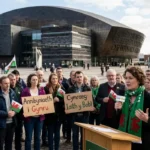
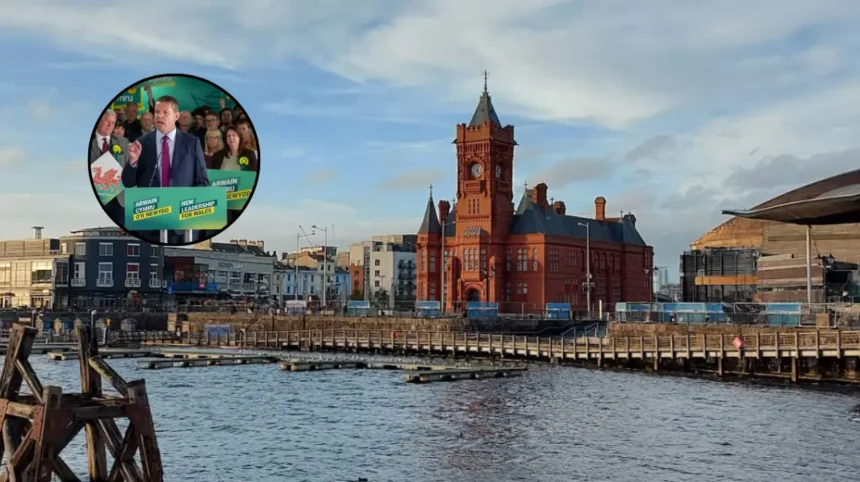
- Ap Iorwerth addressed supporters and MSs on the Senedd steps in Cardiff Bay on Saturday, describing it as an “immense honour” to represent Wales.
- He stated: “Throughout our nation people have put their faith in Plaid Cymru in numbers never seen before”.
- Ap Iorwerth invited cooperation: “We will do everything we can to repay the faith… inviting everyone to join us in an alliance, to pursue this mission on behalf of Wales”.
- Labour’s Eluned Morgan resigned as Welsh Labour leader after losing her seat in Ceredigion Penfro; Ken Skates appointed interim leader.
- Other parties: Conservatives 7 seats, Greens 2 (first ever), Liberal Democrats 1.
Cardiff Bay (Cardiff Daily) May 9, 2026 – Plaid Cymru leader Rhun ap Iorwerth declared his readiness to become First Minister and lead a minority Welsh government following his party’s position as the largest group in the Senedd with 43 members.
- Key Points
- Why Did Plaid Cymru Win the Most Seats in the Senedd?
- What Is a Minority Government in Wales?
- How Did Rhun ap Iorwerth Respond to the Victory?
- What Happened to Labour After the Election Loss?
- Which Other Parties Performed in the Election?
- Background of the Development
- Prediction for Welsh Voters
Why Did Plaid Cymru Win the Most Seats in the Senedd?
Plaid Cymru secured 43 seats in the 2026 Senedd election, marking the first time a party other than Labour has become the largest in the Welsh Parliament since devolution.
As reported by ITV News Wales, the party fell short of the 49 seats required for a majority in the expanded 96-member chamber. Reform UK took 34 seats, Labour nine, Conservatives seven, Greens two, and Liberal Democrats one, according to full results compiled by Pure West Radio.
Rhun ap Iorwerth, addressing hundreds of supporters on the Senedd steps, said:
“Wales demanded change… a new dawn beckons”.
He emphasised:
“We now need a government that represents that change… governing with fairness, responsibility, compassion and humility”.
Pre-election YouGov MRP polls had projected Plaid Cymru at 43 seats, aligning closely with the outcome and pointing to Labour’s collapse to around 12-13 seats.
The election ended Labour’s century-long dominance, with the party losing ground across Wales from Llanelli to Llandudno. ITV News Wales noted this as a “defining result,” with Plaid positioning itself to replace Labour in government.
What Is a Minority Government in Wales?
Ap Iorwerth told reporters he seeks to run a minority government, meaning Plaid Cymru would govern alone without a formal coalition. Speaking outside the Senedd, he stated: “I made it clear that my desire, if we were able to, would be to form a minority Plaid Cymru government”.
Throughout the campaign, Plaid indicated a preference for minority rule if the largest party but without a majority. Ap Iorwerth added he had spoken to other party leaders, though he did not specify who.
He plans to seek support on a “legislation-by-legislation” basis, working within a “spirit of co-operation”.
Options like coalitions or supply-and-confidence deals were mentioned by ITV News Wales as alternatives, recalling past Plaid-Labour arrangements such as the 2007 One Wales coalition and a recent three-year cooperation agreement. However, ap Iorwerth prioritised a Plaid-only administration.
How Did Rhun ap Iorwerth Respond to the Victory?
In his speech to fellow MSs and supporters in Cardiff Bay, ap Iorwerth described it as an “immense honour” to represent the whole of Wales . On the Senedd steps earlier Saturday, he said:
“Throughout our nation people have put their faith in Plaid Cymru in numbers never seen before. And we will do everything we can to repay the faith that people have put in us because we have a clear determination to make a difference on the things that matter to people’s lives and that resonated to people on all corners of our country”.
He continued:
“It is a new beginning and I have no doubt that when we speak with a national voice that is as determined as we have seen in this election, no UK Government, no UK prime minister now or in the future can cast Wales aside or turn a blind eye to our needs”.
Ap Iorwerth added:
“We will work constructively to seek what is right for Wales. We will build this nation every single day, bringing the competence that is needed and the compassion that is needed”.
The Evening Standard reported ap Iorwerth hailing no Prime Minister “can cast Wales aside”. His remarks were met with supporters singing Hen Wlad Fy Nhadau, drowning out some questions.
What Happened to Labour After the Election Loss?
Labour suffered its worst result in over a century, securing just nine seats. Former First Minister Eluned Morgan lost her seat in the new Ceredigion Penfro constituency and resigned as Welsh Labour leader on Friday.
As reported by WalesOnline, Morgan stated in her resignation at Ysgol Bro Teifi in Llys y Ffynnon:
“The people of Wales rejected Labour… I accept responsibility for the decline in Labour’s support in Wales”.
In Welsh, she added:
“The Welsh Labour Party has faced disappointing results. I will be stepping down as leader of Welsh Labour”.
Nation.Cymru noted Ken Skates was appointed interim Welsh Labour leader shortly after, to serve until a full leadership contest timetable is set. WalesOnline confirmed Skates’ role adheres to Welsh Labour guidelines.
Which Other Parties Performed in the Election?
Reform UK achieved second place with 34 seats, up significantly from 1% in 2021, on 27-29% vote share per polls. The Guardian reported this stalled Reform’s progress somewhat, behind Plaid’s 43.
Conservatives held seven seats on 134,926 votes. Greens won two seats for the first time, with 84,608 votes. Liberal Democrat Jane Dodds retained her single seat with 56,012 votes.
The Independent’s live results map highlighted Labour’s loss of control for the first time.
Background of the Development
The 2026 Senedd election used a new framework expanding to 96 members, requiring 49 for a majority. Pre-election YouGov MRPs showed a tight race, with Plaid and Reform neck-and-neck at times, projecting Labour’s historic losses from 36% to 13% vote share. Plaid had campaigned on replacing Labour, promising “new leadership” amid voter demand for change. Past cooperation like the One Wales deal provided precedent, but ap Iorwerth favoured minority rule to deliver on manifesto commitments directly.
Prediction for Welsh Voters
This development positions Plaid Cymru to lead on key issues like public services and economic fairness through case-by-case alliances, potentially stabilising governance without full coalitions. Welsh voters may see focused Plaid policies on national priorities, with opposition from Reform UK and Labour influencing debates on budgets and legislation. Ongoing support negotiations could affect policy delivery timelines for everyday concerns such as health and housing.