Key Points
- Cardiff Business School welcomed more than 30 visiting students from Dalian University of Technology and Anhui University of Science and Technology.
- The students took part in a Transnational Education summer camp focused on artificial intelligence.
- The programme examined the economic and social implications of AI.
- AI expert Ricardo Calil delivered a practical lecture on using generative AI in learning and research.
- Professor Peng Zhou discussed the benefits and risks associated with artificial intelligence.
- The programme considered how the effects of AI may be distributed unevenly among individuals, organisations and societies.
- The visiting students took part in a guided tour of Cardiff University’s campus and facilities.
- The tour also introduced them to aspects of the Cardiff student experience.
- Professor Zhou said short-term programmes offer flexibility in the duration of international study.
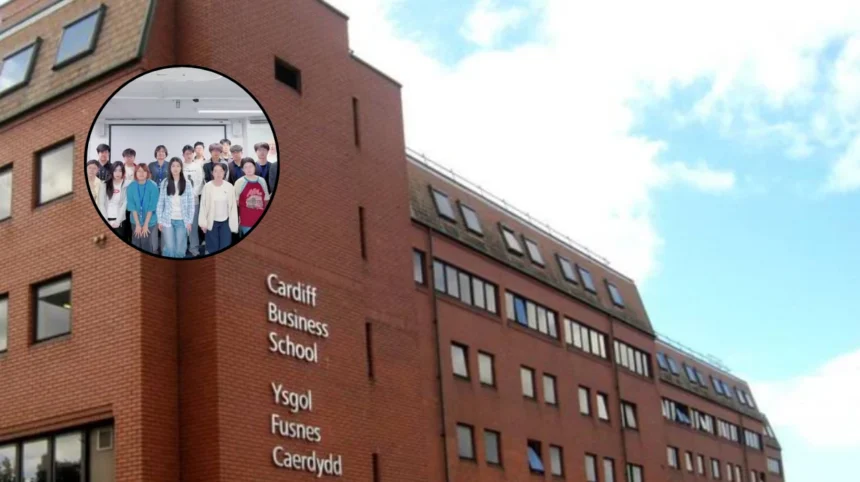
Cardiff (Cardiff Daily) August 8, 2026 – Cardiff Business School welcomed more than 30 visiting students from two Chinese international priority partner universities for a Transnational Education summer camp focused on artificial intelligence and its economic and social implications.
- Key Points
- What did the Cardiff Business School summer camp examine?
- Which Chinese universities took part in the visit?
- What did Ricardo Calil teach the visiting students?
- What did Professor Peng Zhou say about artificial intelligence?
- What did the students do during their Cardiff visit?
- How did Professor Zhou describe Transnational Education?
- What is the background to the Cardiff Business School development?
- How could the summer camp affect students and partner universities?
The visiting students came from Dalian University of Technology and Anhui University of Science and Technology. During their time in Cardiff, they took part in academic sessions examining the role of artificial intelligence, including its potential benefits, its risks and the way its effects may be experienced differently by individuals, organisations and societies.
The programme also included a practical session led by AI expert Ricardo Calil, a former member of Cardiff University Council. His lecture focused on generative artificial intelligence and explored how the technology can be used in learning and research.
Professor Peng Zhou also contributed to the programme by discussing the opportunities and challenges linked to artificial intelligence. The session highlighted that the advantages and risks of AI may not be shared equally, with different consequences for individuals, organisations and wider societies.
As part of the visit, the students took part in a guided tour of Cardiff University. The tour showcased the university campus and its facilities while also offering the visitors an introduction to the Cardiff student experience.
What did the Cardiff Business School summer camp examine?
The summer camp explored artificial intelligence from both economic and social perspectives. Rather than focusing only on the technical operation of AI, the programme considered how the technology may influence people, institutions and communities.
The focus on economic implications placed attention on the possible effects of artificial intelligence across organisations and wider society. The social dimension of the programme considered how individuals and groups may experience the development and use of AI in different ways.
The programme therefore presented artificial intelligence as a subject involving opportunities as well as challenges. The discussions addressed the potential benefits of AI while also recognising that its risks and effects may not be distributed evenly.
Professor Peng Zhou highlighted this uneven distribution during the programme. His contribution focused on how the benefits and risks of artificial intelligence can vary between individuals, organisations and societies.
Which Chinese universities took part in the visit?
The visiting students came from Dalian University of Technology and Anhui University of Science and Technology. Both universities are described as Chinese international priority partner universities of Cardiff University.
More than 30 students from the two institutions attended the Transnational Education summer camp at Cardiff Business School. Their participation formed part of an international academic programme that combined classroom learning, practical teaching and an introduction to the university campus.
The involvement of students from two different partner universities also gave the programme an international and collaborative character. The summer camp provided a shared setting in which the visitors could explore artificial intelligence while experiencing Cardiff University’s facilities and student environment.
What did Ricardo Calil teach the visiting students?
Ricardo Calil delivered a hands-on lecture about generative artificial intelligence and its use in learning and research. He was described as an AI expert and a former member of Cardiff University Council.
The practical nature of the lecture allowed students to engage directly with the subject. The session focused on how generative AI can be applied in academic settings, particularly for learning and research activities.
The lecture formed one of the central elements of the summer camp. It connected the broader discussion about artificial intelligence with a practical examination of how generative tools may be used by students and researchers.
The session also complemented Professor Zhou’s discussion of the wider consequences of AI. While Calil’s lecture focused on using generative AI, Professor Zhou addressed the benefits and risks that may arise from the technology and the possibility that those effects may differ between groups.
What did Professor Peng Zhou say about artificial intelligence?
Professor Peng Zhou highlighted both the benefits and risks of artificial intelligence during the summer camp. He also explained that these effects may be distributed unevenly across individuals, organisations and societies.
His contribution placed emphasis on the different ways people and institutions may be affected by AI. The same technology may offer advantages in one setting while creating risks or challenges in another, depending on how it is used and who is affected.
The discussion provided the students with a broader view of artificial intelligence. It showed that AI should not be considered only in terms of its capabilities, but also in relation to its consequences for people, organisations and society.
Professor Zhou’s comments also connected with the wider purpose of the programme, which was to explore the economic and social implications of artificial intelligence. The summer camp combined practical learning with consideration of the wider issues surrounding the development and use of AI.
Explore More Local Cardiff News
Heol Goch Reopens with Traffic Control Following Cardiff Flooding 2026
Woman Dropped from Operating Table During Surgery in Cardiff 2026
What did the students do during their Cardiff visit?
The visiting students took part in a guided tour of Cardiff University’s campus and facilities. The tour was designed to showcase the university environment and provide an insight into the Cardiff student experience.
Alongside the academic sessions, the tour gave the students an opportunity to see the setting in which Cardiff University students study and spend their time. It added a campus-based element to a programme otherwise centred on artificial intelligence and its implications.
The visit therefore combined academic activity with an introduction to university life. The students attended sessions led by experts, explored the subject of generative AI and toured the facilities available at Cardiff University.
How did Professor Zhou describe Transnational Education?
Reflecting on the visit, Professor Peng Zhou said that Transnational Education provides flexibility in the location of international study, while short-term programmes provide flexibility in its duration.
He said:
“While TNE provides flexibility in the location of international study, short-term programmes offer flexibility in its duration.”
The statement drew a distinction between two forms of flexibility. Transnational Education can allow international study to take place across different locations, while a short-term programme can make international academic engagement possible within a limited period.
The Cardiff summer camp reflected that approach by bringing visiting students from Chinese partner universities to the university for a focused programme. The students were able to take part in teaching and campus activities without the visit being described as a full-length international study period.
What is the background to the Cardiff Business School development?
The summer camp was organised as a Transnational Education programme involving Cardiff Business School and students from two Chinese international priority partner universities: Dalian University of Technology and Anhui University of Science and Technology.
Its central theme was artificial intelligence, including the technology’s economic and social implications. The programme included a hands-on lecture on generative AI, a discussion of benefits and risks, and a guided campus tour.
The development brought together international academic engagement, practical learning and exposure to the university environment. It also demonstrated how a short-term programme can provide students with an international study experience over a limited duration.
How could the summer camp affect students and partner universities?
For the visiting students, the programme provided direct exposure to discussions about artificial intelligence, including the use of generative AI in learning and research. It also gave them the opportunity to consider the potential benefits and risks of the technology across different parts of society.
For Dalian University of Technology and Anhui University of Science and Technology, the visit created an opportunity for their students to participate in an academic programme delivered through their partnership with Cardiff University. The guided tour also allowed the students to experience Cardiff University’s campus, facilities and student environment.
The wider effect of the development will depend on how the students apply what they learned after the programme. Based on the information available, the summer camp gave them both practical and broader academic perspectives on artificial intelligence, while providing a short-term international study experience.