Key Points:
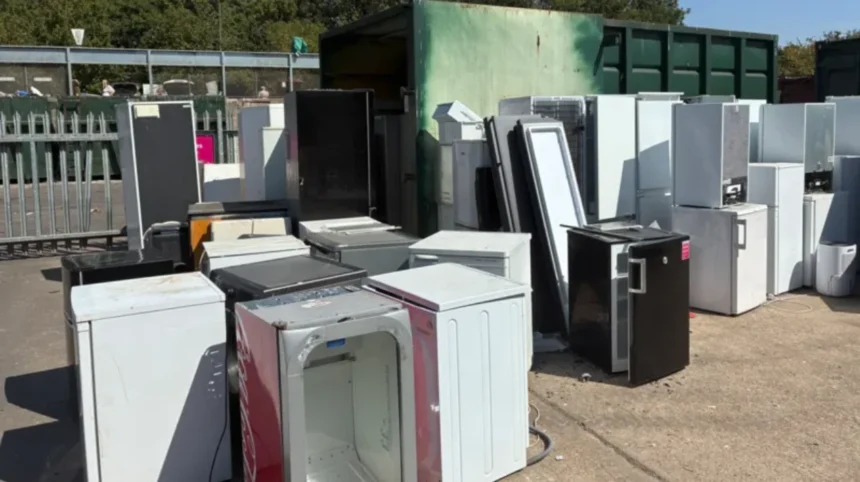
- Up to tens of thousands of fridge freezers imported from other countries are now being held up at UK ports due to the failure of a leading recycling plant in 2025.
- The closure of the biggest recycling plant in Newport, South Wales, led to the loss of around 30% of the nation’s total recycling capacity of fridges.
- Collection of bulky items for cooling devices by waste management companies and local authorities has been placed on hold or drastically limited.
- People living in different parts of various local authorities have been found storing their damaged fridges and freezers in their yards, garages, and homes for many months now.
- It has been stated by the Local Government Association (LGA) that the lack of proper facilities has become a major hindrance.
- Government approval for takeovers is urgently sought by industry players and local councils.
London (Cardiff Daily) September 20, 2026 – Tens of thousands of imported fridge freezers are currently marooned at British ports, triggering widespread household collection suspensions and severe recycling backlogs across the United Kingdom following the collapse of a major waste management enterprise last year.
Why Are Tens of Thousands of Fridge Freezers Stranded at British Docks?
The accumulation of cooling appliances at maritime entry points stems directly from the corporate collapse of a primary recycling firm in 2025, which left massive shipments of imported white goods in legal and logistical limbo. As reported by correspondents from the BBC, the sudden insolvency of the processing company halted operations at critical infrastructure sites, most notably a landmark facility located in Newport, South Wales.
According to data highlighted by the Local Government Association (LGA) and cited via the BBC, the closure of the Newport recycling plant effectively obliterated roughly 30% of the entire United Kingdom’s capacity to process and recycle household refrigerators and freezers safely. Because these appliances contain complex ozone-depleting substances and potent greenhouse gases—such as chlorofluorocarbons (CFCs) and hydrofluorocarbons (HFCs)—they cannot be disposed of in standard landfill sites and require specialized degassing and dismantling treatment.
With the primary processing pipeline severely constricted, thousands of imported units destined for commercial recycling networks have been left sitting indefinitely at port docks. The bottleneck has cascaded down through municipal waste chains, preventing commercial handlers from clearing container space and forcing international suppliers to pause onward transit.
Explore more Cardiff Council News
Cardiff Council Expands Specialist Education for Additional Learning Needs in Cardiff 2026
Cardiff Council Provides Free Bikes to Local Children in Cardiff 2026
How Has the Appliance Processing Crisis Impacted Local Household Collections?
The paralysis at the ports has directly crippled municipal waste services throughout England and Wales. Numerous local authorities have been forced to suspend or heavily ration their scheduled household bulky waste collections for refrigeration units, leaving ordinary citizens without a legal or practical means to dispose of broken-down appliances.
As documented in reports by the BBC, citizens up and down the country have resorted to storing obsolete or malfunctioning fridges and freezers in their back gardens, alleyways, and residential garages for months on end. Local government representatives have expressed grave concerns that prolonged domestic storage increases the risk of illegal fly-tipping, as frustrated homeowners seek alternative ways to clear space on their properties.
Waste management directors have noted that local councils are bound by strict environmental regulations regarding hazardous electrical waste (WEEE regulations). Without functioning processing centers to absorb collected units, council-run household waste recycling centres (HWRCs) have had to turn away residents or impose strict quotas on incoming cooling units.
What Are Authorities and Industry Experts Doing to Resolve the Bottleneck?
Pressure is mounting on central government departments and industry regulators to expedite administrative and financial procedures required to rescue collapsed recycling assets. Local government bodies are currently engaged in emergency talks to find temporary storage and alternative processing pathways for both the stranded dockside containers and the mounting domestic backlogs.
Industry analysts point out that reopening or successfully transferring ownership of the mothballed Newport facility is critical to restoring national recycling equilibrium. However, complex corporate restructuring, environmental permitting transfers, and safety compliance audits have slowed down the acquisition process, leaving the infrastructure offline for extended periods.
Environmental agencies have reminded the public that abandoning or improperly disposing of refrigeration units carries severe legal penalties due to the hazardous gases trapped within their cooling circuits. Meanwhile, local authorities continue to urge patience while national waste networks negotiate emergency capacity-sharing agreements to clear the port backlogs and resume regular council pick-up schedules.
Background of the Particular Development
The current crisis facing the United Kingdom’s fridge-recycling sector is the culmination of years of structural consolidation within the waste management and environmental services industry. Specialized recycling infrastructure requires high capital investment, rigorous environmental permitting, and advanced technological capabilities to safely capture and neutralize ozone-depleting blowing agents found in older insulation foams.
Over the past decade, the UK has increasingly relied on a small handful of mega-facilities to handle the vast majority of its hazardous electrical waste processing. When a key operator experiences financial distress or sudden insolvency—such as the 2025 collapse of the Newport recycling hub—the redundancy built into the national system proves inadequate. The sudden loss of 30% processing capacity exposed the vulnerability of relying on centralized recycling nodes without sufficient regional backups or distributed treatment plants, leaving both municipal authorities and international supply chains exposed to sudden shocks
This ongoing recycling and collection bottleneck is expected to exert significant financial and operational strain on local authorities and residents alike over the coming months. For householders and local council taxpayers, the continued suspension of bulky waste collections means that municipal services will likely face extended waiting lists and potential council tax pressures as local authorities are forced to fund emergency storage, clear illegal fly-tipping hotspots, and manage public health complaints regarding stored domestic waste.
Furthermore, if port congestion persists, importers and retailers may pass down higher logistics and storage overhead costs to consumers purchasing new cooling appliances. For local government waste teams, the crisis underscores an urgent need for decentralized infrastructure planning to ensure that future corporate insolvencies do not paralyze basic municipal sanitation and environmental compliance across British communities.