Key Points
- Cardiff Council has submitted planning applications for a temporary managed drop-off and collection area at Ysgol Gynradd Groes-Wen Primary School.
- The proposal includes eight short-term waiting spaces, low-level lighting bollards, pedestrian safety barriers, protective canopies and 2.4-metre-high weldmesh fencing.
- The planning portal has received 33 public comments, with 30 strongly opposing the development.
- Objectors have raised concerns about traffic congestion, pedestrian safety, noise pollution and the suitability of narrow residential roads for peak-hour traffic.
- Supporters say the scheme would offer a safer and more organised alternative to parking along main roads.
Cardiff (Cardiff Daily) August 28, 2026 – Cardiff Council is facing mounting opposition from local householders following the submission of planning proposals to construct a temporary school drop-off and collection zone serving Ysgol Gynradd Groes-Wen Primary School. Located at the foot of a nearby residential cluster, the proposed infrastructure aims to manage daily traffic associated with the school run. However, the application has triggered a sharp response on the local authority’s public planning portal, where community members have raised substantial concerns regarding road safety, environmental disturbance, and the capacity of existing residential infrastructure to absorb peak-time traffic.
What Do the Proposed Planning Measures Entail?
According to the official documentation submitted to the local authority, the scheme establishes a managed short-stay zone featuring eight parking bays intended specifically for parent pick-up and drop-off routines. To ensure child safety and site security, the development integrates multiple infrastructure elements, including low-level lighting bollards, protective pedestrian barriers designed to separate foot Traffic from vehicle carriageways, overhead weather canopies where children can gather prior to being escorted onto the school premises, and 2.4-metre-high weldmesh fencing enclosing the perimeter of the facility.
Why Are Local Residents Objecting to the Proposal?
Public sentiment on the local authority portal remains overwhelmingly critical, with 30 out of 33 recorded public submissions registering formal opposition. The primary objections centre upon the physical incompatibility of the neighborhood’s road layout with the anticipated volume of vehicular traffic.
One local objector highlighted the structural limitations of the area, writing:
“The estate was not designed to accommodate this level or type of traffic. It is a traffic-calmed environment, with narrow roads, parked vehicles, and pedestrian activity typical of a residential setting. Introducing a regular flow of school-related vehicles, particularly during peak morning and afternoon periods, will inevitably lead to congestion, queuing, and obstruction within the estate. This will negatively impact residents’ ability to access their homes safely and freely.”
Further representations focused on broader environmental and safety risks. A second resident stated:
“Having reviewed the application I submit that the proposal, if permitted, will put pedestrians at risk, cause traffic congestion, traffic noise and increase pollution caused by the traffic using the estate roads.”
A householder residing directly adjacent to the site expressed similar misgivings regarding the operational viability of the scheme:
“I strongly object against the temporary pick-up and drop-off arrangements at Ysgol Gynradd Groes-Wen Primary School. I live right opposite the school, I believe the current implementation is fundamentally flawed and poses significant risks to the community.”
The remaining 27 submissions opposing the project reflected identical themes, consistently identifying vehicular queuing, reduced road visibility, noise disruption, and heightened peril for local pedestrians as primary grounds for refusal.
What Arguments Have Been Raised in Support of the Scheme?
Despite the prevailing opposition, three public submissions were logged in favor of the infrastructure proposal. Supporters maintained that the dedicated area offers a structured solution to ongoing traffic difficulties along main transit routes.
One comment endorsing the development noted:
“The idea of this planning is reasonable, it diverts the road side parking to a safer location without posing much noise nuisance to the neighbours. The proposed parking location is closer to the school and more safe for the students and parents.”
A second supportive submission emphasized the organization of vehicle movements:
“The idea is good to direct the traffic in a systematic manner and keep parents and pupils safe. The waiting area is near the school and at an uncrowded place. Good choice!”
A third public comment advocated for a pragmatic resolution to current parking habits:
“I would say this planning is a good idea. Students and parents of the school will be safer. Parked cars will no longer be seen on the main road near the pylons. Just be more realistic, if you think the existing situation should be changed somehow. It is more desirable to move to the newly planned location.”
Background of the Development
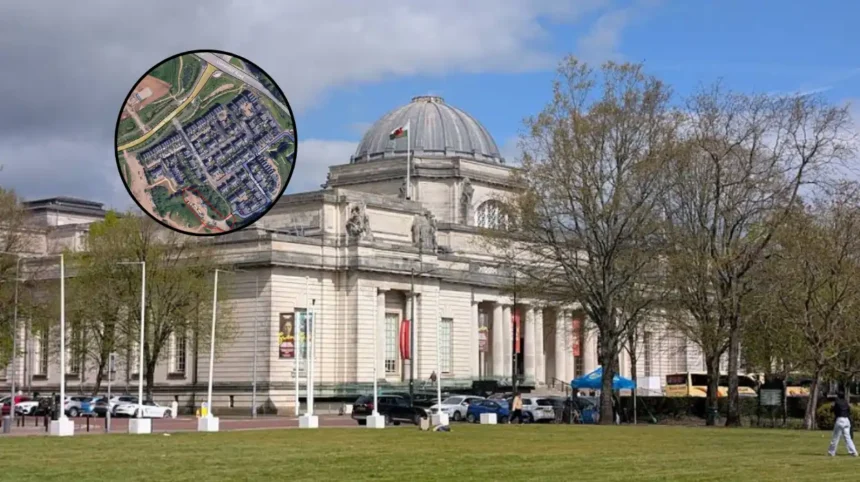
Ysgol Gynradd Groes-Wen Primary School forms a central educational component of the expansive Plasdwr garden village development located in north-west Cardiff. Built to accommodate the growing population within this major urban extension, the school serves as a bilingual dual-stream facility. As housing construction across the site has progressed, logistical challenges surrounding transport infrastructure, vehicle capacities, and safe access corridors for families have increasingly become points of dialogue between developers, the local authority, and newly established residential communities.
Explore More Local Cardiff News
Cardiff Cocktail Week Returns for 2026 Bank Holiday Weekend
Roadworks Diversion Causes 20 Vehicle Collisions at Repair Centre, Cardiff 2026
Prediction: How This Development May Affect the Local Community
The ultimate decision on this planning application holds clear implications for both residents and the school community:
- For Local Residents: Approval of the temporary drop-off zone could lead to concentrated periods of traffic congestion during morning drop-off and afternoon pick-up hours. Residents may experience temporary access restrictions to private driveways, elevated ambient noise, and increased localized air pollution from idling engines. Conversely, should the proposal be rejected without an alternative strategy, informal on-street parking on adjacent highways may persist, maintaining existing congestion patterns.
- For Parents and Pupils: Implementation of the dedicated zone would afford a designated, enclosed environment for children arriving at and departing from the school, reducing direct exposure to live main-road traffic. However, if space constraints within the eight-bay facility lead to vehicle queuing onto access roads, parents could encounter delays during peak travel windows.