

Key Points
- Confirmed Ebola infections in the Democratic Republic of the Congo have reached 12,021, with 5,904 deaths, according to government data reported on 26 November 2026.
- The outbreak was declared in Ituri province in mid-May and has spread to eight of the country’s 26 provinces.
- Fighting between the Congolese army and Convention for the Popular Revolution rebels has disrupted surveillance, treatment and access to affected communities.
- Responders, including World Health Organization personnel and Congolese health officials, have been evacuated from areas affected by crossfire.
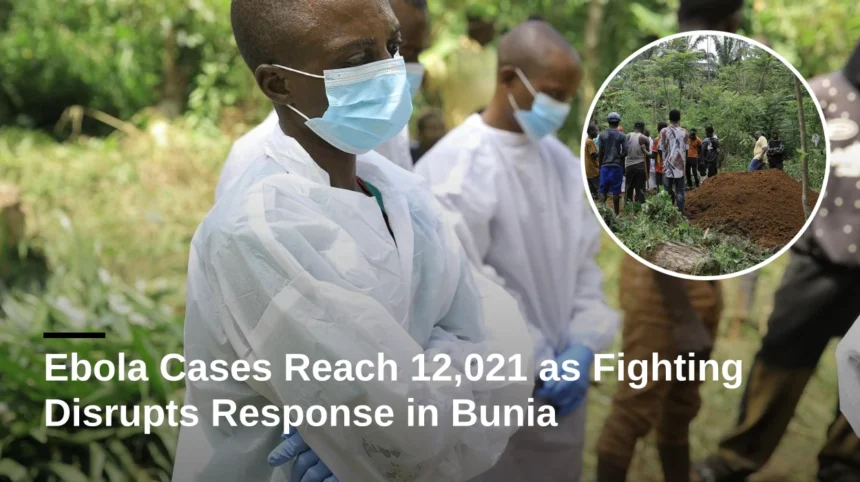
Bunia (Cardiff Daily) November 26, 2026 – The Ebola outbreak in the eastern Democratic Republic of the Congo has surpassed 12,000 confirmed cases, with 5,904 deaths recorded, as renewed fighting in Ituri province disrupts efforts to contain the disease. Government data cited by the Associated Press, Al Jazeera and other outlets put the total number of confirmed infections at 12,021. The outbreak, caused by the Bundibugyo species of Ebola virus, began in Ituri and has since reached eight provinces. Fighting has restricted access to communities, displaced civilians and forced some health workers to evacuate.
How has fighting affected the Ebola response?
As reported by the Associated Press, clashes between the Congolese army and Convention for the Popular Revolution fighters have prevented response teams from reaching some communities. The violence has also interrupted monitoring of people exposed to the virus and left some treatment centres with reduced staffing.
Fighting resumed in Iga-Barrière, a mining town about 15 miles north of Bunia, sending new waves of displaced people towards the provincial capital. Bunia is a major centre for the Ebola response in Ituri province.
Dr Catherine Smallwood, the World Health Organization’s Ebola incident manager, said about a dozen people, including two World Health Organization personnel and Congolese health officials, were evacuated to Bunia after being trapped for three days in a hospital in Akwe amid intense crossfire.
What is known about the outbreak’s scale and spread?
Government figures reported by Al Jazeera, Gulf Today and the Associated Press show 12,021 confirmed infections and 5,904 deaths. The figures make the outbreak the fastest-growing Ebola outbreak reported to date, according to the Associated Press.
The outbreak was declared in mid-May in Ituri province in north-eastern Congo. Gulf Today reported that the disease had spread to eight of the Democratic Republic of the Congo’s 26 provinces. The outbreak is being caused by the relatively rare Bundibugyo species of Ebola virus.
What could the development mean for communities affected by Ebola?
Continued insecurity could make it harder for health teams to identify contacts, provide treatment and maintain regular surveillance in affected communities. Displacement towards Bunia may increase pressure on health services and complicate efforts to separate people exposed to the virus from the wider population.
The immediate effect on communities will depend on whether responders can safely return to inaccessible areas and whether displaced people can receive testing, treatment and follow-up care. The confirmed death toll and the continuing disruption show that the outbreak remains a major public-health emergency for people in Ituri and other affected provinces.
Background: How did the outbreak develop?
The Democratic Republic of the Congo declared the outbreak in mid-May in Ituri province. It is caused by the Bundibugyo species, a rare form of Ebola virus. Government data later recorded more than 12,000 confirmed infections and 5,904 deaths. The outbreak has spread beyond Ituri to eight provinces, while conflict has repeatedly hindered access for response teams and displaced residents.
What could happen next in the Ebola response?
If fighting continues, response teams may face further evacuations, staffing shortages and delays in contact monitoring. More people moving from insecure areas to Bunia could increase demands on treatment and screening services. Restoring safe access for health workers and maintaining surveillance will be central to limiting further transmission, while the current figures indicate that communities affected by Ebola remain at serious risk.