Key Points
- Core Issue Addressed: Private automobiles are identified as the key cause of urban traffic and pollution, and not lorries, buses, or vans.
- Problem with Perception: Public transportation, especially the bus system, is negatively perceived as an unpleasant means of commute, be it work-related, leisurely, or business.
- Lack of Effectiveness of Alternative Prompting: The attempt to encourage drivers to walk or use bicycles has not produced any significant changes in modal behavior of passengers.
- Deficient Approaches to Road Infrastructure: According to historical data and transport research conducted since 1970s, attempts to widen roads or build bypass roads have a temporary effect, after which induced demand brings back the congestion at previous level.
- Policy Conditions for Success: Passenger increase will only become a sustainable factor when an effective network with decent prices, qualified staff, and increased network capacity emerges before any attempts to limit private automobile traffic or to remove the parking lots.
- Positive Exemplifications: The case of Lothian Buses in Edinburgh and the bus lane development in Dublin prior to tram introduction proves that modal shift is possible when customer satisfaction and integrated networks exist.
Cardiff (Cardiff Daily) September 26, 2026 – Urban transport experts have renewed calls for a comprehensive overhaul of public transport perceptions, arguing that tackling the deep-seated image problems of bus and coach services could significantly alleviate chronic road congestion. Writing for Nation.Cymru, Professor Stuart Cole CBE, Emeritus Professor of Transport Economics and Policy at the University of South Wales, detailed that private automobiles remain the absolute core cause of urban traffic delays, which subsequently handicap commercial delivery and service vehicles. The analysis stresses that shifting public sentiment and prioritizing sustainable infrastructure are vital prerequisites to curbing car dependency.
- Why do private cars remain the primary contributor to urban road congestion?
- Can road widening and bypasses permanently solve traffic bottlenecks?
- How can public transport networks successfully win over car users?
- What role does wider public sector strategy play in reducing car dependency?
- Background of the Particular Development
- How This Development Can Affect Public Transport Users and Commuters
Why do private cars remain the primary contributor to urban road congestion?
As reported by Professor Stuart Cole CBE in Nation.Cymru, “Road congestion isn’t caused by lorries, buses, white vans or couriers. What many drivers don’t appear to want to hear is the uncomfortable truth that cars cause most of the congestion and so delay vans and lorries which service the economy.”
The commentary highlights that motorists who frequently complain about traffic delays and compromised air quality are inadvertently the primary creators of the problem. Past attempts to counter this trend by encouraging drivers to switch directly to walking or cycling have yielded limited results, leaving public transport transformation as a crucial missing link.
Can road widening and bypasses permanently solve traffic bottlenecks?
According to Professor Stuart Cole CBE, historical transportation research dating back to the 1970s consistently shows that traditional capital expenditures on road widening and urban bypasses fail to provide permanent relief. Such investments frequently induce extra traffic because they temporarily create the illusion of efficient movement.
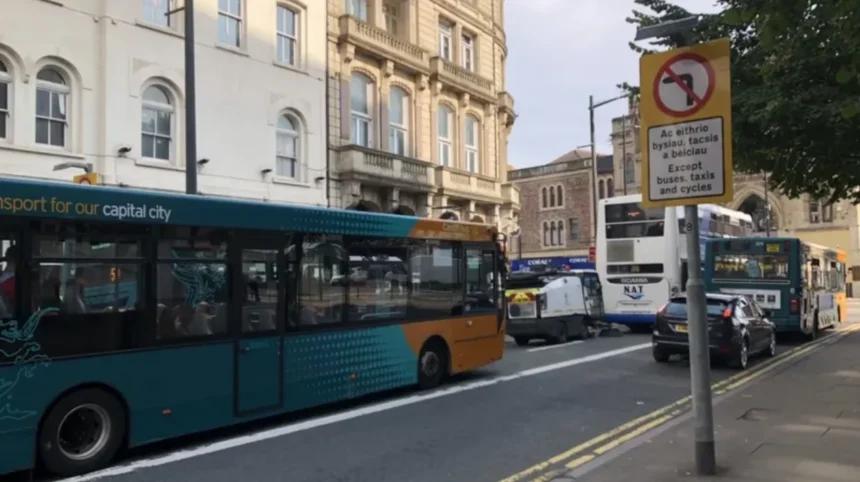
As noted in the analysis by Professor Stuart Cole CBE for Nation.Cymru, previous proposals—such as creating urban bypasses around Newport or allowing private vehicles to utilize bus lanes during peak rush hours—offer only short-term reprieves while exacerbating long-term congestion patterns. Furthermore, removing existing bus lanes to appease motorists is counterproductive, as dedicated lanes allow buses to bypass gridlock and maintain schedule reliability.
Explore more Local Cardiff News:
Cardiff Council School Drop-Off Zone Sparks Resident Backlash Cardiff 2026
Welsh Government Announces £20M Transport Investment for Cardiff 2029
How can public transport networks successfully win over car users?
To achieve a measurable modal shift away from private vehicle usage, public transport must first become a genuinely attractive, reliable alternative. Drawing parallels with Edinburgh’s municipally owned Lothian Buses, Professor Stuart Cole CBE cited the operator as one of the most successful public transport models in the United Kingdom due to its young, environmentally sustainable fleet.
Quoting Sarah Bond, Lothian Buses Chief Executive, Nation.Cymru reported:
“Sustained investment and a basic ethos of customer care have achieved a high-performing integrated network with passenger growth, a high level of customer satisfaction and operational performance.”
Furthermore, Professor Stuart Cole CBE emphasized that successful public transport systems depend on affordable or capped fares, absolute reliability, frequent scheduling, and friendly, helpful staff. Upgrades such as flat fares, integration into Transport for Wales (TfW) Pay-As-You-Go systems, increased double-decker fleet capacities to mitigate “bus full” incidents, and real-time electronic information boards at stops are vital components to eliminating boarding delays and reducing commuter frustration.
What role does wider public sector strategy play in reducing car dependency?
Achieving large-scale behavioral changes requires substantial public investment to precede any coercive measures like restricting parking spaces or banning vehicles from urban centres. Restoring frequency cuts in major urban hubs—such as expanding services between Swansea and Llanelli—and introducing out-of-town park-and-ride facilities are essential early steps. Without first delivering a comfortable, frequent, and reasonably priced service, coercive traffic management policies risk severe public backlash.
Background of the Particular Development
The discourse surrounding public transport image and urban congestion management arrives at a critical juncture for regional transport policy. Over recent years, transport authorities have sought ways to address net-zero carbon targets, prompting significant policy shifts, such as lower default speed limits and broader sustainable transport hierarchies. However, friction between top-down restrictions on private motorists and the practical limitations of existing regional bus networks has fueled ongoing public debate. Historically, solutions focused heavily on major roadway expansions—such as the long-debated M4 relief road projects—which faced repeated delays and cancellations due to environmental and financial constraints. Consequently, transport economists and policymakers have increasingly redirected focus toward demand management, bus priority measures, and enhancing the cultural appeal and reliability of public mass transit to naturally attract commuters out of their private vehicles.
How This Development Can Affect Public Transport Users and Commuters
If policymakers adopt the integrated, customer-centric strategies outlined in this development, regular public transport users can anticipate marked improvements in service reliability, reduced boarding times via smart ticketing, and greater vehicle capacity during peak hours. Commuters who rely on buses may experience faster journey times as expanding bus priority lanes insulate transit from private car gridlock. However, if regional authorities pursue restrictive measures—such as parking curbs or traffic filtering—without first delivering the necessary funding and frequency upgrades to bus networks, commuters face heightened travel friction and potential socioeconomic strain. Ultimately, aligning infrastructure investments with genuine service enhancements will determine whether everyday travelers willingly embrace a permanent transition away from private car dependency.