Key Points
- Welsh National Opera’s 2026/27 season was inaugurated in the Wales Millennium Centre with two twentieth-century opera productions including Béla Bartók’s Bluebeard’s Castle and Igor Stravinsky’s Oedipus Rex.
- Joe Hill-Gibbins directs both productions, which feature sets designed by Milla Clarke and Rosanna Vize with lighting design by Jack Knowles and Ian Jackson-French.
- Bluebeard’s Castle is based on an ENO production performed previously in 2024, whereas Oedipus Rex is an entirely new companion piece.
- LJ Parkinson appears in both productions playing a speaking role.
- The musical side of WNO is conducted by Lidiya Yankovskaya.
- Principal opera parts are played by Christine Rice (Judith/Jocasta), Nathan Berg (Bluebeard/Tiresias), and Peter Hoare (Oedipus).
Cardiff (Cardiff Daily) September 22, 2026 – The Welsh National Opera has opened its autumn season with a dark, psychological double bill pairing Béla Bartók’s Bluebeard’s Castle and Igor Stravinsky’s Oedipus Rex at the Wales Millennium Centre. Directed by Joe Hill-Gibbins, the pairing unifies two monumental 20th-century scores through stark minimalism, central table staging, and gripping vocal performances, though critics noted distinct stylistic contrasts between the transfer production and the new staging.
H1: How Did Welsh National Opera’s Double Bill of Bluebeard’s Castle and Oedipus Rex Unfold in Cardiff?
As reported by George Hall of The Stage, the Welsh National Opera launched its 2026/27 season in high style with a double bill of 20th-century one-act classics: Béla Bartók’s Bluebeard’s Castle (premiered in 1918) and Stravinsky’s Oedipus Rex (1927), both presented in productions by director Joe Hill-Gibbins.
Writing for The Guardian, critic Rian Evans observed that Welsh National Opera might be marking its 80th year, but any feelgood factor was decidedly absent from their season-opener, noting that serial murders, patricide, incest, and floods of blood made for a challenging yet powerful experience.
The evening commenced unconventionally. As detailed by The Stage reviewer George Hall, proceedings began with the offstage female voices of the WNO Chorus singing two pieces of plainchant—specifically the antiphon O Rubor Sanguinis and the responsory Rex Noster Promptus Est—by medieval abbess and composer Hildegard of Bingen. Following this, the curtain rose on Bartók’s spoken prologue.
What Happened in Joe Hill-Gibbins’s Staging of Bluebeard’s Castle?
According to The Stage review by George Hall, Bluebeard’s Castle started life at the English National Opera in 2024, where it earned an Olivier nomination. In this iteration, the traditional physical doors of the castle are replaced by metaphorical symbolism.
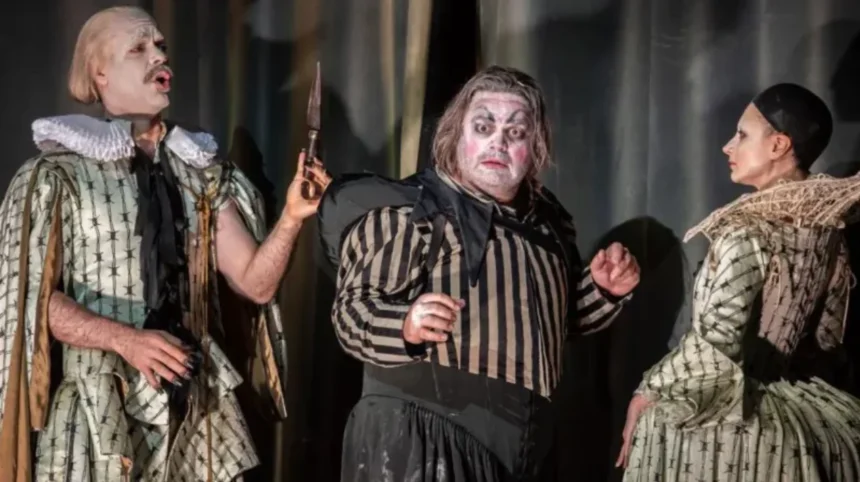
As outlined by The Arts Desk reviewer, the production features a brightly lit, white-painted table running the full width of the stage, designed by Milla Clarke with lighting by Jack Knowles. Actor LJ Parkinson—performing with what The Arts Desk described as “a certain high camp aggression”—delivered the spoken prologue and acted as a subterranean Jeeves-like figure who spilled or tipped the symbolic contents of each cupboard door as it opened.
Rian Evans of The Guardian noted that Parkinson served as the shamanic regös (narrator) of Hungarian tradition, offering signature contents of the hidden rooms, such as red wine bleeding out of the torture chamber, a clatter of knives from the armoury, and gold tinsel from the treasury.
The vocal performances received widespread acclaim. As noted by The Stage, the two singing roles were “superbly delivered”. George Hall highlighted that Christine Rice’s Judith was consistently beautiful in tone and richly inflected with expressive colourings, while Nathan Berg’s Bluebeard was complex—portrayed as furtive, would-be commanding, yet ultimately vulnerable. The Arts Desk further observed that Rice sang Judith with great warmth, intensity, and physical movement across the long table.
At the conclusion of the opera, as the seventh door opened, the entire female chorus appeared as Bluebeard’s former wives in their wedding dresses. The Guardian pointed out a unique directorial departure: unlike traditional stagings, Christine Rice’s Judith was not permitted to join them in the darkness, but was instead consigned to live an eternal hell with Bluebeard.
Explore more Local Cardiff News
Cardiff Logistics Expert Aris Syntetos Wins Top OR Honor Cardiff 2026
Cardiff Yellow Box Junction Fines Hit Motorists Hard in Cardiff 2026
How Did Stravinsky’s Oedipus Rex Contrast as a Companion Piece?
Following an interval, the evening transitioned to Stravinsky and Jean Cocteau’s Oedipus Rex. As noted by The Stage, the work—termed an “opera-oratorio” by its composer—shared visual elements and three cast members with the preceding Bartók piece.
However, reviewers observed a stark contrast in execution. While The Arts Desk noted that Stravinsky and Cocteau conceived the piece as a series of cinematic freeze-frames with immobile choruses and masked characters, Hill-Gibbins’s new staging was described as exceptionally active. Rian Evans of The Guardian reported that the production utilized a formidable 35-strong male chorus embodying the desperate citizens of plague-ridden Thebes, set against a stark black backdrop punctuated by a massive half-globe of dazzling light.
Critical reception to the staging’s physical movement was mixed. The Arts Desk suggested that the high volume of movement occasionally made it difficult to isolate solo characters, writing that performers like Peter Hoare were somewhat inhibited by the production style. Conversely, The Guardian praised the monumental scale, noting that Peter Hoare delivered in “total vocal command” as the tragic king, charting the gradual disintegration of his composure upon realizing he had killed his father and married his mother.
Christine Rice transitioned smoothly to the role of the glamorous yet tragic Jocasta, supported by Stephen Richardson as Creon and the Messenger, and Nathan Berg as Tiresias. LJ Parkinson returned as the narrator, though The Guardian noted that some of their spoken text was slightly under-projected against the orchestral weight. Throughout both operas, conductor Lidiya Yankovskaya earned praise from critics across publications for her decisive musical leadership and command of the WNO orchestra.
Background of the Particular Development
The staging of this double bill reflects a broader strategic shift within the Welsh National Opera. Following recent leadership transitions involving general director Sarah Crabtree and artistic director Adele Thomas, the company has actively pursued initiatives to modernize its profile, attract younger demographics, and incorporate more daring, contemporary staging concepts into its repertoire. Incorporating Bluebeard’s Castle—which originated as a critically praised production at the English National Opera in 2024 under Joe Hill-Gibbins—allows WNO to bring high-profile, Olivier-nominated modern opera staging to Welsh audiences while sharing production overheads through strategic inter-company collaboration.
This programming choice is expected to polarize traditional opera-goers while successfully drawing in contemporary theatre enthusiasts who favor sleek, minimalist conceptual designs over traditionalist staging. For the core audience of classical opera patrons, the heavy reliance on conceptual metaphors—such as the unifying long table and non-traditional character placements—may challenge conventional expectations of 20th-century masterworks. However, for younger demographics and modern theatre-goers targeted by WNO’s recent accessibility campaigns, the visceral psychological intensity, cinematic pacing, and unified thematic exploration of fate and hidden guilt are likely to strengthen the company’s appeal as a forward-thinking, culturally daring institution on tour across the UK.