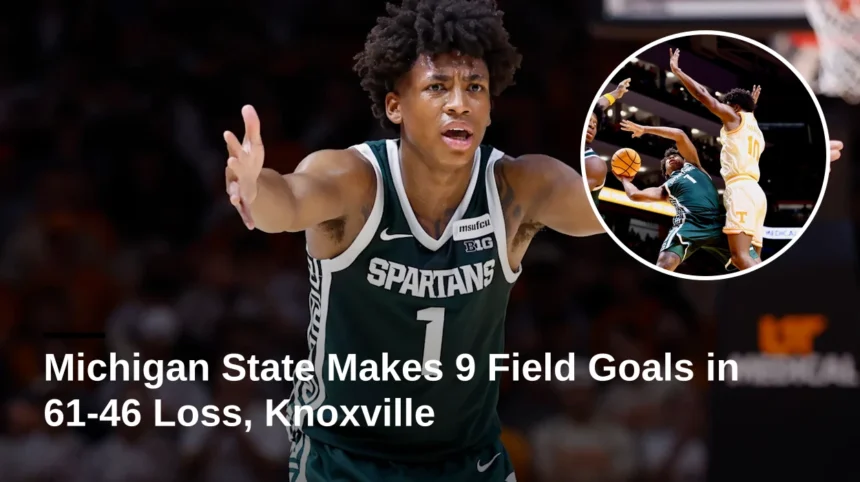
Key Points
- No. 2 Michigan State lost 61-46 to No. 14 Tennessee in Knoxville.
- The Spartans made nine of 50 field-goal attempts, shooting 18 per cent.
- It was Michigan State’s fewest field goals during Tom Izzo’s 32-year tenure and the first time since 1949 that an Associated Press Top 20 team made fewer than 10 field goals in a game.
- Michigan State led early but endured a near 10-minute stretch without a field goal.
- Jeremy Fears Jr. scored 16 points, all from the free-throw line.
Knoxville (Cardiff Daily) November 18, 2026 – No. 2 Michigan State suffered a historic offensive collapse in a 61-46 defeat by No. 14 Tennessee at Food City Center on Tuesday. The Spartans converted only nine of 50 field-goal attempts, including four of 19 three-point attempts, as Tennessee turned an early deficit into its first win over Michigan State since 1971. Michigan State’s poor shooting overshadowed a strong free-throw performance, with the Spartans making 24 of 30 attempts.
How did Tennessee defeat Michigan State?
As reported by The New York Times’ The Athletic, Michigan State’s nine made field goals were the fewest in Tom Izzo’s 32-year tenure. The Associated Press, in a report published by Newsday, said the 9-for-50 performance was the first time since 1949 that an Associated Press Top 20 team failed to reach 10 made field goals in a game.
Michigan State opened with a 9-2 lead and held Tennessee to nine points during the first 10 minutes, according to WATE. The Volunteers then improved offensively, while Michigan State’s shooting deteriorated.
According to The State News, Michigan State went without a field goal from the 5:02 mark of the first half until 15:03 remained in the second half. Knox News reported that the Spartans missed 13 consecutive shots during a drought lasting nearly 10 minutes.
Tennessee used a 25-4 run between Michigan State baskets to take control, according to Knox News. Miles Rubin led the Volunteers with 14 points, eight rebounds and three blocks, according to Field Level Media. Tennessee also received 12 points from Ward, who made four of the Volunteers’ field goals.
What were the key individual performances?
WATE reported that Jeremy Fears Jr. led all scorers with 16 points but went 0-for-3 from the field, scoring all of his points at the free-throw line. Michigan State moved within six points at 47-41 with 5:17 remaining after Fears made two free throws, but Tennessee responded to preserve the victory.
The Michigan State athletics report confirmed that the Spartans led for most of the first half before their shooting problems persisted throughout the contest. Tennessee’s win extended its home winning streak against non-conference opponents to 48 games, according to Field Level Media.
What is the background to Michigan State’s loss?
Michigan State entered the game after beating Duke and setting a school record for three-pointers four days earlier, according to Knox News. The Spartans were listed as the No. 2 team in reports from The Associated Press, The Athletic and Michigan State athletics, while some coverage from Knox News referred to Michigan State as No. 3.
The defeat was Michigan State’s first of the season, with Knox News listing the Spartans at 4-1 afterwards. The loss followed an offensive display that contrasted sharply with the team’s recent three-point performance.
Tom Izzo described the result as an “all-time low”, according to USA Today. The State News also reported Izzo’s comment that Tennessee had recently set a record for making 18 three-pointers, highlighting the sharp contrast between the teams’ performances.
Tennessee’s defence held Michigan State to 18 per cent shooting and prevented the Spartans from establishing consistent scoring opportunities. The result marked Tennessee’s first victory over Michigan State since 1971, according to WATE.
What could the result mean for Michigan State’s next score?
Michigan State’s 61-46 defeat suggests that its next score could depend heavily on whether the Spartans restore their normal field-goal efficiency. The team’s nine made baskets against Tennessee created an unusually low offensive baseline, while the 24-for-30 free-throw performance indicates that scoring opportunities remained available at the foul line.
If Michigan State reduces extended shooting droughts and receives more production from its perimeter players, its total should move closer to its usual level. If opponents continue to force contested shots and limit Jeremy Fears Jr. and the other starters from scoring in open play, another lower-scoring game remains possible. The Tennessee result alone does not establish the final score of Michigan State’s next game.