Key Points
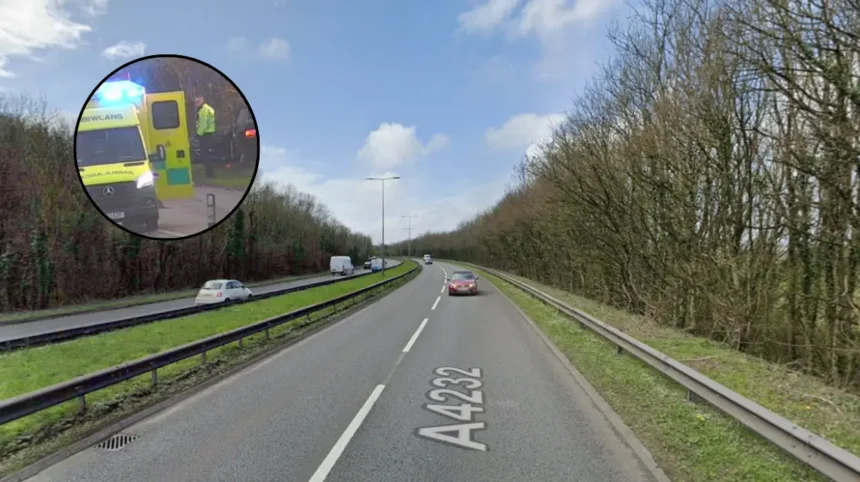
- A major collision on the A4232 Grangetown Link in Cardiff has blocked the eastbound carriageway near Culverhouse Cross.
- Inrix said the incident happened near the A48 Cowbridge Road junction.
- Mandatory diversions have been put in place for drivers heading into central Cardiff.
- AA traffic planners reported delays rising to around 15 minutes of stationary waiting time shortly after the crash.
- Congestion has spread back towards the M4 junction and the Leckwith Interchange.
- Emergency services have secured the scene, but the road remains heavily disrupted while recovery work continues.
- The incident has created wider pressure on Cardiff’s road network and secondary routes.
Cardiff (Cardiff Daily) July 28, 2026 — a major collision on the A4232 eastbound at Culverhouse Cross has shut a key traffic corridor in Cardiff, causing severe delays, mandatory diversions, and gridlock across the city’s western approaches. The incident, reported by traffic monitoring service Inrix and reflected in live traffic updates, has affected one of the capital’s most important arterial routes and disrupted the morning commute for thousands of motorists.
What happened at Culverhouse Cross?
The crash took place on the eastbound carriageway of the A4232 Grangetown Link near the A48 Cowbridge Road intersection at Culverhouse Cross, a location known for heavy daily traffic.
According to the information reported in the live traffic feed, the collision blocked the route and forced authorities to divert vehicles away from the main carriageway.
The eastbound side was described as fully blocked, with traffic held up during the morning peak period when the road is usually carrying a high volume of commuters.
Inrix said the diversion involved drivers going “up to the roundabout and straight back on again,” which indicates that the normal flow through the junction was interrupted and redirected through local roads.
How severe is the disruption?
The disruption quickly escalated beyond a single incident on the road. AA traffic planners reported delays of around 15 minutes of stationary waiting time within the first hour, showing how fast the congestion built once the eastbound carriageway was closed.
Traffic was also reported as backing up between the M4 junction and the Leckwith Interchange, meaning the effects of the collision stretched far beyond the immediate crash scene.
That kind of knock-on congestion is common when one of the city’s main strategic routes is taken out of service during rush hour, because traffic is forced onto roads that are not designed to absorb that level of demand at short notice.
Why does the A4232 matter?
The A4232 Grangetown Link is one of Cardiff’s key transport corridors, connecting the M4 to central Cardiff, Cardiff Bay, and surrounding commercial areas.
When that route is blocked, the impact is not limited to motorists caught directly in the queue; it can also affect buses, deliveries, service vehicles, and commuters trying to reach workplaces on time.
Traffic guidance in news writing places emphasis on the lead facts first, because readers need the crucial details immediately: what happened, where it happened, when it happened, and what the consequences are. In this case, those core facts are that a major collision has blocked an important eastbound route at Culverhouse Cross and created widespread delay.
Which routes and areas are affected?
The most immediate impact has been on eastbound traffic on the A4232, with delays building near the roundabout at Culverhouse Cross and spreading back along the route.
The congestion has also affected traffic heading towards the Leckwith Interchange and the M4 connection, both of which are important for movement into and out of the city.
The diversion has pushed vehicles onto secondary roads around the junction, which can create a second layer of congestion even after the main scene is secured.
That is because a major roundabout has only limited capacity, and once it is forced to handle overflow traffic from a closed dual carriageway, delays often ripple outward into nearby streets.
What have responders and traffic services said?
The traffic information released through Inrix confirmed the location and the diversion arrangement, giving drivers a practical route away from the blocked section.
AA traffic planners then reported that delays increased rapidly as queues formed, showing that the disruption was not brief or isolated but had already become a wider network issue.
The report also says emergency services secured the scene soon after the collision, but the wreckage covered multiple lanes, making immediate clearance impossible.
That means the situation was not just about traffic control, but also about the time needed for recovery crews to remove vehicles and make the road safe again.
What does this mean for Cardiff drivers?
For drivers, the immediate effect is slower journeys, missed connections, and long queues on a route that many people use as a main entry point into the city.
It also increases pressure on local roads nearby, because diverted traffic often concentrates at junctions that are not built for sustained heavy flow.
The wider lesson from the incident is that a single collision at a major junction can interrupt movement across a much larger part of the city.
Newswriting guidance recommends using short, clear sentences and the inverted pyramid style so readers can understand the most important facts quickly, which is especially useful for traffic incidents where conditions can change fast.
Explore More Local cardiff News
Cardiff Park Advisors Buys More AMD Shares in Cardiff 2026
Cardiff University plans 665-bed student scheme in Gabalfa 2026
How should the story be understood?
As reported in the traffic updates cited above, the key issue is not only the collision itself but the role of the A4232 in Cardiff’s transport system.
Because the road functions as a major connector between the motorway network and the city, a closure in one section can affect commuter flow, logistics, and access to central districts within minutes.
The most important verified facts are limited to the location, the blockage of the eastbound carriageway, the diversion instructions, and the scale of the delay.
Anything beyond that would be speculation, so the story should remain focused on the reported traffic impact and the ongoing recovery response.
Background of the Development
The A4232 is a strategic route in Cardiff that helps move traffic between the M4 and the city’s southern and western areas, including Cardiff Bay and the Leckwith corridor. Because of that role, incidents at Culverhouse Cross often have a disproportionate effect on the wider road network, especially during the morning commute.
Live traffic services such as Inrix are commonly used to track these disruptions in real time, while organisations like the AA monitor the growing impact on journey times.
In reporting traffic incidents, journalists usually start with the most significant fact, then build in route details, delay estimates, and road-user implications beneath the lead.
Prediction
If the closure continues for long, commuters, delivery drivers, and public transport users are likely to face extended delays across Cardiff’s western side, especially around the M4 approaches and Leckwith Interchange.
Local businesses that depend on punctual vehicle access may also experience knock-on disruption, particularly where time-sensitive deliveries or staff travel are involved.
Once the road is cleared, traffic should gradually ease, but the immediate recovery period may still leave residual congestion on nearby junctions and roundabouts.
For regular users of the route, the most likely short-term effect is slower journey times and a need to seek alternative paths until the incident scene is fully reopened.