Key Points
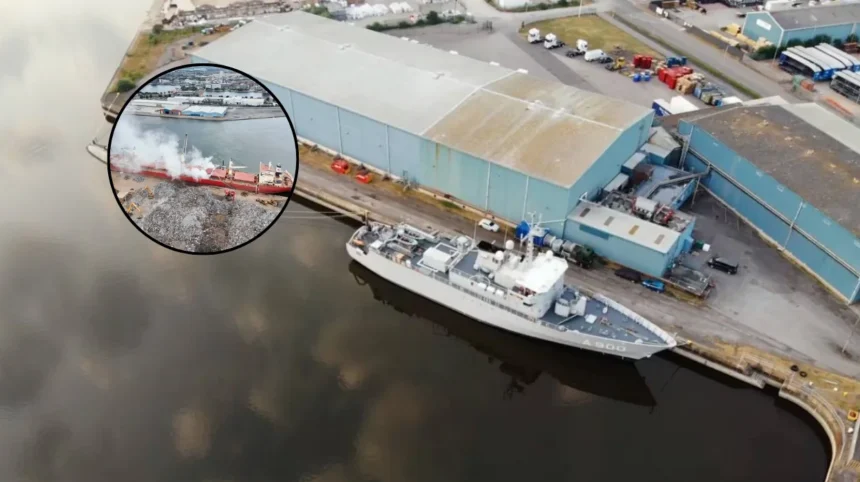
- Incident Location: A major fire broke out on board a vessel docked at Queen Alexandra Docks in Cardiff.
- Vessel Details: The vessel involved has been identified as the Federal Welland, carrying approximately 20,000 tonnes of scrap metal in its hold.
- Crew Safety: All members of the ship’s crew have been fully accounted for and confirmed safe.
- Emergency Response: South Wales Fire and Rescue Service (SWFRS) deployed extensive emergency resources, including water appliances, rescue tenders, an aerial hydraulic platform, a boat, a firefighting tug, and an operational drone.
- Port Support: Associated British Ports (ABP), the owners and operators of the Port of Cardiff, confirmed ongoing close coordination with emergency services.
- Public Health & Safety Directives: Public Health Wales (PHW) advised residents in affected areas—including Cardiff Bay, Cardiff city centre, and Penarth—to keep windows and doors closed due to heavy smoke and smog.
- Drone Warning: SWFRS issued a strict request asking the public to refrain from flying unauthorized drones over the area to prevent interference with operational safety.
Cardiff (Cardiff Daily) August 25, 2026 – Firefighters are tackling a major blaze on board a bulk cargo vessel docked at Queen Alexandra Docks in Cardiff, which has sent large plumes of smoke drifting across the Welsh capital and neighboring communities.
As reported by Robert Dalling of Wales Online, South Wales Fire and Rescue Service (SWFRS) responded to reports of a fire originating within the hold of the cargo vessel Federal Welland, which is carrying approximately 20,000 tonnes of scrap metal. emergency services quickly dispatched a comprehensive fleet of specialist resources to manage the incident, including multiple fire appliances, rescue tenders, an aerial hydraulic platform, an operational vessel, a firefighting tug, and a drone for aerial reconnaissance.
Confirmation was provided by emergency responders that all members of the ship’s crew were safely evacuated and accounted for, with no injuries reported on board. SWFRS verified that whilst there is no immediate direct danger to the general public, active firefighting tactics could result in the ongoing and intermittent release of heavy smoke across nearby districts.
What details have emergency services and site operators released regarding the vessel fire?
Operational agencies quickly initiated containment protocols to tackle the burning material inside the cargo ship’s hold.
As reported by Maggie John of the South Wales Argus, a spokesperson for the South Wales Fire and Rescue Service stated:
“South Wales Fire and Rescue Service is currently dealing with a fire on board the vessel ‘Federal Welland’ at Cardiff Docks. Crews, appliances and specialist resources, including rescue tenders, an aerial hydraulic platform, a boat and a drone, are currently in attendance at the incident involving a large vessel carrying approximately 20,000 tonnes of scrap metal.”
The fire service confirmed that the operational strategy relies on multi-agency coordination to suppress the deep-seated fire within the densely packed metal scrap.
As reported by Western Telegraph, an official statement from Associated British Ports (ABP), the owners and operators of the Port of Cardiff, detailed the port authority’s role in the multi-agency containment effort. An ABP spokesperson stated:
“Associated British Ports, the owners and operators of the Port of Cardiff, is continuing to support the emergency response to a fire involving scrap metal in the hold of the vessel at the port. We are working closely with South Wales Fire and Rescue Service and other partner agencies as they manage the incident. We encourage people to follow the advice of the emergency services and avoid the area while operations remain ongoing.”
Emergency teams have also addressed potential hazards caused by third-party interference during ongoing operations. SWFRS issued an explicit directive instructing members of the public not to fly civilian drones anywhere near the incident space, explaining that unauthorized remote-controlled aircraft pose a significant risk to aerial operations and the safety of first responders operating on site.
How are public health authorities responding to the smoke and smog across Cardiff?
The environmental impact of burning scrap metal became evident as plumes of smoke and smog spread beyond the perimeter of the port estate.
As reported by Robert Dalling of Wales Online, the containment operations are generating significant volumes of smoke capable of reaching residential and commercial zones, including Cardiff Bay, Cardiff city centre, and Penarth. Public Health Wales (PHW) subsequently issued health guidance aimed at reducing exposure for residents and workers situated downwind of the blaze.
Public Health Wales advised individuals living or working in the affected areas to keep all windows and doors securely closed while smoke remains present. The agency noted that once visible smoke clears, properties should be ventilated by opening doors and windows to improve air quality and cool interior spaces. PHW further instructed anyone feeling unwell or suffering from respiratory aggravation to contact NHS 111 or their GP, urging members of the public to contact emergency services on 999 only in cases of severe medical distress.
Reports from local residents noted an intense smell of burning materials hanging in the air across various parts of the city as atmospheric conditions carried the emissions inland. Emergency services reaffirmed that despite the heavy visual presence of smog, there is no immediate physical threat to public safety outside of the advised precautionary health measures.
Background of Scrap Metal Fires in Maritime Logistics
Bulk scrap metal transport carries inherent operational risks related to thermal runaway and localized combustion within cargo holds. Deep-seated fires in scrap metal vessel loads frequently originate from hidden contaminants within the bulk cargo, such as residual oils, discarded lithium-ion batteries, shredded rubber, or organic debris trapped deep within the dense piles of metal pieces.
When scrap metal is packed into enclosed cargo holds in quantities as large as 20,000 tonnes, oxygen trapped between the fragments can sustain smouldering combustion for extended periods before visible flame or heavy smoke breaks through the surface. Firefighting tactics in bulk maritime incidents present unique logistical challenges. Standard water application must be carefully calculated, as injecting massive volumes of water into a ship’s hold can compromise the vessel’s stability and buoyancy—a risk known in naval architecture as the “free surface effect.”
Consequently, port authorities and fire departments typically combine specialist marine firefighting tugs, temperature monitoring, and controlled ventilation management to cool the hull and extinguish cargo fires without endangering the structural integrity of the ship or the surrounding port infrastructure.
Impact Assessment and Prediction for Local Stakeholders
The incident at Queen Alexandra Docks is expected to create short-term operational and environmental disruptions for several distinct groups across the region:
- Port Logistics and Maritime Freight Operators: Operational access to specific berths inside the Port of Cardiff may experience temporary delays or re-routing while emergency crews remain on scene. The clearing and safety inspection of the Federal Welland will require extensive post-incident assessments before cargo handling can resume, potentially creating a backlog for scheduled vessel movements within Queen Alexandra Docks.
- Local Residents and Commercial Businesses: Residents in Cardiff Bay, Penarth, and Cardiff city centre face ongoing air quality considerations until the fire is completely extinguished and smoke disperses. Businesses operating indoor public venues or outdoor hospitality spaces downwind may experience short-term reductions in footfall due to precautionary recommendations regarding closed windows and reduced outdoor activity.
- Emergency Services and Municipal Planning: The prolonged deployment of specialist appliances, including marine units and aerial hydraulic platforms, will require resource rotation across South Wales Fire and Rescue Service to maintain standard emergency coverage across surrounding districts while suppressing the vessel fire.