Cardiff’s historic public houses form an important part of the city’s architectural, social and industrial heritage. Pubs developed alongside Cardiff’s growth from a medieval market town into a major Victorian port and later the capital city of Wales. Their buildings preserve evidence of changing communities, brewing businesses, working-class life, migration, entertainment and urban redevelopment.
- What makes Cardiff’s public houses historically important?
- How did Cardiff’s pub culture develop during the industrial period?
- Which Cardiff public houses have the strongest surviving historic architecture?
- What is the history of the Golden Cross in Cardiff?
- How did Cardiff’s historic pubs reflect LGBTQ+ history?
- Why is The Vulcan Hotel important to Cardiff’s pub history?
- How did Cardiff’s docklands shape historic public houses?
- Which Cardiff areas are best for exploring historic public houses?
- How are Cardiff’s historic public houses protected?
- What can visitors learn from Cardiff’s historic public houses?
Historic public houses are particularly visible around Cardiff city centre, St Mary Street, High Street, Westgate Street, Bute Street, Butetown and the former docklands. Some retain original tiled façades, decorative glass, timber bars and historic interiors. Others survive mainly through their listed architectural fabric or historical records.
Cardiff Council identifies around 1,000 listed buildings across the city, while Cardiff has 27 designated conservation areas protecting areas with special architectural or historic interest. Public houses form part of this wider historic environment.
What makes Cardiff’s public houses historically important?
Cardiff’s historic public houses are important because they preserve architectural fabric and record social, industrial and commercial change. Buildings such as the Golden Cross, King’s Cross and Blue Anchor connect Cardiff’s Victorian growth with later community, entertainment and LGBTQ+ history.
A historic public house is more than an old drinking establishment. Its importance can come from the building itself, its interior, its former occupants, its relationship with surrounding streets or its role in significant community events.
The Victorian expansion of Cardiff created a strong demand for pubs. Population growth, industrial employment, railway development and the expansion of Cardiff Docks increased movement through the city. Public houses developed close to commercial streets, residential districts, workplaces, markets and transport routes.
The architectural evidence remains especially valuable. Historic pub buildings often contain features designed specifically for licensed trade. These include tiled entrances, etched or engraved glass, timber partitions, decorative bars, serving hatches, fireplaces and separate drinking areas.
The Golden Cross provides one of Cardiff’s strongest surviving examples. The present building dates from around 1903–04 and contains extensive green-and-gold tiling, decorative glass, a historic saloon bar and murals depicting Cardiff Castle and Cardiff Town Hall.
The significance of these buildings also extends beyond architecture. The King’s Cross and Blue Anchor became important locations in Cardiff’s LGBTQ+ history during the 1970s. Cadw records the King’s Cross as Cardiff’s first official gay bar from 1972 and identifies the Blue Anchor as the location of Cardiff Gay Liberation Front meetings in 1971.
How did Cardiff’s pub culture develop during the industrial period?
Cardiff’s industrial expansion transformed its public-house network during the nineteenth century. Dock workers, railway employees, merchants, migrants and growing residential communities created demand for licensed premises near workplaces, markets, transport routes and densely populated neighbourhoods.
Cardiff’s transformation accelerated during the nineteenth century as coal exports expanded through the docks. The port became a major centre for the movement of coal from South Wales valleys to domestic and international markets.
This industrial economy changed the physical structure of the city. New streets, warehouses, commercial premises, workers’ housing and transport infrastructure appeared around the expanding port.
Public houses became closely associated with this urban growth. The historic record of The Vulcan Hotel demonstrates this relationship particularly clearly. The pub was first registered as an ale house in 1853 at 10 Adam Street in Newtown, an area later associated with Adamsdown. It served a predominantly Irish community connected with the development of Cardiff Docks.
The Vulcan was not an isolated establishment. Museum Wales records that several public houses stood along Adam Street, including the Wheat Sheaf and Forester’s Arms. A First World War heritage trail records nine pubs in the small Newtown community.
This concentration illustrates the relationship between population density and licensed premises. Newtown developed alongside Cardiff’s industrial economy and contained a significant Irish population. Many residents worked in or around the docks.
The pub therefore functioned as a commercial premises and a local social institution. Its importance extended to accommodation, employment, news, social meetings and neighbourhood relationships.
The history of Cardiff’s public houses also reflects migration. Industrial Cardiff attracted workers from Wales, Ireland and other parts of Britain. The presence of Irish communities around Newtown and the docks influenced the social character of districts where pubs operated.
Which Cardiff public houses have the strongest surviving historic architecture?
The Golden Cross has one of Cardiff’s strongest surviving historic pub interiors, while the Blue Anchor and King’s Cross retain important Victorian architectural associations. The Queens Vaults on Westgate Street is another Grade II listed public-house building with distinctive late-Victorian decoration.
Cardiff’s surviving historic pubs display several architectural periods and styles. Victorian and Edwardian buildings are particularly prominent because Cardiff experienced rapid urban development during the nineteenth and early twentieth centuries.
The Golden Cross is one of the most significant examples. Its current structure probably dates from 1903–04, although the site had a public house from the mid-nineteenth century. The earlier establishment was the Shield and Newcastle Tavern, constructed in 1849. It became the Castle Inn and then the Golden Cross in 1863.
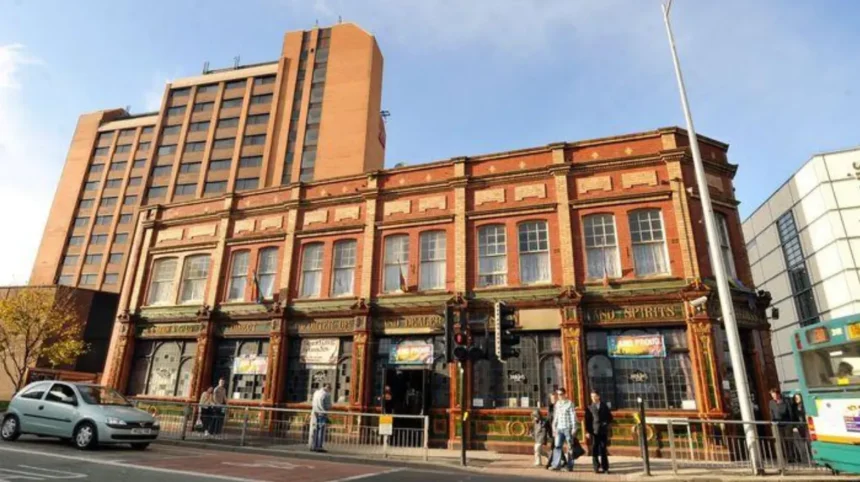
The building is Grade II listed. Its exterior contains red and yellow brickwork, green-and-gold tiles, decorative lettering and stained glass. Its interior contains a richly decorated saloon bar, tiled walls, engraved glass doors and murals.
The Blue Anchor is another important historic building. Located at 62 St Mary Street, it occupies a Dutch Renaissance-style hotel building. Cadw identifies it as a Grade II listed building and records its role in Cardiff’s LGBTQ+ history.
The King’s Cross at 25 Caroline Street is a Victorian pub building dating from 1874. Cadw listed it in 1999 because of its historic and architectural interest. Its later role as Cardiff’s first official gay bar added an important layer of social history.
The Queens Vaults, formerly known as the Flyhalf and Firkin, represents another category of historic Cardiff public house. The Grade II listed building on Westgate Street dates from the late nineteenth century and features red brick with polychromatic tile decoration on the ground-floor façade.
These buildings demonstrate how pub architecture formed part of Cardiff’s wider Victorian streetscape. Their façades were commercial signs in architectural form, using tiles, glass, lettering and decorative materials to identify the premises.
What is the history of the Golden Cross in Cardiff?
The Golden Cross developed from an 1849 tavern site into a landmark Cardiff public house, taking its present form around 1903–04. Its Grade II listing recognises its architectural and historic interest, including exceptional tiled decoration and a preserved interior.
The Golden Cross stands at the junction of Customhouse Street and Bute Street in central Cardiff. Its location reflects the historic relationship between the city centre, commercial streets and the former dockland economy.
The site was occupied by the Shield and Newcastle Tavern from 1849. The establishment later became the Castle Inn before adopting the Golden Cross name in 1863. The surviving building was constructed around 1903–04.
Its architectural design reflects the commercial pub architecture of the period. The building uses red and yellow brick on the upper storeys and extensive green-and-gold tile decoration at ground level.
The façade contains the name of S A Brain & Co Ltd, reflecting the importance of Cardiff brewing businesses in the city’s licensed trade. Brains became one of Wales’s best-known brewing companies and operated extensively in Cardiff.
The interior is particularly significant. Historic fabric includes a tiled saloon bar, polychrome wall tiles, decorative friezes and engraved glass. Murals showing Cardiff Castle and Cardiff Town Hall connect the pub directly with the visual identity of the city.
The building faced a serious conservation threat in 1978 when demolition was proposed. A campaign involving the South Wales Echo, Cardiff branch of the Campaign for Real Ale and Brains Brewery helped secure its survival. Major restoration and structural work continued into 1986. The restoration received a Prince of Wales Award.
The Golden Cross also has an important LGBTQ+ history. Cadw describes it as Cardiff’s oldest surviving gay bar and records its continuing importance to the city’s LGBTQ+ community. Its listed status dates from 1975.
How did Cardiff’s historic pubs reflect LGBTQ+ history?
Cardiff’s historic pubs became important LGBTQ+ social and political spaces during the 1970s. The King’s Cross, Blue Anchor and Golden Cross provided meeting places, nightlife and community networks during a period of major legal and social change for gay people in Wales.
Cardiff’s public-house history includes an important chapter in modern Welsh LGBTQ+ history. The 1967 Sexual Offences Act changed the legal position of consensual sexual activity between men over 21 in England and Wales.
Cadw identifies the 1970s as a period of expanding gay culture in Wales. Cardiff’s first openly gay bar opened in 1972, creating a recognised social space for the city’s gay community.
The King’s Cross at 25 Caroline Street became Cardiff’s first official gay bar in 1972. It operated in this role until 2011. Cadw records its importance to Cardiff University’s Gay Society and to generations of young people experiencing their sexuality and building social networks.
The Blue Anchor played a different but equally important role. The building at 62 St Mary Street hosted Cardiff Gay Liberation Front meetings in 1971. The organisation subsequently organised Wales’s first march for gay rights. The venue also hosted early meetings of the Cardiff and Newport branch of the Campaign for Homosexual Equality.
The Golden Cross developed its own LGBTQ+ identity and remains historically associated with Cardiff’s gay community. Cadw identifies the building as one of three listed Cardiff pubs connected with LGBTQ+ history.
This history demonstrates why historic public houses should be understood as social heritage sites. Their significance does not depend solely on construction dates or architectural style. Community activity, political organisation and cultural change also contribute to historic value.
Why is The Vulcan Hotel important to Cardiff’s pub history?
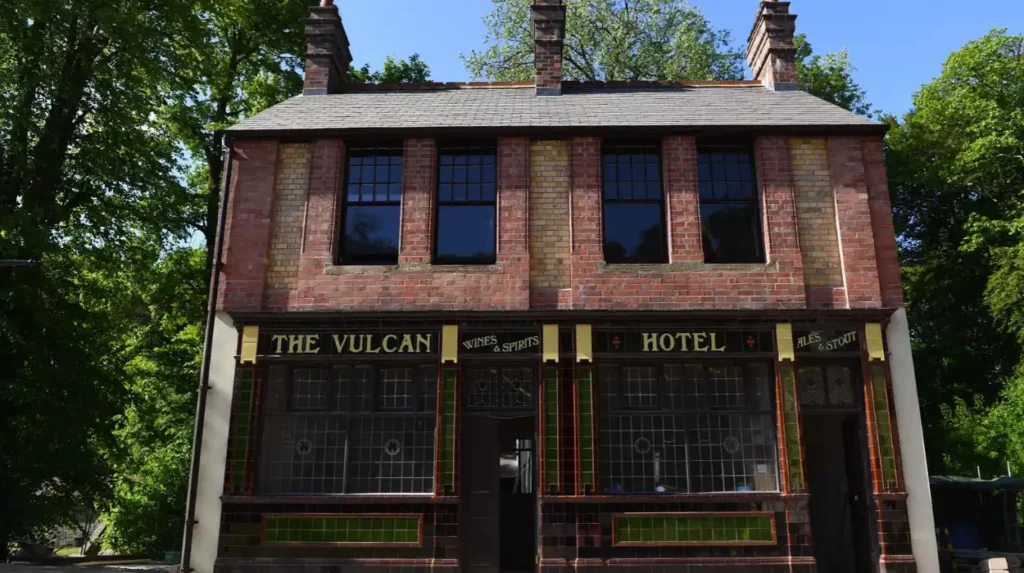
The Vulcan Hotel is important because it preserves a nineteenth-century Cardiff public house connected with Newtown, the docks and an Irish migrant community. Built in 1853, it closed in 2012 before being dismantled and reconstructed at St Fagans National Museum of History.
The Vulcan Hotel provides an unusual example of historic building conservation. Rather than remaining on its original site, the building was transferred to Amgueddfa Cymru – Museum Wales for preservation.
The pub was first registered as an ale house in 1853. Its original address was 10 Adam Street, Cardiff. The establishment served the predominantly Irish community of Newtown, an area closely connected with Cardiff’s dock development.
The pub closed permanently in 2012. Following a campaign to save it from demolition, the owners offered the building to Amgueddfa Cymru. Museum specialists documented the structure before dismantling it brick by brick.
Reconstruction began in 2020 at St Fagans National Museum of History. The museum recreated the building as an interpretation of the pub in 1915.
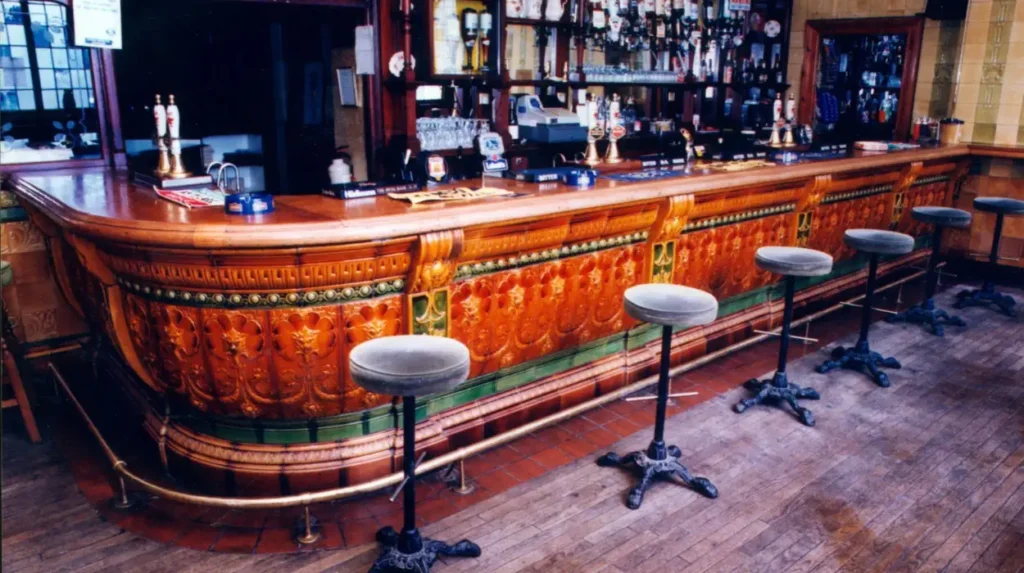
The 1915 date is significant because the building underwent refurbishment that year. Its distinctive green and brown tiled frontage and redesigned interior formed part of the reconstructed historical setting.
The Vulcan also preserves evidence of family life within historic pubs. Museum Wales records interviews with Ellen MacCarthy, who was born upstairs at the pub in 1915 while her father, Dennis MacCarthy, was the landlord.
The reconstructed building demonstrates how a public house could function simultaneously as a business, home, accommodation and community centre.
St Fagans National Museum of History has incorporated original historic buildings from across Wales since its foundation in 1948. In 2025 it recorded 570,207 visitors, making it Wales’s most visited attraction for the third consecutive year according to ALVA figures reported by Museum Wales.
How did Cardiff’s docklands shape historic public houses?
Cardiff’s docklands created concentrated communities of workers, migrants, merchants and sailors, supporting a dense network of public houses. Butetown, Newtown and surrounding streets contained pubs that served neighbourhood residents and people connected with Cardiff’s international port economy.
Cardiff Docks transformed the city during the nineteenth century. Coal exports generated commercial activity and attracted workers from different regions and countries.
Butetown became closely associated with Cardiff’s maritime economy. Public houses developed alongside housing, warehouses, commercial premises and transport routes.
The Mount Stuart provides an important historical example. Coflein records it as a nineteenth-century Grade II listed building located at the corner of Bute Place and Bute Crescent. It was later demolished on 29 March 1987 as part of wider redevelopment.
The Mount Stuart demonstrates that historic pub heritage is not limited to buildings that survive. Documentary records preserve information about demolished premises and their communities.
Museum Wales also holds photographic evidence of Cardiff’s historic dockland pubs. Its collections include a 1982 photograph of a customer at the Mount Stuart and another showing Jack Grant at the Avondale pub in Butetown. The photographs formed part of a project documenting community change and redevelopment in Cardiff Docks.
The former Dowlais Inn provides another example of how the dockside commercial environment changed. Coflein records that Dowlais Chambers was erected in the late 1880s on the former site of the Dowlais Inn.
These records demonstrate the scale of urban change around Cardiff’s docks. Public houses disappeared as roads, buildings and commercial districts were redeveloped.
Historic pub research therefore requires more than visiting surviving premises. Maps, photographs, planning documents, archaeological records and museum collections provide evidence of lost establishments.
Which Cardiff areas are best for exploring historic public houses?
Cardiff city centre provides the strongest concentration of surviving historic public-house architecture, particularly around St Mary Street, High Street, Westgate Street, Caroline Street, Customhouse Street and Bute Street. Former dockland districts add important industrial and community history.
St Mary Street remains one of the most historically significant areas for Cardiff pubs. Coflein identifies the St Mary Street Conservation Area as one of Cardiff’s 27 conservation areas. It was designated in 1975 and includes part of the historic walled medieval borough.
The street’s modern appearance is dominated by Victorian and early twentieth-century buildings. Public houses form part of the historic commercial environment alongside shops, cafés, restaurants and offices.
The Blue Anchor is associated with St Mary Street. Its historic role extends beyond architecture because of its importance in the development of Cardiff’s LGBTQ+ community.
Westgate Street provides another important heritage route. The Queens Vaults is a Grade II listed late-Victorian public house with polychromatic tile decoration. Its location demonstrates the relationship between historic licensed premises and Cardiff’s major sporting and entertainment district.
Caroline Street provides another significant location through the former King’s Cross. Although the premises later changed use, the Victorian building remains part of Cardiff’s documented LGBTQ+ heritage.
Customhouse Street and Bute Street are particularly important for the Golden Cross. Their location connects the surviving pub with the historic commercial and dockside geography of central Cardiff.
Former dockland neighbourhoods such as Butetown also deserve attention. Even where historic pubs have disappeared, museum collections and architectural records preserve evidence of their role in local communities.
Explore More Area Guide
Best Sunday Lunch Spots by Cardiff Area
Independent Coffee Roasters Across Cardiff: Local Coffee Guide
How are Cardiff’s historic public houses protected?
Historic public houses are protected through mechanisms including listed-building designation, conservation-area controls, planning legislation and historic-environment recording. Listed status recognises special architectural or historic interest and controls alterations that affect a building’s protected character.
Cadw is the Welsh Government’s historic environment service. Listed-building designation identifies buildings of special architectural or historic interest and gives them protection through the planning system.
Cardiff Council states that the city has around 1,000 listed buildings. It also has 27 conservation areas designed to protect places with special architectural or historic interest.
The protection of a listed pub extends beyond its façade when historic interiors form part of its significance. The Golden Cross demonstrates this principle because its historic interior, tiled walls, bar and decorative glass contribute to its Grade II listing.
Listed Building Consent is required for relevant alterations or extensions affecting the character of a listed building or its curtilage. Cardiff Council provides planning information covering listed buildings and conservation areas.
Cadw also explains the role of Welsh Ministers in the listed-building consent process. Cardiff Council is among the Welsh local authorities authorised to determine certain applications affecting Grade II listed buildings without notification to Welsh Ministers, subject to the applicable conditions and statutory framework.
Protection does not guarantee that every historic pub continues operating as a pub. A listed building can change use while retaining protected architectural features.
This distinction is important when researching Cardiff’s historic public houses. A historic pub can survive as a functioning licensed premises, operate under a different commercial use, become part of a museum collection or disappear while its documentary record remains.
What can visitors learn from Cardiff’s historic public houses?
Cardiff’s historic public houses provide a practical way to understand the city’s industrial expansion, migration, architecture, brewing industry, docklands, nightlife and LGBTQ+ history. Their buildings and records connect everyday social activity with major changes in Cardiff’s development.
Visitors can read Cardiff’s urban history through its surviving public houses and former pub sites.
The Golden Cross demonstrates the importance of Edwardian commercial architecture, Welsh brewing and LGBTQ+ heritage. Its decorative tiles and interior provide direct physical evidence of early twentieth-century pub design.
The Blue Anchor connects Victorian architecture with the emergence of organised LGBTQ+ activism in Cardiff during the early 1970s.
The King’s Cross demonstrates how an ordinary Victorian pub building became an important social institution for Cardiff’s gay community. Its 1874 construction date places it firmly within the period of rapid Victorian urban development.
The Vulcan provides a different perspective. Its history reveals the relationship between Cardiff’s docks, Irish migration, family life and working communities. Its reconstruction at St Fagans preserves the physical character of a Cardiff pub that disappeared from its original neighbourhood.
Former establishments such as the Mount Stuart demonstrate the impact of redevelopment. Its demolition in 1987 shows that historic pub buildings can disappear as urban districts change. Museum Wales’s photographic archive provides evidence of the building and the community around it.
Historic public houses therefore provide evidence for several areas of Cardiff history at once. They reveal architecture, commerce, migration, industrialisation, social organisation, leisure and community identity.
For visitors exploring Cardiff, the most useful approach is to treat pubs as heritage landmarks rather than isolated hospitality venues. Street patterns, listed-building records, historic photographs and museum collections add context to the surviving buildings.
Cardiff’s historic public houses remain relevant because the city continues to evolve. Conservation decisions determine which architectural details survive, while changing commercial uses reshape how historic buildings function. The surviving record ensures that former pubs and their communities remain part of Cardiff’s documented heritage.
The city’s pub history is therefore a history of urban change. From nineteenth-century dockside ale houses to Victorian public houses and twentieth-century LGBTQ+ venues, these establishments reflect the communities that built, worked in and transformed Cardiff.
What is the oldest historic pub in Cardiff?
The Golden Cross is one of Cardiff’s best-known surviving historic public houses. The site dates to 1849, when the Shield and Newcastle Tavern operated there. The present building was constructed around 1903–04 and is Grade II listed.