Key Points
- The restoration works on the glass roof of the Cardiff Market are expected to begin towards the end of September.
- This represents the official beginning of an investment worth millions of pounds into the Grade II listed building.
- The market and the traders in the 135 year old market will stay operational despite the construction going on.
- Phase one of the development involves roof repairs, installation of solar panels, refurbishment of the toilets at ground level, as well as improvements to the lantern windows, lighting and electrical works.
- Phase 1A of the development is expected to take 12 months before phase 1B begins.
- Funding for the wider £6.5 million project includes the last £3.1 million grant from the Welsh Government’s Transforming Towns scheme..
Cardiff (Cardiff Daily) September 23, 2026 — Essential restoration work is set to begin on the historic glass roof of Cardiff Market at the end of the month, marking the official launch of a multi-million-pound revitalization project. Operating continuously for 135 years, the iconic venue and its internal traders will remain open to the public while construction takes place inside enclosed zones designed to limit operational disruption. Backed by government funding and council backing, phase one of the scheme will address critical maintenance issues while introducing modern sustainability features to the Victorian landmark.
When Will the Cardiff Market Restoration Work Begin and What Does Phase One Involve?
As reported by Bryana Francis, Senior Reporter for WalesOnline, restoration work on Cardiff Market’s historic glass roof is set to begin in September, signalling the commencement of a multi-million-pound investment into the municipal space.
As detailed by WalesOnline, the initial stage of the development will focus on essential structural repairs to the roof of the Grade II-listed building alongside the installation of new solar panels. Alongside these exterior and overhead improvements, ground floor toilets will undergo a complete refurbishment, accompanied by targeted restoration efforts on the structure’s lantern windows, lighting infrastructure, and electrical systems.
According to information shared with WalesOnline, phase 1A of the project is projected to span 12 months before subsequent work under phase 1B begins.
How Will the Project Affect Traders and Visitors Inside the Market?
Despite the scale of the engineering challenges involved, the 135-year-old market will maintain continuous operations for its traders and customers. As outlined by WalesOnline, renovations will be strictly contained within enclosed working areas to minimise disruption to the wider trading floor.
Highlighting the structural and cultural significance of the venue, Cabinet Member for Finance, Modernisation & Performance, Cllr Leo Thomson, stated to WalesOnline:
“Having served residents and visitors for more than 130 years, Cardiff Market is one of the city’s most important heritage assets and an important part of its identity.”
Cllr Thomson further emphasized the long-term objectives of the public investment to WalesOnline, adding: “This is the start of a multi-million investment in its restoration which will safeguard its future and help ensure it remains a vibrant destination at the heart of the city centre for generations to come.”
Addressing the immediate priorities of the site, Cllr Thomson told WalesOnline:
“Fixing the historic glass roof is an important first step that will help preserve the market’s unique character, address essential maintenance issues, and with the addition of solar panels, help enhance its long-term sustainability.”
How Was the Multi-Million-Pound Funding Secured?
The path toward the current restoration has evolved through successive stages of municipal planning and financial acquisition. As documented by WalesOnline, Cardiff Council initially granted planning approval for the comprehensive multi-million-pound renovation in August 2023.
While initial approval was secured subject to external grants, WalesOnline reported that Cardiff Council successfully obtained the final £3.1 million required from the Welsh Government’s Transforming Towns programme in November of that year, cementing the full £6.5 million budget needed to deliver the overarching masterplan. Additional funding streams for the broader upgrade of the Victorian property include grants from the National Lottery Heritage Fund and the Shared Prosperity Fund.
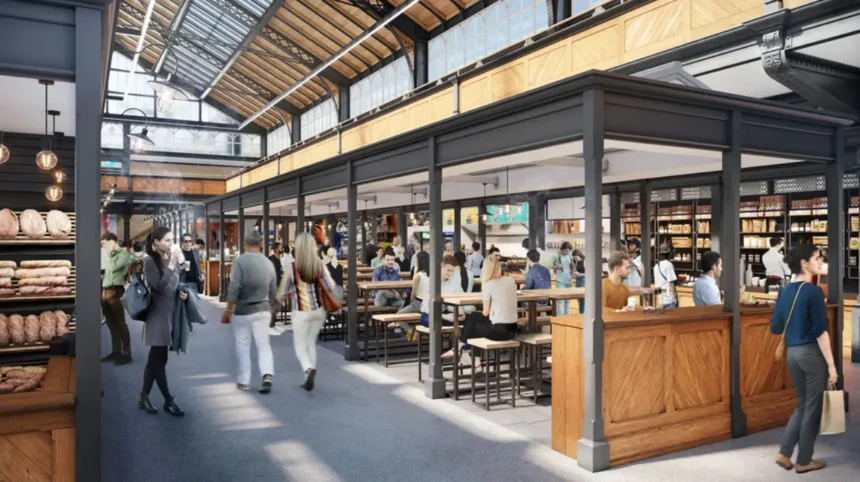
The extensive long-term blueprints for the site incorporate additional plans to remodel the St Mary Street and Trinity Street entrances, replace poorly constructed legacy stalls with authentic timber structures, and build a new covered ground-floor seating area.
Explore more Local Cardiff News:
Cardiff Council Launches Soft Plastics Recycling Trial for Local Households Cardiff 2026
Cardiff City Hall Reopening Delayed Further Until Summer 2027 in Cardiff 2026
Background of the Particular Development
The initiative to modernise and restore Cardiff Market stems from decades of heavy footfall and the natural degradation of a Victorian commercial infrastructure originally opened in 1891. Owned and managed by Cardiff Council, the Grade II*-listed building accommodates dozens of independent businesses—ranging from traditional fishmongers and greengrocers to modern street food vendors—drawing millions of visitors annually. Over recent years, structural studies indicated an urgent need to address weatherproofing vulnerabilities, antiquated electrical frameworks, and poor spatial configurations, such as 20th-century mezzanine additions. Recognizing the market’s vital role in the local economy and urban heritage, municipal leaders pursued structured external grants, culminating in a combined funding model involving the Welsh Government, National Lottery Heritage Fund, and council investments to future-proof the facility without compromising its historic architectural identity.
The multi-million-pound restoration of Cardiff Market is expected to significantly affect local independent traders, city-centre shoppers, and visitors. In the short term, the phased construction approach and creation of enclosed work zones will allow traders to maintain business continuity, mitigating immediate revenue losses, though minor localized logistical adjustments may occur. Over the medium to long term, the introduction of energy-efficient lighting, solar panels, upgraded electrical systems, and a planned ground-floor seating area will enhance the visitor experience, improve accessibility, and draw higher footfall. For the 61 independent businesses operating within the space, these structural enhancements will secure a modernized, commercially viable, and sustainable trading environment that preserves the market’s unique historic character for future generations.