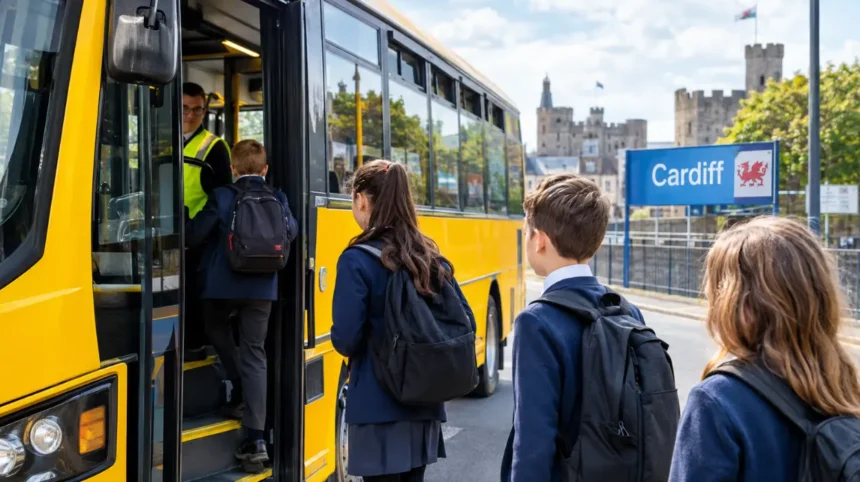
Free school transport in Cardiff helps eligible children travel between home and school without paying for their regular school journey. Cardiff Council assesses eligibility using the pupil’s age, home address, distance from the relevant catchment school and school placement. Primary school pupils generally qualify when they live more than 2 miles away, while secondary school pupils generally qualify when they live more than 3 miles away. These arrangements operate within the legal framework established by the Learner Travel (Wales) Measure 2008.
- What Is Free School Transport in Cardiff?
- What Are the Free School Transport Eligibility Rules in Cardiff?
- How does eligibility work for primary school pupils?
- How does eligibility work for secondary school pupils?
- Does living within the distance limit qualify a child?
- How Does Cardiff Council Decide Which School Counts for Free Transport?
- How Does the Cardiff Free School Bus Pass System Work?
- When do pupils receive their bus passes?
- What should parents do if a pass does not arrive?
- Can parents replace a lost or damaged bus pass?
- How Is the Distance Between Home and School Measured?
- Does Cardiff Provide Free Transport for Pupils With Additional Learning Needs?
- Do Cardiff Secondary School Pupils Receive Free Transport After Year 11?
- What Happens if a Cardiff Family Moves House?
- How Can Parents Apply for Free School Transport in Cardiff?
- Can Parents Appeal a Cardiff School Transport Decision?
- What Rules Must Pupils Follow on Cardiff School Transport?
- What Are the Alternatives if a Child Does Not Qualify for Free Transport?
- What Is Changing in Cardiff’s School Transport Policy?
- How Can Families Confirm Their Cardiff School Transport Entitlement?
For parents moving to Cardiff, choosing a primary or secondary school, or preparing a child for a new academic year, understanding the rules is essential. A school place does not automatically guarantee a free bus pass. Families must meet the council’s eligibility conditions, and choosing a school outside the designated catchment area normally affects transport entitlement.
What Is Free School Transport in Cardiff?
Free school transport in Cardiff is a council-provided travel service for eligible school-age pupils who meet the local authority’s distance and school-placement requirements. Depending on the area, the service uses dedicated school buses or bus passes valid on public transport. The council assesses pupils against its transport policy and applicable Welsh legislation.
The service supports access to compulsory education by helping eligible pupils travel between their home and school. It also reduces the need for parents to arrange and pay for daily transport when their child meets the qualifying conditions.
Cardiff Council administers mainstream school transport and publishes information about eligibility, routes, passes, additional learning needs and appeals. Its official school transport service explains how pupils receive their passes and which services they can use.
The system distinguishes between statutory entitlement and discretionary assistance. Statutory entitlement refers to transport that the council must provide when the legal requirements are met. Discretionary assistance refers to additional support that a local authority provides under its powers and published policies.
Parents should check the current rules rather than assume that every child attending a Cardiff school receives free transport.

What Are the Free School Transport Eligibility Rules in Cardiff?
Cardiff Council generally provides free mainstream school transport to primary pupils living more than 2 miles from their eligible catchment school and secondary pupils living more than 3 miles away. The council also considers school placement, catchment arrangements and individual circumstances under its published transport policy.
The distance thresholds reflect the national framework established by the Learner Travel (Wales) Measure 2008. Cardiff applies its own operational policy to determine how pupils qualify and how transport is arranged.
How does eligibility work for primary school pupils?
Primary school pupils generally qualify when they live over 2 miles from their catchment school, subject to the council’s eligibility assessment. For example, a child living 2.4 miles from the relevant school meets the distance threshold, but the council must still confirm that the school placement and other requirements are satisfied.
Cardiff Council assesses eligible pupils in Reception through Year 6 as part of its mainstream school transport arrangements. Parents should use the council’s official school information and catchment map to identify the relevant school.
How does eligibility work for secondary school pupils?
Secondary school pupils generally qualify when they live over 3 miles from their eligible catchment school. For example, a Year 8 pupil living 3.6 miles away meets the distance threshold, provided the school placement and other applicable conditions are satisfied.
Cardiff Council assesses pupils entering Year 7 and reviews eligibility for pupils in Years 8 to 11. The authority communicates decisions and transport arrangements to families ahead of the new school year.
Does living within the distance limit qualify a child?
Living within the standard distance threshold does not ordinarily qualify a mainstream pupil for free transport on distance grounds alone. A primary pupil living 1.5 miles away or a secondary pupil living 2.5 miles away normally falls below the relevant threshold.
Other circumstances require separate consideration under the applicable legislation and council policy. These include certain additional learning needs, disability-related requirements and other recognised grounds for assistance. Parents should contact Cardiff Council when a child’s circumstances make the normal distance rules unsuitable.
How Does Cardiff Council Decide Which School Counts for Free Transport?
Cardiff Council bases mainstream transport eligibility on the relevant catchment school and its published placement rules. The nearest school geographically is not always the designated catchment school. If the catchment school is full, the next nearest suitable school considered under the council’s arrangements can affect eligibility.
A catchment area is a geographical zone associated with a school for admissions purposes. Cardiff provides online information to help families identify English-medium schools, Welsh-medium schools, primary schools and secondary schools linked to their home address.
Parents should check catchment arrangements before submitting a school application. Living inside a school’s catchment area does not guarantee admission, and receiving a place at a preferred school does not automatically establish transport entitlement.
What happens if the catchment school is full?
When the designated catchment school is full, Cardiff Council considers the next nearest suitable school in accordance with its policy and the circumstances of the application. Transport eligibility is assessed against the school recognised under those arrangements.
For example, a family whose catchment school cannot offer a place needs to establish which alternative school the council recognises for transport purposes. The family should retain the admissions decision and seek written confirmation if the transport assessment is unclear.
What happens if parents choose a different school?
Parents who choose a school outside their catchment area are normally responsible for arranging and paying for their child’s transport. This rule is particularly important when selecting a school for specialist subjects, personal preferences or convenience.
A place at a preferred school does not itself create a right to a free bus pass. Families should review transport implications before accepting an offer, especially when the school is outside the relevant catchment area.

How Does the Cardiff Free School Bus Pass System Work?
Eligible pupils receive instructions from Cardiff Council explaining which bus service or pass they can use. The council generally provides a dedicated school bus where one operates locally. If no school bus service is available, eligible pupils receive a pass for public transport buses.
The bus pass gives an eligible pupil access to the transport arrangement assigned by the council. It does not automatically allow travel on every school bus or public transport route in Cardiff.
Parents should read the council’s letter carefully and check the relevant timetable, stops and travel conditions. The council publishes route information so families can identify the correct service and pickup arrangements.
When do pupils receive their bus passes?
Cardiff Council states that eligibility letters are issued during the summer, with bus passes usually distributed during the first two weeks of September. Families preparing for the new academic year should monitor correspondence and contact the council if the expected information does not arrive.
Pupils starting Year 7 receive an eligibility assessment before the start of secondary school. Pupils in Years 8 to 11 are assessed again each year.
What should parents do if a pass does not arrive?
Parents should contact Cardiff Council if a pass or eligibility letter has not arrived when expected. They should provide the pupil’s name, school, year group and current address so the authority can check the record.
Families should not assume that a missing pass confirms either eligibility or rejection. The council must clarify the pupil’s status and explain the next steps.
Can parents replace a lost or damaged bus pass?
Cardiff Council provides information about replacing school bus passes. Parents should use the council’s official school transport service to find the current replacement process and any requirements for submitting photographs or confirming pupil details.
Families should report a lost pass promptly and ask the council how the pupil should travel while a replacement is arranged. The conditions for temporary travel depend on the council’s instructions and the relevant service.
How Is the Distance Between Home and School Measured?
Cardiff Council assesses distance using the shortest walking route rather than simply relying on straight-line distance or the distance travelled by car. The route measurement determines whether a pupil meets the applicable primary or secondary threshold under the council’s transport arrangements.
This distinction matters because road routes, pedestrian paths and direct map measurements can produce different results. A school that appears close on a map can fall beyond the qualifying distance when the recognised walking route is measured.
Parents should use the council’s assessment rather than a general navigation application’s driving estimate. If the recorded distance appears incorrect, they should ask the council to explain the route used and how the measurement was calculated.
The national framework also addresses the concept of a safe, available walking route. The relevant legal provisions and the local authority’s published methodology determine how route suitability and distance are assessed.
For families near the 2-mile primary threshold or 3-mile secondary threshold, even a relatively small measurement difference can affect eligibility. Written confirmation from the council is therefore important before making financial or travel arrangements.
Does Cardiff Provide Free Transport for Pupils With Additional Learning Needs?
Cardiff Council operates separate transport arrangements for pupils with additional learning needs, assessing individual circumstances under the applicable policy and educational requirements. A pupil’s needs, school placement and required support can affect the transport decision, so families should contact the council for an individual assessment.
Additional learning needs, commonly abbreviated as ALN, refer to learning needs that require additional learning provision. Some pupils need transport arrangements that differ from mainstream school bus services.
The assessment process considers the pupil’s circumstances and the requirements established by the relevant education and transport arrangements. Parents should explain any disability-related mobility barriers, medical considerations or educational recommendations that affect the journey.
What information should parents provide?
Parents should provide the information requested by Cardiff Council, including relevant educational documentation and details of the pupil’s transport requirements. Medical or professional evidence should be supplied when requested or when it is necessary to explain the support needed.
Families should not assume that every pupil with an additional learning need automatically receives individual transport or a dedicated vehicle. The authority determines the appropriate arrangements according to the child’s circumstances and the applicable policy.
How can parents discuss existing arrangements?
Cardiff Council’s school transport service includes information for pupils with additional learning needs and a route for raising questions about current travel arrangements or bus passes.
Parents should contact the council if a pupil’s needs change, a placement changes or an existing journey becomes unsuitable. Early communication helps the authority assess whether the transport arrangements require review.
Do Cardiff Secondary School Pupils Receive Free Transport After Year 11?
Cardiff Council does not provide free mainstream school transport to pupils in Years 12 and 13 under its standard arrangements. These pupils are generally outside the compulsory school-age entitlement, although a paid pass for an existing school bus service can be available in some circumstances.
Post-16 education includes sixth-form study and other education undertaken after compulsory school age. Transport support for these learners differs from the standard arrangements for Reception to Year 11.
Students entering Year 12 should check travel costs before choosing a sixth form or school. The cost and availability of a spare or paid seat depend on the service and the council’s current arrangements.
The Welsh Government’s statutory framework does not generally require local authorities to provide free transport to learners over 16. Local authorities retain discretionary powers to support eligible learners under their policies.
Students attending further education colleges should check the college’s travel assistance arrangements as well as any support offered by Cardiff Council. Financial assistance, concessionary fares and institution-specific schemes are separate from the standard free school transport entitlement.
What Happens if a Cardiff Family Moves House?
Families who move address should notify Cardiff Council because the new home address can change the pupil’s catchment school, measured distance and transport eligibility. The council requests proof of the new address, such as a utility bill, and updates its records before assessing the relevant circumstances.
A bus pass issued for an earlier address does not guarantee continued eligibility after a move. The new journey must be assessed against the council’s rules.
Parents should provide accurate details as soon as possible. If the child lives at two addresses, the family should tell the council so it can update the pupil’s information and explain how the policy applies.
Cardiff Council states that it does not provide free mainstream school transport from a temporary address under its current published arrangements. Families in temporary accommodation should contact the authority to clarify their circumstances and available support.
Moving house during the school year also affects planning. Parents should confirm the pupil’s eligibility and route before relying on a previous bus pass or assuming the same service remains available.
How Can Parents Apply for Free School Transport in Cardiff?
Parents should begin with Cardiff Council’s official school transport information, check the catchment school and confirm whether the pupil meets the distance and placement requirements. Eligible pupils are generally assessed by the council, but families with unusual circumstances or recent address changes should contact the authority directly.
The process starts with identifying the relevant school and checking the child’s current home address. Parents should then review the council’s guidance for the pupil’s year group and transport category.
What steps should families follow?
First, identify the catchment school using Cardiff Council’s school information. Second, check the applicable distance threshold: more than 2 miles for primary pupils or more than 3 miles for secondary pupils under the council’s mainstream criteria. Third, review the school placement and any relevant exceptions.
Next, monitor correspondence from the council during the summer. If the pupil qualifies, the council provides information about the assigned transport service and pass. If no letter arrives when expected, contact the authority rather than assuming the application has been approved.
Families moving to Cardiff or enrolling a child late should contact the council because their circumstances require individual clarification. The official online service also provides information about school bus routes, replacement passes, transport incidents and appeals.
Can Parents Appeal a Cardiff School Transport Decision?
Parents who disagree with a Cardiff Council school transport decision can use the council’s published appeal process. They should review the decision, identify the reason for disagreement and provide relevant supporting information, such as address evidence, school-placement details or concerns about the recorded walking route.
An appeal is a formal request for the authority to reconsider a decision. It differs from a general enquiry because it asks the council to review its application of the relevant rules.
Parents should read the decision letter and follow the current instructions on Cardiff Council’s school transport page. They should explain the specific issue rather than relying solely on the fact that the journey is inconvenient.
For example, a parent disputing the measured distance should explain why the recognised route or recorded address requires review. A family whose circumstances have changed should provide updated evidence and ask the authority to assess the new information.
The council also provides routes for reporting transport incidents and submitting complaints. These processes serve different purposes from an eligibility appeal, so parents should select the procedure that matches their concern.
What Rules Must Pupils Follow on Cardiff School Transport?
Pupils using council-arranged school transport must follow the applicable school transport policy and the Welsh Government’s Travel Behaviour Code. These rules establish expectations for safe, respectful behaviour during journeys and help protect pupils, drivers and other passengers.
The Travel Behaviour Code applies to learners using school transport. Pupils are expected to follow driver instructions, behave safely, respect other passengers and avoid actions that distract the driver or create danger.
Parents should explain the rules before the first journey. Children should understand where to wait, how to board safely, when to remain seated and how to behave at pickup and drop-off points.
Families should consult the council’s current policy for the detailed conditions applying to their service. Serious or repeated behaviour issues can lead to action under the relevant transport rules, so parents should discuss concerns with the school and council promptly.
What Are the Alternatives if a Child Does Not Qualify for Free Transport?
Families whose children do not meet Cardiff’s free school transport criteria must arrange a suitable journey independently. Options include public transport, walking, cycling, shared family travel and other arrangements that comply with the child’s age, safety needs and school requirements.
Cardiff Council encourages active travel, including walking, cycling and scooting, where suitable. The practical choice depends on the route, distance, traffic conditions, the child’s age and whether a safe journey is available.
Parents can consult Traveline Cymru for public transport information and compare available bus routes with the school’s start and finish times. They should also check whether the school operates a relevant service and whether a paid seat is available.
A spare seat is not the same as a free transport entitlement. Cardiff Council provides information about purchasing spare seats on school bus services, but availability and conditions must be confirmed directly with the authority.
Families choosing a school should consider the daily journey before accepting a place. Transport costs, travel time, safe walking access and public transport connections all affect the practical suitability of a school.
Explore More Area Guide
Cardiff Secondary Schools: A Complete Parent Guide
Prepared for the article: Cardiff Primary School Guide for New Residents
What Is Changing in Cardiff’s School Transport Policy?
Cardiff Council’s refreshed Home to School Transport Policy is scheduled to apply to school admissions from September 2027, following approval in 2026. The published policy update states that the refresh aligns the council’s arrangements with legislation, guidance and operational practice rather than changing the level of transport entitlement.
The council’s policy information distinguishes between the arrangements applying to admissions up to August 2027 and the refreshed policy applying from September 2027 onwards.
For parents, the key point is to check the policy relevant to the child’s admission circumstances and academic year. A policy approved for future implementation should not be treated as if every provision already applies to current pupils.
The legal framework remains important. The Learner Travel (Wales) Measure 2008 establishes the national statutory basis for qualifying home-to-school transport, including the standard distance criteria for primary and secondary pupils.
Families planning a move, selecting a school or preparing for a transition into Year 7 should check Cardiff Council’s latest guidance rather than rely on older online discussions or outdated bus-pass information.
How Can Families Confirm Their Cardiff School Transport Entitlement?
Families can confirm eligibility by checking Cardiff Council’s current school transport guidance and contacting the authority with the child’s year group, home address and school placement. The council’s assessment determines whether the pupil qualifies and identifies the service or pass available for the journey.
Parents should establish the correct catchment school, confirm the recognised walking distance and check whether any additional learning needs or exceptional circumstances require separate consideration. They should also verify the relevant policy for the academic year.
The main eligibility thresholds are straightforward: primary pupils generally qualify when they live more than 2 miles away, while secondary pupils generally qualify when they live more than 3 miles away. However, distance alone does not guarantee a pass because school placement and other policy requirements also matter.
Cardiff Council’s official school transport pages provide the most reliable starting point for eligibility checks, route timetables, pass replacement, appeals and policy updates. Confirming the decision directly with the council helps families plan school journeys accurately and avoid unexpected travel costs.
Who qualifies for free school transport in Cardiff?
Primary school pupils generally qualify if they live more than 2 miles from their eligible catchment school. Secondary school pupils generally qualify if they live more than 3 miles away. Cardiff Council also considers school placement and other applicable eligibility conditions.