Key Points
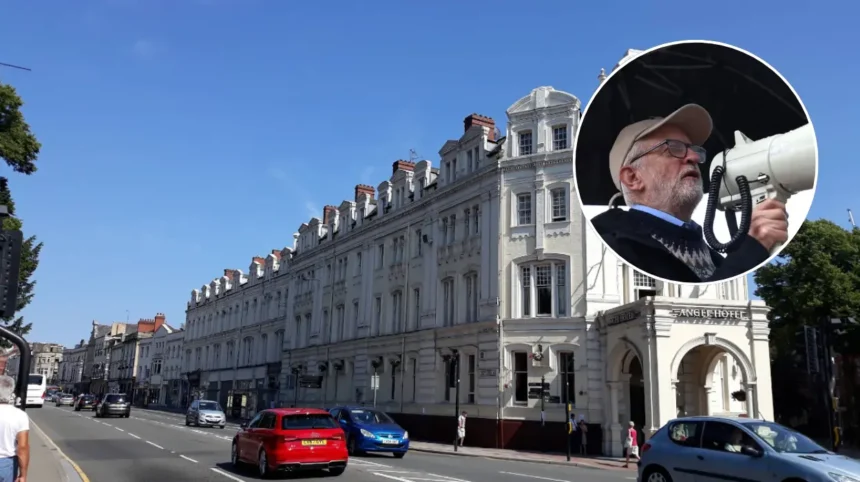
- According to Bryana Francis from WalesOnline, the former Labour Party leader, Jeremy Corbyn, was one of those hundreds who gathered outside Cardiff Central to participate in the anti-racism and unity march.
- Though there were warnings about very bad weather and difficulties in traveling because of the storm named Boelo, more than 400 people attended the protest.
- The protest included participation of people such as Leanne Wood, the former leader of Plaid Cymru.
- The protesters raised several issues, such as solidarity with Palestine, fundraising for RNLI, anti-migration politics, and underfunding of services including NHS.
- The march was one of the many protests across Britain against racism, which took place in Sheffield, Newcastle, Morecambe, and Wakefield.
Cardiff (Cardiff Daily) October 24, 2026 — Defying severe weather warnings and transport disruptions caused by Storm Boelo, more than 400 demonstrators gathered outside Cardiff Central for a high-profile anti-racism and unity march. Former Labour leader Jeremy Corbyn joined the crowd, telling attendees that he was witnessing “unprecedented” support for international solidarity. The mobilization brought together community campaigners, political figures, and trade unionists to push back against far-right politics and advocate for social justice.
Why Did Jeremy Corbyn and Hundreds of Protesters Brave Storm Boelo in Cardiff?
As detailed by Bryana Francis of WalesOnline, heavy wind and rain warnings failed to deter crowds from turning out in central Cardiff. The demonstration was organized to foster community unity, oppose racism and Islamophobia, and counter rising far-right sentiment across the United Kingdom.
As reported by WalesOnline, Jeremy Corbyn addressed the gathered protesters outside Cardiff Central, stating that he was witnessing “unprecedented” levels of support for international solidarity. He was joined by other prominent political figures, including former Plaid Cymru leader Leanne Wood, who also participated in the mobilization.
Organisers noted that the event was designed to build a unified front following anti-migrant demonstrations seen in other parts of the UK, such as Portsmouth, during the previous month. Demonstrators waved flags, carried banners, and chanted slogans, drawing inspiration from similar mass protest movements across European nations like France, Italy, Greece, and Spain.
What Did Speakers and Protesters Say Regarding Public Services and Social Issues?
Participants at the Cardiff march voiced widespread frustration over the state of public infrastructure and economic inequality. Sol Gaules, a participant interviewed by WalesOnline, stated:
\“Public life is continuing to get worse and worse. Our systems are crumbling. The NHS is being underfunded and we think this is the fault of the capitalist system as a whole. We’re seeing these big protest events erupt all over Europe at the minute, in Italy, Greece, Spain, and France. It’s only a matter of time before some large movement erupts.”
Alice Nicholson, a local resident from Cardiff, added, as quoted by WalesOnline:
“All over Europe we’ve been seeing far right groups emboldened… We want to show there is a solution and actually what’s going on in France is going to come to Britain. I want to say to people who are angry at the far right and the government, there is something we can do about it and we are incredibly powerful.”
Another protester, whose identity was not fully disclosed but who shared a personal account with WalesOnline, emphasized that community division is fueled by systemic policy choices rather than immigration. As reported by WalesOnline, the attendee noted:
“Immigrants are being blamed for problems but it’s actually the funding, the state cutting out services… We’re trying to help people understand what the actual problem is and we can do that by being unified together.”
Other attendees carried signs supporting the RNLI in response to recent maritime migration debates, while others focused on global issues, including solidarity with Palestine and Sudan.
Explore more Local Cardiff News
Franky Rizardo Open-Air Show Announced at Cardiff Castle, Cardiff 2027
Cardiff Castle Green Illumination Mocked Online 2026
How Does This Cardiff March Fit Into the Wider UK-Wide Movement?
The demonstration in the Welsh capital did not occur in isolation. According to reports by Herald.Wales, the Cardiff march formed a key part of a coordinated national day of action against racism and fascism across Britain. Similar solidarity rallies and marches were reported in English cities and towns, including Sheffield, Newcastle, Morecambe, and Wakefield.
The coalition supporting the Cardiff event spanned multiple sectors and political organizations. According to Herald.Wales, backing came from groups such as the National Education Union, Asylum Justice, Cardiff for Sudan, Black Lives Matter, Women Against the Far Right, and the Cardiff Stop the War Coalition. Campaigners emphasized that despite adverse weather conditions, the turnout demonstrated a strong, organized appetite in Wales to resist xenophobia and advocate for public investment.
Background of the Particular Development
The anti-racism rally in Cardiff arrives amid a tense socio-political climate across the United Kingdom marked by polarized debates over immigration, border security, and economic austerity. In recent months, cities across England and Wales have experienced recurring public flashpoints, including anti-migrant demonstrations in locations like Portsmouth and heightened activity from far-right factions. Concurrently, progressive campaigns and trade unions have sought to mobilize public discontent over the cost-of-living crisis, NHS waiting lists, and public sector funding cuts. Events like the Cardiff unity march represent a concerted effort by left-wing political figures, trade unions, and grassroots community networks to reframe public grievances away from anti-immigrant narratives and toward structural economic reform and international solidarity.
This coordinated wave of anti-racism demonstrations and the visible involvement of prominent political figures like Jeremy Corbyn are likely to energize grassroots progressive networks across Wales and the wider UK. For the particular audience of local campaigners, trade unionists, and anti-racism activists in Cardiff, this development reinforces organizational momentum, validating their strategy of visible public mobilization against far-right expansion. However, it also underscores deep societal polarization. As economic pressures persist and public services remain strained, intensified friction between rival political demonstrations can be expected in urban centers, increasing operational challenges for local law enforcement and placing pressure on regional political leaders to address community cohesion and public safety.