Key Points
- Proposed Tidal Lagoon: The Cardiff Capital Region has unveiled plans for the development of a tidal lagoon which will be based at Aberthaw, Vale of Glamorgan – the first lagoon in a new generation of tidal lagoons to be established in the Severn Estuary.
- Size and Electricity Production: This ambitious 600MW scheme aims to produce renewable energy which is highly predictable and could power up to half a million homes over a period of more than 120 years.
- Investment in the Project: The Cardiff Capital Region has pledged to invest up to £6.4m over the next three years using its City Deal money to conduct extensive proof-of-concept studies.
- Economic Value: It is estimated that this Aberthaw lagoon could create about £3.5bn in economic value, creating thousands of jobs.
- Possible Investors: The future investors could include the UK government’s £28bn National Wealth Fund and pension funds as well as a potential regulated asset base model partially financed by energy bill payments.
- Statement from Key Leaders: Key statements and endorsements were made by individuals such as Ann Brocklesby (the Chair of Cardiff Capital Region and Leader of Monmouthshire Council), Adam Price (Cabinet Secretary for Enterprise, Connectivity, and Energy), Stephen Kinnock (Secretary of State for Wales), and Dr. Andrew Garrad (the Chair of the Western Gateway Partnership Commission).
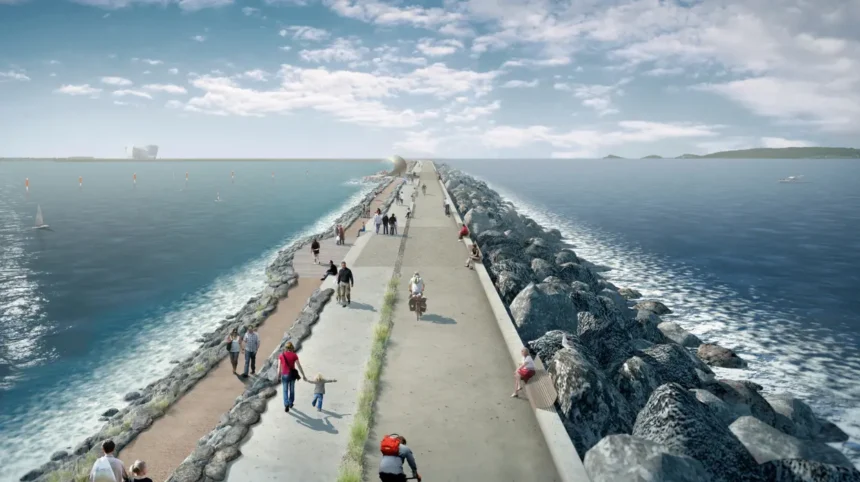
Cardiff (Cardiff Daily) September 16, 2026 — Plans for the first in a new generation of tidal lagoons within the Severn Estuary have been unveiled by the Cardiff Capital Region. The proposed project, sited at Aberthaw in the Vale of Glamorgan, is set to be roughly twice the scale of the previously planned Swansea Bay initiative. Designed as a 600MW installation, the facility aims to supply renewable electricity to half a million homes while potentially generating an economic value of £3.5bn and supporting thousands of local jobs.
What are the core details of the proposed Aberthaw tidal lagoon project?
The ambitious initiative in the Severn Estuary is spearheaded by the Cardiff Capital Region, an alliance comprising the ten local authorities of south-east Wales. As reported by Sion Barry, Business Editor of Cardiff Daily, the region will commit up to £6.4m over the next three years to fund an extensive exploratory study.
The initial work programme will encompass environmental considerations, engineering design, modelling, and commercial assessments. As reported by Sion Barry of Cardiff Daily, Ann Brocklesby stated that
“This represents a potentially game-changing moment for renewable energy generation in the UK. The Severn Estuary has one of the highest tidal ranges in the world, with the potential to generate predictable, homegrown renewable energy that complements existing wind and solar power.”
She further added, as reported by Sion Barry of Cardiff Daily, that
“In a time when energy security has become increasingly essential, the ability to access reliable and cost-effective renewable energy to power a significant number of homes, while placing Wales at the forefront of innovation in such an important sector, makes this a generational opportunity. I am proud that the Cardiff Capital Region, along with our partners, is taking this exciting project forward.”
How will the project be funded and what are the future financial mechanisms?
Financing for the initial developmental stages is drawn directly from the region’s £1.2bn City Deal. However, taking any major lagoon project through the complete planning and construction pipeline involves costs reaching tens of millions of pounds for planning, alongside construction costs well north of £1bn.
To achieve this, the project will require substantial external investment from public and private sectors. As reported by Sion Barry of Cardiff Daily, potential financial backing could come from the UK Government’s £28bn National Wealth Fund—with which the city region recently formed a partnership—as well as institutional pension funds. Additionally, models like the regulated asset base could be utilized, where upfront construction costs are partly financed via consumer energy bills.
Explore more Cardiff Council News
Tongwynlais Housing Plan Refused Over Village Community Concerns: Cardiff 2026
Cardiff Council Continues Flood Recovery Operations in Gwaelod-y-Garth 2026
What are the environmental and strategic goals according to Welsh and UK leaders?
The project design places significant emphasis on balancing power generation with ecological preservation. The Cardiff Capital Region already owns a 500-acre site at Aberthaw, acquired from energy giant RWE, where it plans to build a green energy park to support the lagoon development.
Cabinet Minister for Enterprise, Connectivity and Energy, Adam Price, emphasised the broader regional vision. As reported by Sion Barry of Cardiff Daily, Adam Price stated that
“Our vision is for Wales to become a world leader in marine renewables. With the second-largest tidal range in the world, the Severn Estuary presents immense potential to deliver significant renewable energy generation and economic benefits for Wales.”
He added, as reported by Sion Barry of Cardiff Daily, that
“We will continue to work closely with partners to ensure we maximise the opportunities offered by this unique project as it progresses. This project will help us understand how tidal technology can contribute to the transition to clean power, tackle climate change and create good clean jobs in the future.”
Secretary of State for Wales, Stephen Kinnock, also welcomed the announcement. As reported by Sion Barry of Cardiff Daily, Stephen Kinnock stated that
“Wales has a great track record of innovation and partnership, and Cardiff Capital Region is continuing to harness those strengths with projects that support economic growth, investment and clean energy. I look forward to following the development with great interest.”
Furthermore, Dr Andrew Garrad, who chaired the commission set up by the Western Gateway Partnership, expressed strong support. As reported by Sion Barry of Cardiff Daily, Dr Andrew Garrad stated that
“The Severn Estuary has immense energy potential and the Commission concluded that there is a compelling case to use that potential. Equally, it must be done in the right way – with the unique and internationally important environment of the Estuary remaining at the heart of how the project is designed and developed.”
He concluded, as reported by Sion Barry of Cardiff Daily, by saying
“I am delighted to see Cardiff Capital Region taking forward the Commission’s recommendation for a commercial demonstration project. This investment is an important next step in building the evidence, working closely with environmental organisations, and demonstrating how tidal range can deliver large-scale, clean, economic energy while respecting the Severn’s exceptional natural environment.”
Background of the Development
The concept of harnessing the Severn Estuary’s massive tidal range—one of the highest in the world—has a long history of exploration in the UK. Previous efforts, most notably the Swansea Bay Tidal Lagoon scheme proposed years ago, ultimately stalled when they failed to secure crucial subsidy backing from the UK Government in 2018. Despite those historical setbacks, local authorities and independent advisory groups have continued to champion tidal energy as a vital component of the UK’s long-term green energy transition. The formation of the Western Gateway Partnership commission, chaired by Dr Andrew Garrad, renewed momentum by publishing reports endorsing commercial-scale tidal demonstrations. Building upon these recommendations, the Cardiff Capital Region acquired the former Aberthaw Power Station site from RWE, laying the physical and strategic groundwork necessary to transition from concept to exploratory reality.
This development has the potential to significantly transform the regional economy and energy landscape for residents, businesses, and energy consumers in south-east Wales. For local households and communities, the creation of a 600MW predictable renewable energy source could enhance long-term energy security and stabilise power access, though models involving consumer energy bills could introduce new cost-sharing structures. For local businesses and the regional workforce, the projected £3.5bn economic impact and the establishment of a green energy park at Aberthaw are expected to generate thousands of direct and indirect jobs, fostering innovation within supply chains and positioning Wales as a national hub for marine renewable technology.