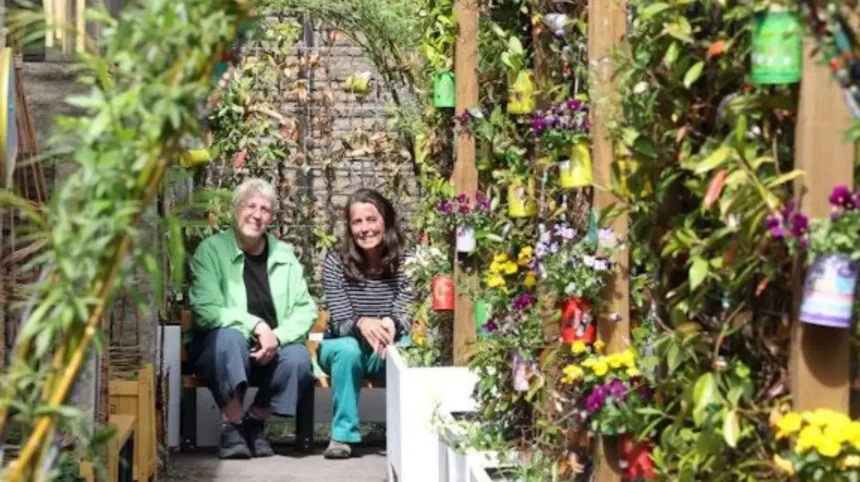
Cardiff has developed a substantial network of pollinator projects involving wildflower meadows, reduced mowing, bee banks, gardens, nesting habitats, community planting and wildlife recording. These initiatives connect Cardiff Council, Buglife Cymru, RSPB Cymru, schools, residents and conservation organisations.
- What are pollinator projects in Cardiff?
- Why are pollinator projects important for Cardiff?
- How did Cardiff’s major pollinator projects develop?
- What was the Urban Buzz Cardiff project?
- Which Cardiff locations have supported pollinator conservation?
- What is Giving Nature a Home in Cardiff?
- What is the Cardiff Pollinator Pledge?
- How does Cardiff Council manage land for pollinators?
- How do wildflower meadows support Cardiff pollinators?
- What are bee banks and bee hotels used for?
- How does the B-Lines approach connect Cardiff’s pollinator habitats?
- What is the Cardiff Local Nature Partnership pollinator project?
- How can Cardiff residents support pollinator projects?
- What evidence shows the wider need for pollinator conservation in Wales?
- What is the future of pollinator projects across Cardiff?
Pollinator conservation in Cardiff sits within wider Welsh biodiversity policy. Wales introduced its Action Plan for Pollinators in 2013, with the aim of reducing and reversing pollinator decline through diverse, connected, flower-rich habitats. The 2026 Nature Recovery Action Plan continues this approach and specifically supports flowering habitats in towns, cities and developed areas.
Cardiff provides an important urban setting for this work because pollinators use parks, gardens, roadside verges, allotments, cemeteries, school grounds, community spaces and other green infrastructure. Projects across these locations create feeding, nesting and shelter opportunities within the built environment.
What are pollinator projects in Cardiff?
Pollinator projects in Cardiff are conservation activities that create, restore or manage habitats for bees, butterflies, hoverflies and other insects. They include wildflower meadows, pollinator gardens, bee banks, nesting sites, reduced mowing, tree planting, community action and wildlife recording.
Pollinator projects focus on the habitat requirements of insects rather than on honey bees alone. Welsh Government guidance identifies bumblebees, solitary bees, butterflies, moths, hoverflies, beetles, wasps and thrips among the pollinating insects that benefit from suitable habitats.
The basic requirement is continuous access to food and suitable places for reproduction and shelter. Flowering plants provide nectar and pollen. Longer vegetation provides cover. Bare or sandy ground provides nesting conditions for some solitary bees. Stems, dead wood and purpose-built structures provide additional nesting opportunities.
Cardiff’s projects therefore use several habitat-management methods. These include creating wildflower-rich grassland, planting nectar-rich flowers, managing existing vegetation differently, creating bee banks, installing bee hotels and planting trees and hedges.
This approach also supports other invertebrates. Pollinator-friendly habitats provide resources for insects that form part of wider urban food webs.
Why are pollinator projects important for Cardiff?
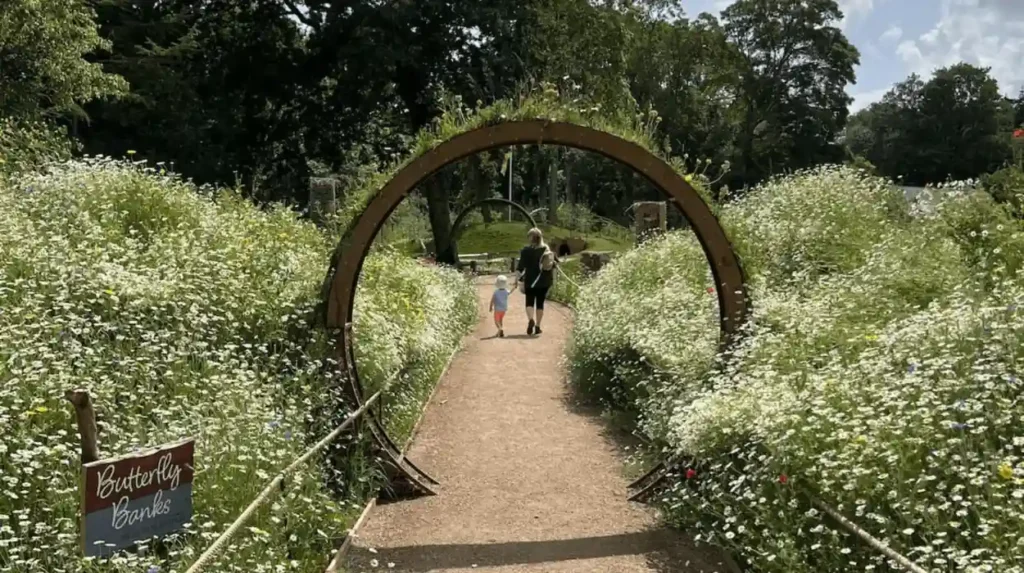
Pollinator projects are important because Cardiff’s urban habitats provide food, nesting areas and movement routes for insects while supporting plant reproduction and biodiversity. Welsh evidence identifies habitat loss, fragmentation and degradation as major pressures on wild pollinators.
Pollinators transfer pollen between flowers, enabling many plants to reproduce. This process supports wild plants and agricultural crops and contributes to wider ecosystem functioning. Welsh Government guidance states that pollinators help produce seeds, fruits and nuts that support other wildlife.
Cardiff’s urban landscape contains a mixture of buildings, roads, gardens, parks and other developed areas. Pollinator projects increase the ecological value of suitable spaces within this landscape.
Habitat connectivity is particularly important. A single isolated flower bed provides food at one location. Connected flower-rich areas provide a broader network through which insects can move between feeding and nesting locations.
Welsh Government’s Action Plan for Pollinators identifies diverse and connected flower-rich habitats as a central conservation requirement. The 2026 Nature Recovery Action Plan continues this objective for towns, cities and developed areas.
Cardiff also has a significant scientific and conservation interest in rare pollinators. Buglife recorded the shrill carder bee, Bombus sylvarum, at Hendre Lake during the Urban Buzz project. The species is described by Buglife as the UK’s rarest bumblebee.
How did Cardiff’s major pollinator projects develop?
Cardiff’s modern pollinator programme developed through coordinated conservation projects involving Buglife, Cardiff Council, RSPB Cymru and local communities. Urban Buzz began in Cardiff in 2015, expanded habitat creation through 2016–2017, and influenced later citywide pollinator initiatives.
Buglife launched Urban Buzz in 2015 as an urban pollinator habitat programme operating across several UK cities. Cardiff was one of the participating locations, with Cardiff Council supporting local delivery.
The Cardiff programme subsequently developed into a large network of community-led habitat projects. Buglife’s project record states that Urban Buzz Cardiff created or enhanced 25 hectares of pollinator habitat across 103 Buzzing Hotspots, with more than 1,000 volunteers contributing to the work.
Earlier project reporting recorded more than 20 Cardiff sites being improved during the first phase, including work with council sites, community centres, schools, churches, libraries, Cardiff University and Cardiff Castle. The work included meadows, herb gardens, bee banks, hedges and trees.
Urban Buzz therefore established a practical model for Cardiff: local organisations managed small and medium-sized sites while conservation specialists provided guidance and project coordination.
The programme also demonstrated that pollinator conservation can operate across many different urban land uses rather than relying exclusively on nature reserves.
What was the Urban Buzz Cardiff project?
Urban Buzz Cardiff was a major urban pollinator conservation project delivered from 2016 to 2017. It created or enhanced 25 hectares across 103 Buzzing Hotspots and involved more than 1,000 volunteers in habitat creation and improvement.
The project used different habitat features according to local conditions. These included wildflower-rich grassland, bug-friendly garden planting, elm planting, green-roof bike shelters, carved wooden structures and bee planters.
A Buzzing Hotspot was a location where habitat improvements were made specifically to benefit pollinating insects and other invertebrates.
Project work included publicly accessible spaces and community-managed areas. Rhydypennau Library became one example of a community site containing a mini meadow, vegetable bed and herb planting designed to provide pollen, nectar and nesting opportunities.
Forest Farm Garden became another significant example. Buglife’s project records identify it as Cardiff’s winning Urban Buzz site in the project’s later recognition programme, while Rhydypennau Library was named the Cardiff runner-up.
The programme also supported pollinator education. Workshops, surveys and community activities helped residents understand insect identification and habitat management.
This combination of habitat creation and public participation became a defining characteristic of Cardiff’s pollinator work.
Which Cardiff locations have supported pollinator conservation?
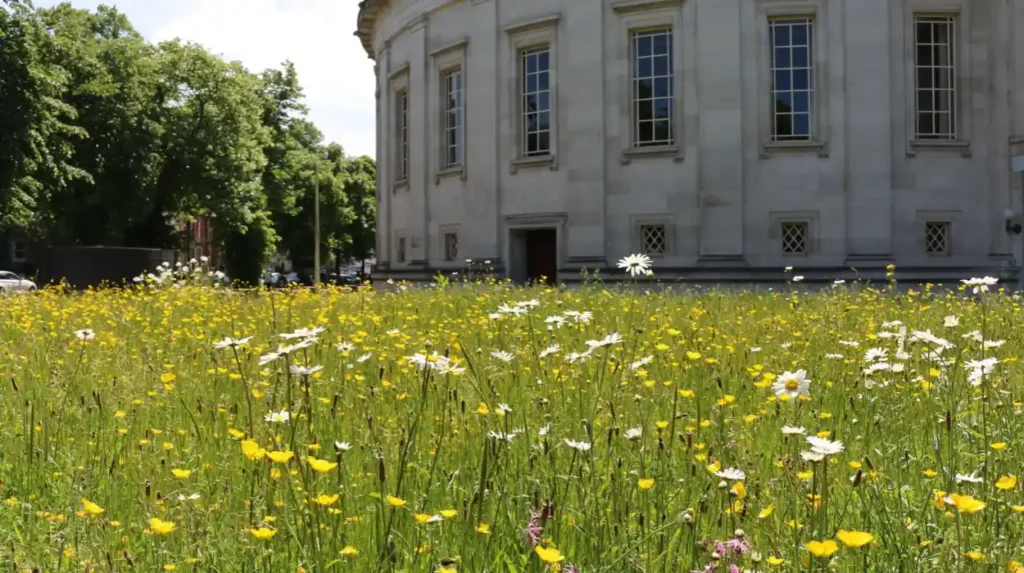
Cardiff’s pollinator conservation network includes parks, libraries, schools, allotments, cemeteries, community spaces and other green areas. Examples include Hendre Lake, Forest Farm Garden, Rhydypennau Library, Cathays Cemetery, Llandaff North allotments and Bute Park.
Hendre Lake in St Mellons has particular conservation significance because Buglife and the Bumblebee Conservation Trust recorded the shrill carder bee there during Urban Buzz-related survey work. Native wildflower seed was also added to enhance the site’s habitat.
Rhydypennau Library demonstrates how small community sites can contribute to a citywide network. Its planting combined flowers with nesting opportunities and community involvement.
Cathays Cemetery was used for planting work involving Allensbank Primary School and Cardiff Council during the Urban Buzz programme. Llandaff North allotments also featured in the project’s habitat work.
Bute Park has also featured in Cardiff’s pollinator activity. Buglife reported pollinator trails and habitat boxes in the park, demonstrating how an established urban park can incorporate dedicated invertebrate habitat alongside recreational uses.
Forest Farm Garden received recognition as Cardiff’s leading Urban Buzz Buzzing Hotspot. The site illustrates the role of community and council partnerships in developing urban wildlife habitat.
These examples show that Cardiff’s pollinator network extends across different types of land rather than being concentrated in one conservation site.
What is Giving Nature a Home in Cardiff?
Giving Nature a Home in Cardiff is a partnership approach involving RSPB Cymru, Buglife Cymru and Cardiff Council. It connects urban habitat creation, community engagement and pollinator conservation across gardens, allotments, parks, verges and other city spaces.
The programme provided an umbrella for community action alongside specialist conservation work. Urban Buzz sites in Cardiff were managed by local groups with support from RSPB Cymru, Buglife Cymru and Cardiff Council.
This partnership approach matters because urban biodiversity depends on many landowners and land managers. Cardiff’s ecological network includes public land, private gardens, community spaces, institutional grounds and transport-related areas.
The programme also encouraged residents to take practical action at home. In 2021, Buglife launched the Urban Buzz Pollinator Pledge as part of Giving Nature a Home in Cardiff. The pledge encouraged actions such as planting pollinator-friendly flowers and allowing lawns to grow longer.
This shifted pollinator conservation beyond designated project sites. Individual gardens and allotments became part of a broader citywide habitat network.
What is the Cardiff Pollinator Pledge?
The Cardiff Pollinator Pledge is a community action approach encouraging residents and land managers to make gardens, allotments and other spaces more useful for pollinating insects through flowers, longer vegetation and other habitat improvements.
The pledge emerged from Cardiff’s wider effort to improve pollinator habitat. Its practical actions include planting flowers suitable for pollinators and reducing intensive lawn management.
Longer grass is significant because closely cut lawns provide limited habitat compared with flowering and structurally diverse vegetation. Welsh Government guidance identifies reduced mowing and meadow-like areas as practical approaches for supporting pollinators.
A pollinator-friendly garden does not need to be large. A sequence of small gardens, balconies, community plots and public spaces can collectively increase the amount of flowering habitat available to insects.
The pledge therefore complements larger council and conservation projects by extending habitat management into residential areas.
How does Cardiff Council manage land for pollinators?
Cardiff Council supports pollinator habitat through park management, grass-cutting practices, wildflower areas and reduced pesticide use. Most parks and green spaces are cut up to six times a year, while sports pitches receive different management according to their use.
Cardiff Council states that its grass-cutting season runs from March to October. Most parks and green spaces are cut up to six times annually, although exact schedules vary according to weather, ground conditions and site priorities.
Different mowing regimes create different habitat conditions. Sports pitches require regular management for recreation. Other grassland can receive less intensive management where biodiversity objectives apply.
Pesticide reduction also forms part of Cardiff Council’s environmental approach. The council reports that pesticide use decreased from 3,500 litres in 2021 to 2,910 litres in 2024.
The council also states that its contractor is no longer required to spray around tree bases in all mown grass areas.
These management decisions are important because pollinator conservation depends not only on planting flowers but also on how vegetation is maintained after planting.
How do wildflower meadows support Cardiff pollinators?
Wildflower meadows support Cardiff pollinators by supplying nectar and pollen while providing varied vegetation structure. Cardiff projects use meadow creation and enhancement to convert selected urban grassland into habitats that support bees, butterflies, hoverflies and other insects.
A meadow contains flowering plants that provide food during different periods of the growing season. Diverse flowering periods are important because pollinating insects require food across their active seasons.
Welsh Government guidance states that pollinators require flowers for feeding as well as habitats where they can live, lay eggs and support developing young.
Cardiff’s Urban Buzz programme specifically created and enhanced wildflower-rich grassland. The project also used other complementary habitat features, including hedges, trees, bee banks and planting schemes.
Meadow management requires appropriate timing. Cutting too frequently during flowering periods removes food resources. Management therefore needs to balance biodiversity objectives with safety, access and recreational requirements.
Cardiff’s grass-cutting framework provides a broader context for this approach because different areas can receive different levels of maintenance depending on their function.
What are bee banks and bee hotels used for?
Bee banks and bee hotels provide nesting opportunities for pollinating insects. Bee banks supply suitable exposed ground for ground-nesting species, while bee hotels provide artificial cavities used by some solitary bees and other insects.
Not all bees live in large colonies. Many solitary bee species construct individual nests and require specific nesting materials or conditions.
Bee banks can provide bare or sparsely vegetated ground suitable for nesting. Bee hotels provide tubes or cavities that imitate natural nesting spaces such as hollow stems and holes in dead wood.
Cardiff’s Urban Buzz programme included bee banks and bee hotels among its habitat interventions. Project reporting also identifies artificial nests and bee hotels as categories of work used at Cardiff sites.
These structures work best when combined with food resources. A nesting site surrounded by suitable flowers provides a more complete habitat than an isolated structure.
This explains why Cardiff’s projects combine nesting infrastructure with meadows, gardens, hedges and flowering trees.
How does the B-Lines approach connect Cardiff’s pollinator habitats?
B-Lines is a Buglife conservation approach that maps and creates flower-rich habitat corridors for pollinating insects. In Cardiff, residents and organisations can add wildflower projects to the B-Lines network to improve habitat connectivity across the city.
Habitat fragmentation separates ecological resources into smaller areas. B-Lines addresses this problem by identifying routes where flower-rich habitat can be created or restored.
Buglife’s Cardiff Local Nature Partnership project encourages residents to add their own wildflower projects to the B-Lines map, helping expand Cardiff’s pollinator highway network.
The approach treats individual gardens, community meadows and public green spaces as components of a larger network.
Connectivity is a central principle of Welsh pollinator policy. The national Action Plan calls for diverse and connected flower-rich habitats, while the 2026 Nature Recovery Action Plan continues support for this objective.
For Cardiff, B-Lines therefore provides a framework for linking separate pollinator projects rather than treating every meadow or garden as an isolated site.
What is the Cardiff Local Nature Partnership pollinator project?
The Cardiff Local Nature Partnership project operated from April 2024 to March 2025 and brought residents, communities, schools and organisations together to improve pollinator habitat and support Cardiff’s Nature Recovery Action Plan.
Buglife reports that Cardiff Council funded a part-time Buglife Conservation Officer through the Cardiff Local Nature Partnership scheme. The project involved Cardiff Council, Buglife Cymru, Wales Biodiversity Partnership, WCVA, Natural Resources Wales, SEWBReC, Cardiff University and other local organisations.
The project supported development of Cardiff Council’s Pollinator Action Plan. Its intended actions include creating new habitats, enhancing existing habitats, encouraging reduced pesticide use and introducing favourable mowing regimes.
The programme also focused on biological recording. Residents were encouraged to record pollinators through platforms and organisations including iRecord, LERC Wales, Aderyn, iNaturalist and SEWBReC.
This creates a connection between habitat creation and scientific evidence. Recording helps identify which species use urban sites and provides information for future conservation planning.
How can Cardiff residents support pollinator projects?
Cardiff residents can support pollinators by planting nectar- and pollen-rich flowers, reducing intensive lawn mowing, avoiding unnecessary pesticide use, creating nesting habitat, joining community projects and recording pollinator sightings through recognised biodiversity recording platforms.
Gardens and allotments form an important part of Cardiff’s urban ecological network. Even small areas can provide flowering resources when planted and managed specifically for insects.
Residents can also leave sections of grass longer rather than maintaining every part as closely cut lawn. Welsh Government guidance specifically identifies meadow-like areas as one method of helping pollinators.
Plant selection also matters. Flowers with accessible nectar and pollen provide more direct value to insects than purely ornamental planting with limited ecological function.
Residents can participate in community meadow creation, wildlife recording and local environmental groups. Cardiff’s Local Nature Partnership project specifically encourages public recording of pollinators and other invertebrates.
Avoiding unnecessary pesticide use is another practical measure. Cardiff Council’s own pesticide reduction programme demonstrates the wider direction toward reducing chemical impacts where alternative approaches are available.
Explore More Area Guide
Urban Wildlife in Cardiff Suburbs: Species, Habitats and Conservation
Seasonal Nature Walks Around Cardiff: Best Year-Round Routes
What evidence shows the wider need for pollinator conservation in Wales?
Welsh evidence identifies habitat loss, fragmentation, degradation, pesticides, disease and climate change as pressures on pollinators. National monitoring published in 2025 also reported a significant decrease in pollinators, reinforcing the importance of habitat restoration and long-term monitoring.
The Welsh Government’s Action Plan for Pollinators identifies land-use intensification, habitat loss and fragmentation, disease, agrochemicals and climate change as major concerns.
The scale of historic habitat loss is significant. The national action plan reports an estimated 91% loss of semi-natural lowland grassland in Wales between the 1930s and 1990s, with dry unimproved lowland grassland loss estimated at up to 97%.
These historic losses explain why urban habitat creation has strategic value. Cardiff cannot replace lost rural habitats, but its parks, gardens, verges, allotments and community spaces can contribute to habitat availability.
The Welsh Government’s 2025 monitoring statement also reported a significant decrease in pollinators within its national environmental indicators. The monitoring programme included more than 500 kilometres of butterfly and pollinator transects.
The evidence supports continued monitoring alongside habitat management.
What is the future of pollinator projects across Cardiff?
The future of Cardiff’s pollinator projects depends on connected habitats, long-term management, community participation, ecological monitoring and integration with wider nature recovery. Cardiff’s work increasingly fits within Wales’ long-term biodiversity and nature-recovery framework.
The Welsh Government’s 2026 Nature Recovery Action Plan explicitly commits to continuing the Action Plan for Pollinators and supporting diverse, connected flowering habitats in towns, cities and developed areas.
The plan also supports Local Nature Partnerships and community-focused nature recovery through initiatives designed to bring nature closer to where people live.
For Cardiff, this policy direction supports continued cooperation between the council, conservation organisations, schools, universities, community groups, residents and land managers.
Future progress depends on more than creating new flower beds. Existing habitats require appropriate maintenance. Pollinator projects need monitoring to determine which habitats support which species. Habitat corridors require coordination across property boundaries.
Cardiff already has a substantial foundation. Urban Buzz established 103 Buzzing Hotspots and enhanced 25 hectares of habitat. Later partnership work expanded the emphasis toward nature recovery, local recording, pollinator planning and connected habitat.
The long-term significance of Cardiff’s pollinator projects therefore lies in building a connected urban ecological network. Parks, gardens, verges, schools, allotments and community spaces can each contribute habitat. Together, they form a citywide system that supports pollinating insects and broader urban biodiversity.
What are pollinator projects in Cardiff?
Pollinator projects in Cardiff are conservation initiatives that create and improve habitats for bees, butterflies, hoverflies and other pollinating insects. They include wildflower meadows, pollinator gardens, bee banks, reduced mowing, nesting habitats and community planting.