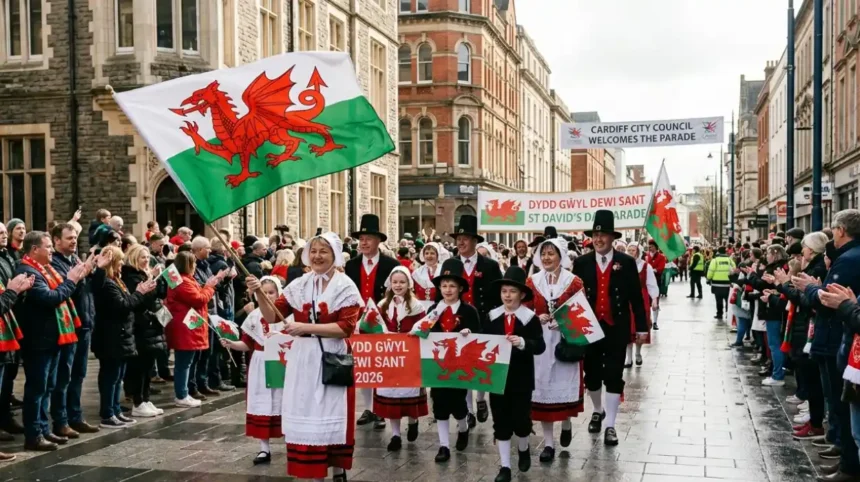
The National St David’s Day Parade in Cardiff 2026 is a major civic and cultural event held in the capital city of Wales, uniting thousands of residents and visitors around the feast day of Wales’ patron saint, St David. The parade takes place on 1 March 2026, starting at Cardiff City Hall and finishing at The Hayes, with the core procession scheduled between 12:00 noon and shortly after 13:30. This guide details the official route, timings, key landmarks along the way, and what spectators can expect to see, written for a broad audience visiting Cardiff or planning ahead for future St David’s Day events.
- What is the St David’s Day Parade in Cardiff?
- When is the St David’s Day Parade in Cardiff 2026?
- Where does the St David’s Day Parade in Cardiff start and finish?
- What is the full parade route in Cardiff 2026?
- What are the exact procession timings and key schedule points?
- What types of groups and performers take part in the parade?
- Where are the best places to watch the St David’s Day Parade in Cardiff?
- What is there to see along the parade route in Cardiff?
- What cultural and heritage elements feature in the Cardiff parade?
- What should you know about safety, accessibility, and visitor logistics?
- What else can you do in Cardiff on St David’s Day 2026?
- How does the Cardiff parade fit into St David’s Day celebrations across Wales?
What is the St David’s Day Parade in Cardiff?
The St David’s Day Parade in Cardiff is the national St David’s Day procession for Wales, hosted annually in the Cardiff city centre. It brings together school groups, community organisations, cultural societies, musicians, flag bearers, and civic representatives to mark the birth of St David, the patron saint of Wales, on 1 March. The event is organised in partnership with Cardiff council, VisitWales, and other cultural bodies, and forms part of a wider programme of St David’s Day activities across Cardiff that includes music, food, and storytelling.
Participants typically wear traditional or celebratory Welsh dress, including national costumes, dragon‑themed outfits, and green, white, and red colours. The parade includes marching bands, choirs, youth groups, and often a large dragon or giant figure representing Welsh folklore, which walks the route alongside the main contingents. The whole operation is designed as a free, family‑friendly public celebration, with designated viewing areas and supporting activities in nearby venues and public spaces.

When is the St David’s Day Parade in Cardiff 2026?
The St David’s Day Parade Cardiff 2026 takes place on Wednesday 1 March 2026, aligning with the fixed date of St David’s Day in the Welsh calendar. Participants are required to assemble in front of Cardiff City Hall from 11:00am, to allow time for roll‑call, safety briefings, and positional marshalling. The parade itself starts at 12:00 noon, with the procession moving along the official route through the city centre and finishing at The Hayes around 13:30.
Spectators are advised to arrive at least 30–45 minutes before 12:00 noon to secure a good viewing position, especially in central locations such as Queen Street and St John’s Street. After the parade concludes at The Hayes, the official programme usually includes a mass singing of the Welsh national anthem outside St David’s Hall, followed by informal music sessions, food stalls, and activities in surrounding streets and venues.
Where does the St David’s Day Parade in Cardiff start and finish?
The 2026 parade begins at Cardiff City Hall, located in the civic centre of Cardiff, and ends at The Hayes, a key pedestrian‑friendly street in the south of the city centre. Cardiff City Hall sits on King Edward VII Avenue, opposite Cathays Park, and serves as the main rallying point for all parade groups before the procession sets off. The Hayes is a short, central street leading into Queens Arcade and Cardiff Market, making it a natural focal point for the finale and post‑parade activities.
The route passes several major landmarks en route, including the Cathedral Road junction, the pedestrianised sections of Queen Street, and the historic St John’s Street area close to Cardiff Market. These locations are deliberately chosen to maximise public visibility, allow for crowd control, and connect the civic and commercial cores of the city. The finishing area around The Hayes and St David’s Hall is typically where the largest crowd gathers for the closing anthem and immediate follow‑up events.
What is the full parade route in Cardiff 2026?
The National St David’s Day Parade route in Cardiff 2026 follows a concise but highly visible path through the heart of the capital. The procession departs from Cardiff City Hall, proceeds along King Edward VII Avenue towards the civic centre roundabout, then turns into the main city‑centre thoroughfare that leads onto Queen Street. Along Queen Street it passes major retail fronts, transport hubs, and public art, maintaining a straight line that is easy for spectators to follow.
From Queen Street the parade continues into St John’s Street, a short, historic lane that connects the main shopping district with The Hayes and the upper part of St David’s Hall’s public forecourt. The route then turns into or along The Hayes, where the final contingents disperse and the official programme concludes with the national anthem outside St David’s Hall. This loop is designed to be compact (typically under 1.5 km in total), accessible for all ages, and suitable for live broadcasting and photography by local media.
What are the exact procession timings and key schedule points?
For Cardiff 2026, the parade’s timeline is structured around three main phases: assembly, procession, and finale. The first key point is 11:00am, when all official groups must be assembled outside Cardiff City Hall for registration and safety checks. The second is 12:00 noon, when the parade officially steps off from City Hall and begins its journey along Queen Street.
The third significant marker is around 13:30, when the last unit is expected to reach the finish point at The Hayes, bringing the core procession to a close. After that, the schedule typically includes a short interval for the mass singing of the Welsh national anthem outside St David’s Hall, followed by a wider programme of music, food, and activities that can extend into the late afternoon. These timings are approximate and may vary slightly year‑to‑year, but Cardiff council and VisitWales usually publish an updated schedule on their official event pages close to 1 March.
What types of groups and performers take part in the parade?
The Cardiff St David’s Day Parade includes a structured mix of participants designed to reflect the breadth of Welsh civic and cultural life. These groups fall into categories such as school contingents, community organisations, military and cadet units, cultural societies, music and dance groups, and civic representatives from Cardiff and national bodies.
Welsh‑language schools and primary‑school groups often walk in order, wearing traditional dress or St David’s Day colours, and may carry handmade dragon banners or daffodil motifs. Community organisations include faith groups, local charities, sports clubs, and heritage societies, each contributing themed costumes, flags, or banners that visualise their role in Cardiff society. Music and performance groups range from brass bands and choirs to folk ensembles and modern dance troupes, who provide a continuous soundtrack as the parade moves through the city.
Where are the best places to watch the St David’s Day Parade in Cardiff?
The best viewing spots for the 2026 parade are clustered along the core route and near the ceremonial start and finish points. A prime location is the immediate area in front of Cardiff City Hall and along the first stretch of King Edward VII Avenue, where spectators can see the parade step off and capture clear images of the lead groups. Another optimal point is the pedestrianised section of Queen Street, particularly near the junctions with St Mary Street and St John’s Street, where the low‑rise buildings and wide pavement allow for unobstructed views.
The segment around St John’s Street and the entrance to The Hayes is especially useful for those who want to see the parade’s finale, as this area funnels crowds toward the final destination. For families, the area near Cardiff Market and the lower end of The Hayes offers easy access to food stalls, toilets, and seating, while still providing a good vantage of the closing procession. Arriving early and positioning on the right‑hand side of the road (from City Hall towards The Hayes) usually gives a clearer view of the front of the contingents.
What is there to see along the parade route in Cardiff?
Along the parade route in Cardiff, spectators encounter a blend of civic architecture, retail streets, and pockets of public‑space activity. Notable built features include the neoclassical façade of Cardiff City Hall, the clock tower and civic buildings around Cathays Park, and the historic street layout of St John’s Street. These landmarks frame the procession visually and reinforce the idea of St David’s Day as a national event held in the capital city.
In addition to architecture, the route showcases temporary elements such as stage structures, PA systems, and event signage that support the official programme. Street‑level details include bunting, flags, and promotional banners from Cardiff council and VisitWales, as well as pop‑up food carts and information kiosks that may be installed on The Hayes or adjacent streets. For those interested in heritage, the proximity to Cardiff Market and St David’s Hall also provides opportunities to explore local crafts, food, and performance spaces before or after the parade.
What cultural and heritage elements feature in the Cardiff parade?
The Cardiff St David’s Day Parade 2026 incorporates several core Welsh cultural symbols and traditions. These include the national flag of Wales (a red dragon on a green and white field), the daffodil and leek as national emblems, and the singing of Welsh hymns and the national anthem in both Welsh and English. The parade also often features traditional costumes, such as Welsh folk dress with bonnets and shawls, worn by schoolchildren and community performers.
Musical elements frequently include male‑voice choirs, brass bands, and folk musicians playing pieces associated with Welsh identity, such as “Men of Harlech” and “Cwm Rhondda.” Storytelling and “Journey of the Legends”‑style events held near the courthouse or other public spaces add narrative depth, connecting the parade to historic figures such as Owain Glyndŵr and the legends of Welsh saints. These components work together to position Cardiff’s St David’s Day not just as a street spectacle but as a living expression of Welsh language, history, and civic pride.
What should you know about safety, accessibility, and visitor logistics?
Cardiff’s St David’s Day Parade 2026 is organised with safety and accessibility as central priorities. Road closures and temporary traffic restrictions are implemented along the route, managed by Cardiff council and South Wales Police, with signage and stewards guiding both vehicles and pedestrians. The route is largely pedestrian‑friendly, with wide pavements and clear sightlines, but congestion is expected in Queen Street and The Hayes, so visitors should stay behind stewards’ barriers and follow instructions.
For accessibility, Cardiff council typically provides designated viewing areas for wheelchair users and people with reduced mobility near Cardiff City Hall and The Hayes, with clear access routes via pavement‑level crossings. Public transport is encouraged, with frequent services on Cardiff’s bus and rail networks converging on Central Station and Queen Street Station, both within a short walk of the route. Parking is limited in the city centre on 1 March, and official guidance usually recommends arriving early or using Park‑and‑Ride options if travelling by car.
What else can you do in Cardiff on St David’s Day 2026?
Beyond the parade, St David’s Day 2026 in Cardiff offers a broader programme of cultural and family‑friendly activities. These can include music sessions in pubs and bars around the city centre, craft workshops linked to Welsh folklore, and themed family events at venues such as Cardiff Market and St David’s Hall complex. In larger years, Cardiff has also hosted special projects such as drone‑light displays over the Principality Stadium or extended food‑and‑music festivals in Bute Park and Cardiff Bay.
For visitors, combining the parade with a visit to Cardiff Castle, the National Museum Cardiff, or the nearby waterfront offers a fuller immersion in the city’s heritage. Many hotels and hostels in Cardiff run St David’s Day packages that include breakfast, parade‑viewing locations, and local‑deal information, making it easier for tourists to plan a multi‑hour experience centred on the event. These layered activities reinforce Cardiff’s positioning as the national focal point for St David’s Day celebrations in Wales.

How does the Cardiff parade fit into St David’s Day celebrations across Wales?
The Cardiff St David’s Day Parade forms the national anchor of a wider network of local parades and events held across Wales on 1 March. Other towns and cities such as Swansea, Newport, and Bangor run their own processions, often following similar formats with school groups, bands, and civic leaders, but on a smaller scale. Cardiff’s event is distinguished by its location in the capital, higher participant numbers, and integration with national media coverage and national‑level dignitaries.
The spread of parades across Wales reflects a decentralised but coordinated approach to celebrating St David’s Day, with Cardiff providing the symbolic “main” event. Local councils and community groups use the day to promote Welsh language, heritage, and civic engagement, while Cardiff’s parade amplifies these themes through larger floats, national‑level performers, and broadcast opportunities. This structure ensures that St David’s Day remains relevant both as a city‑scale spectacle in Cardiff and as a nationwide cultural moment across Wales.
When is the St David’s Day Parade in Cardiff 2026?
The parade takes place on 1 March 2026, starting at 12:00 noon and finishing around 13:30. Participants assemble from 11:00am at Cardiff City Hall.