Key Points
- Manchester’s proposed local plan could guide development through 2039, including city-centre expansion and up to 60,000 homes.
- The proposed boundary would include areas around Great Ducie Street, Victoria North, Ancoats, New Islington, Manchester Science Park and the Manchester Metropolitan University campus.
- The plan identifies a requirement for 1.4 million square metres of office space and 1,627 affordable homes each year.
- Three separate city-centre schemes are also due to be considered, potentially providing about 3,700 homes and student beds.
- The council’s planning committee is expected to decide whether the schemes can proceed to the next stage.
Inverted pyramid:
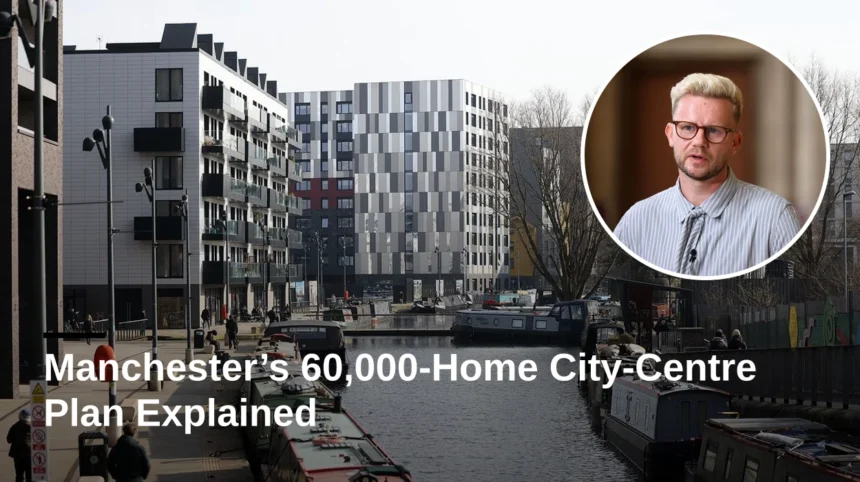
Manchester (Cardiff Daily) November 18, 2026 — Manchester City Council is preparing to send a local plan to the government for examination, setting out how the city could accommodate up to 60,000 additional homes and an expanded city centre through 2039. The plan follows public consultation and would also direct most of the city’s required office development, student accommodation and affordable housing provision.
The proposed boundary would extend towards Great Ducie Street in Strangeways, Victoria North, Ancoats and New Islington. It would also include Manchester Science Park and the Manchester Metropolitan University campus near Oxford Road.
What does Manchester’s proposed local plan include?
Manchester City Council’s draft plan describes the city as experiencing population and economic growth while continuing to face demand for housing, affordable homes, supported accommodation and student housing.
The council says the expanded city centre should support residential growth where it does not harm employment capacity. It also wants development to strengthen Manchester’s role as a national and international visitor destination.
The plan identifies the city centre as the location for most of the 1.4 million square metres of office floorspace required by 2039. Core growth areas include Victoria North, Holt Town, Sportcity and the Central Park business area in North Manchester.
How many affordable homes are proposed?
The draft plan sets an annual target of 1,627 affordable homes, based on Manchester’s housing needs assessment. The proposed policy expects 30% of homes in major schemes of 10 or more dwellings to be affordable, with the figure used as the starting point for negotiations.
Delivery would rely on council programmes, grant-funded schemes and planning contributions from developers.
What did the consultation reveal?
The consultation took place in August and September 2026 and received nearly 600 responses from 97 people or organisations. Some respondents called for more social housing and raised concerns about viability assessments and their effect on affordable-home delivery.
The council is expected to consider sending the plan to the government for examination. Government inspectors would then assess whether the document is legally compliant and sound before it could guide future planning decisions.
Which city-centre schemes are also being considered?
Manchester Mirror reported that Manchester City Council is due to consider three residential schemes with a combined total of about 3,700 homes and student beds. The proposals include a 153-home build-to-rent development by McGoff Group on Rochdale Road and two student-accommodation schemes in the Oxford Road corridor.
The two student schemes would provide about 3,500 beds. Place North West reported a combined figure of about 3,600 when the proposals are counted using different measures for homes and student beds.
Planning officers have recommended approval for the student schemes, while the McGoff proposal is expected to return with a recommendation for approval. Councillors could approve, refuse or defer the applications.
What is the background to Manchester’s expansion plan?
Manchester’s local plan is intended to establish the planning framework for development across the city until 2039. The proposed changes reflect continuing investment in housing, employment, universities, transport-linked areas and major regeneration sites.
The plan identifies projects around Strangeways, North Manchester General Hospital, Manchester Airport, Wythenshawe Hospital and Wythenshawe district centre.
The council also lists Victoria North as a 155-hectare growth area between the city centre and Queen’s Park. Other planned growth locations include Sportcity and the Central Park business area.
The council’s draft assessment says further housing is needed alongside measures to address economic inactivity linked to poor health.
How could the plan affect Manchester city centre’s future?
If approved after examination, the framework would provide a long-term basis for expanding Manchester city centre and concentrating new homes, offices and student accommodation in selected locations.
For residents, the main effects would depend on individual planning applications, infrastructure delivery and the proportion of affordable homes secured in each scheme. The scale of development could increase the city-centre population and demand for transport, public spaces, schools, health services and other facilities.
The plan would not itself grant permission for 60,000 homes. Each development would still require separate approval under the planning system, subject to detailed designs, viability evidence and infrastructure considerations.