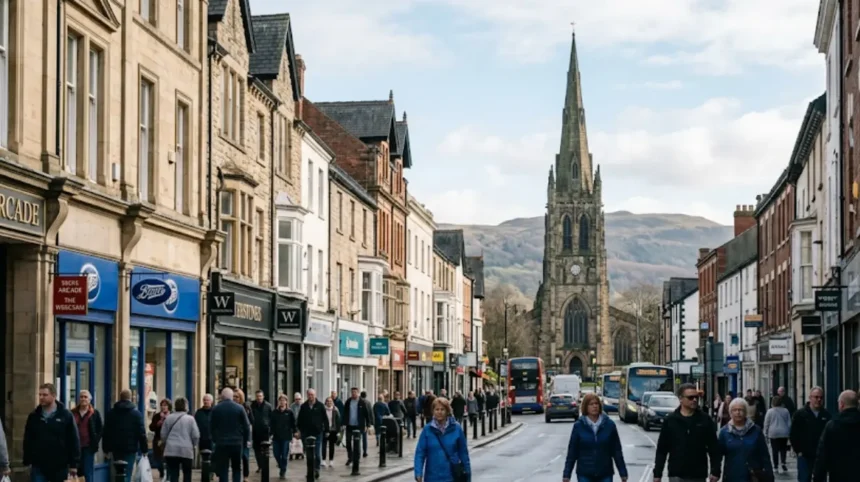
Wrexham is a historic city and administrative center located in the northeast of Wales, situated approximately 12 miles south of Chester and close to the English border. It serves as the principal economic hub for the region of North Wales.
Wrexham, historically known as Wrecsam in Welsh, is the largest urban settlement in North Wales. Positioned within the county borough of Wrexham, it occupies a strategic geographic location bounded by the Dee Valley to the south and the lower hills of the Clwydian Range to the west. The city covers a total administrative area of approximately 50 square kilometers, acting as a critical gateway between the industrial landscapes of Northwest England and the rural terrains of mid and West Wales.
- What is the history of Wrexham from its origins to the modern era?
- How is the local government and administrative structure of Wrexham organized?
- What are the primary pillars of Wrexham’s economy and industry?
- What role does Wrexham play in the higher education and research sectors?
- How has Wrexham A.F.C. impacted the city’s global profile and tourism?
- What are the primary cultural landmarks and heritage sites in Wrexham?
- What are the transport infrastructure and connectivity networks of Wrexham?
- What are the future regeneration and development plans for Wrexham?
For centuries, Wrexham functioned as a market town before transitioning into an industrial powerhouse during the Industrial Revolution. In June 2022, as part of the Platinum Jubilee celebrations of Queen Elizabeth II, Wrexham was officially granted city status, becoming the seventh city in Wales. This administrative elevation altered its status from a regional market town to a formally recognized urban city center, reinforcing its role as a focal point for governance, commerce, and culture within the United Kingdom.
The geographic positioning of Wrexham places it within a well-connected transport corridor. The city is served by the A483 dual carriageway, which links it directly to Chester, Liverpool, and Manchester to the north, and onwards to Cardiff via the A483 and A470 links to the south. This accessibility has historically made the city a primary destination for residents of surrounding regions, including South Wales hubs like Cardiff, seeking economic, educational, and cultural exchanges within the northern principality.
What is the history of Wrexham from its origins to the modern era?
The history of Wrexham spans from Mesolithic and Bronze Age settlements through medieval market developments, culminating in a dominant 18th-century industrial empire driven by coal mining, iron working, lead smelting, and world-renowned commercial brewing enterprises.
Human activity in the Wrexham area dates back to the Mesolithic period, with archaeological excavations revealing flint tools dating to approximately 8000 BCE. By the Bronze Age, the region was populated by agrarian communities, evidenced by the discovery of the Brymbo Man in 1954, a well-preserved skeleton from roughly 1600 BCE. During the Anglo-Saxon period, Wrexham fell under the influence of the Kingdom of Mercia. King Offa constructed Offa’s Dyke, a massive earthwork fortification, just west of the modern city limits in the 8th century to delineate Mercian territory from the Welsh kingdoms.
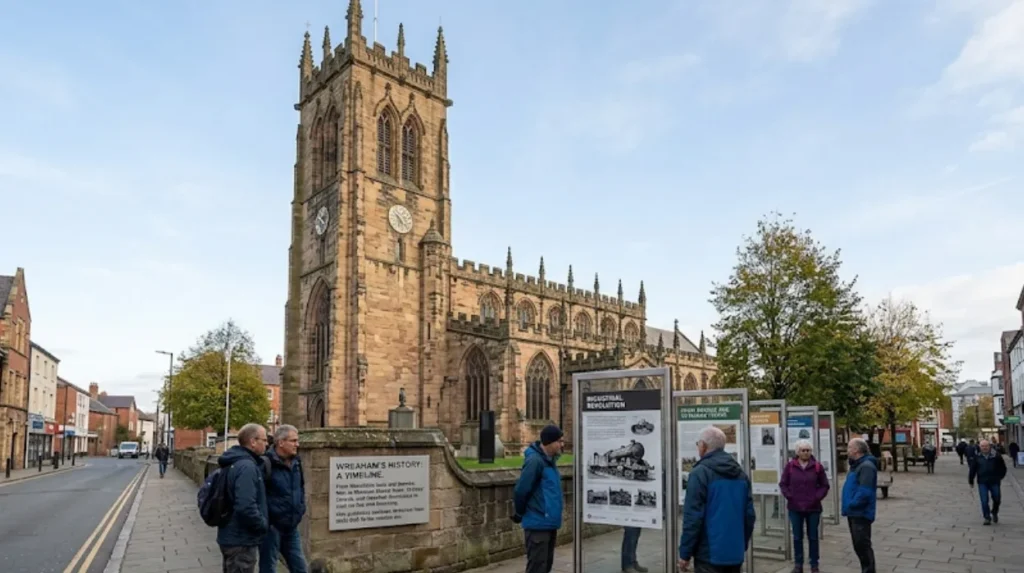
The earliest written record of Wrexham appears in 1161 in documents referencing a castle at “Wristlesham.” By 1327, Wrexham had established itself as a premier market town within the Lordship of Bromfield and Yale. The town’s central ecclesiastical landmark, St Giles’ Church, was constructed in its current late-Gothic style between 1463 and 1520. Its 135-foot tower remains one of the “Seven Wonders of Wales” and serves as a historical marker of the town’s medieval wealth, generated primarily through the regional wool trade and annual commercial fairs.
The onset of the Industrial Revolution in the mid-18th century transformed Wrexham into a global industrial center. The industrialist John Wilkinson opened the Bersham Ironworks in 1762, pioneering advanced techniques for boring iron cannons and steam engine cylinders for Boulton & Watt. This technological leap catalyzed the exploitation of the Denbighshire coalfield, leading to the opening of major collieries. The Wrexham Lager Beer Company, established in 1882 by German immigrants, became the first dedicated lager brewery in the United Kingdom, exporting its product globally across the British Empire via the extensive rail networks linked to Liverpool docks.
How is the local government and administrative structure of Wrexham organized?
Wrexham is governed by the Wrexham County Borough Council, a unitary authority established in 1996 that possesses full legislative and executive powers over local services, resource allocation, urban planning, and regional economic development frameworks.
The administrative architecture of Wrexham is managed by the Wrexham County Borough Council, which operates from the Guildhall in the city center. The council consists of 52 elected councillors representing 47 electoral wards. Elections occur every five years under the local government electoral system of Wales. The political leadership is determined by an executive board comprising a council leader and cabinet members who oversee specific portfolios, such as education, housing, social care, and economic development.
Wrexham Council functions as a unitary authority, meaning it combines the responsibilities of both a county council and a district council. The authority manages a diverse range of public statutory obligations, including the operation of 67 schools, the maintenance of over 850 kilometers of public highways, and the management of social services for a population exceeding 135,000 residents. The council collaborates directly with the Welsh Government in Cardiff to implement national policies on sustainability, Welsh language integration, and infrastructure modernization.
At the community level, the city and its surrounding rural areas are subdivided into community councils, such as Acton Community Council, Rhosllanerchrugog Community Council, and Caia Park Community Council. These local bodies possess limited statutory powers but maintain local amenities, manage community centers, and provide localized feedback to the primary unitary authority. This two-tier consultative structure ensures that urban city planning aligns with the needs of outlying villages and suburban neighborhoods.
What are the primary pillars of Wrexham’s economy and industry?
The economy of Wrexham relies on an advanced manufacturing sector, aerospace engineering, pharmaceutical production, large-scale commercial retail, and an expanding international tourism and hospitality sector accelerated by global sports media exposure.
Wrexham represents the industrial engine of North Wales, hosting the Wrexham Industrial Estate, which is one of the largest industrial parks in Europe, covering over 550 hectares. The estate accommodates more than 340 businesses and employs over 10,000 workers. The local economy shifted away from heavy coal extraction and iron production in the late 20th century, diversifying into high-technology manufacturing and science-based industries that insulate the region from localized economic downturns.
The manufacturing sector features prominent global entities. Aerospace manufacturing is anchored by Airbus in nearby Broughton, which works in tandem with supply chains located directly within Wrexham. The automotive supply chain is represented by companies like Denso Manufacturing UK, which produces automotive air conditioning and cooling systems. The life sciences and pharmaceutical sector is anchored by Wockhardt UK, a major pharmaceutical manufacturer that operates a large sterile injectables facility in the city, famously responsible for fill-finish manufacturing of vaccines during public health emergencies.
The service sector and retail trade form the second-largest employment block. The city center features major retail zones, including the Eagles Meadow shopping complex and traditional indoor markets like the Butcher’s Market and General Market. Additionally, the food manufacturing sector is highly concentrated, with major production facilities operated by companies such as Kellogg’s, which produces breakfast cereals for European markets, and the Village Bakery, a regional baking firm employing over 800 staff across multiple production sites.
What role does Wrexham play in the higher education and research sectors?
Wrexham serves as an educational hub through Wrexham University and Coleg Cambria, institutions that deliver academic degrees, technical certifications, and specialized research programs supporting regional industrial supply chains.
Wrexham University, formerly known as Glyndŵr University, obtained full university status in 2008 and stands as the primary higher education institution in Northeast Wales. The university maintains its main campus on Mold Road, featuring specialized facilities such as the Centre for the Creative Industries and the Wrexham University Racecourse Stadium. The institution offers undergraduate and postgraduate qualifications across diverse faculties, including engineering, computing, nursing, psychology, and creative arts, catering to domestic students and international cohorts.
The research infrastructure at Wrexham University is linked to industrial application. The university operates the OpTIC Technology Centre at St Asaph Business Park, which specializes in optoelectronic engineering, precision optics, and thin-film technology. This facility manufactured prototype mirror segments for the European Extremely Large Telescope project. The university focuses on applied research, collaborating with industrial partners on the Wrexham Industrial Estate to pioneer automated manufacturing systems and advanced composite materials.
Complementing the university is Coleg Cambria, one of the largest further education colleges in the United Kingdom. Formed in 2013 through the merger of Yale College in Wrexham and Deeside College, the institution provides vocational training, technical apprenticeships, and A-level pathways for over 20,000 students. Coleg Cambria maintains strong corporate partnerships with employers like Airbus and JCB, delivering customized workforce training programs that bridge the gap between secondary school education and specialized industrial employment.
How has Wrexham A.F.C. impacted the city’s global profile and tourism?
The acquisition of Wrexham A.F.C. by Rob McElhenney and Ryan Reynolds in 2021 transformed the football club into a global media franchise, driving tourism, hospitality revenue, and international brand recognition.
Wrexham Association Football Club, founded in 1864, is the oldest football club in Wales and the third-oldest professional football team in the world. The team plays its home matches at the Racecourse Ground, which is recognized by Guinness World Records as the world’s oldest international football stadium that still hosts international matches. The club’s historical legacy includes winning the Welsh Cup a record 23 times and defeating Spanish giants Real Madrid in the European Cup Winners’ Cup in 1984.
In February 2021, American actor Ryan Reynolds and American actor Rob McElhenney finalized their purchase of the club through the RR McReynolds Company LLC. This acquisition initiated an unprecedented restructuring of the sports organization and the surrounding community. The owners financed the docuseries Welcome to Wrexham, produced by FX and streamed globally on platforms including Disney+ and Hulu. The documentary detailed the club’s journey, local culture, and community hardships, generating vast international audiences across North America, Europe, and Australasia.
The economic ramifications of this media exposure for the city of Wrexham are quantifiable. Hotel occupancy rates within Wrexham and the surrounding county borough increased by over 20% following the release of the docuseries. Local hospitality venues, such as The Turf Hotel pub adjacent to the stadium, reported a substantial surge in international visitors, particularly from the United States and Canada. Retail sales of football club merchandise grew rapidly, with shirts sold across dozens of international countries, turning a local sports club into a global lifestyle brand.
What are the primary cultural landmarks and heritage sites in Wrexham?
Wrexham contains significant historical monuments and cultural institutions, including the UNESCO World Heritage Pontcysyllte Aqueduct, Erddig Hall, St Giles’ Church, and the newly renovated Wrexham Museum network.
The premier cultural landmark within the Wrexham County Borough is the Pontcysyllte Aqueduct and Canal, inscribed as a UNESCO World Heritage Site in 2009. Designed by civil engineers Thomas Telford and William Jessop, the structure was completed in 1805. It carries the Llangollen Canal 126 feet above the River Dee, utilizing a 1,007-foot-long cast-iron trough supported by 18 stone piers. This engineering feat attracts hundreds of thousands of international visitors annually, cementing Wrexham’s status as a key site of global industrial heritage.
On the southern outskirts of the city lies Erddig Hall, a Grade I listed National Trust property constructed between 1684 and 1689. Erddig is celebrated for its unique historical archive documenting the lives of the estate’s servants through a collection of portraits and verses commissioned by the York family owners. The property features a fully restored 18th-century walled garden, outbuildings including a smithy and a sawmill, and an extensive 1,200-acre country park, making it a critical asset for conservation and historical tourism in the region.
Within the urban core, cultural infrastructure is anchored by:
- St Giles’ Church: A pinnacle of Welsh ecclesiastical architecture housing the tomb of Elihu Yale, the benefactor of Yale University.
- Tŷ Pawb: A multi-award-winning cultural center that repurposed a market hall into an open-plan facility containing contemporary art galleries, food courts, and independent retail spaces.
- Wrexham Museum: Located in the historic County Buildings, it preserves regional artifacts and is undergoing expansion to house the Football Museum for Wales.
What are the transport infrastructure and connectivity networks of Wrexham?
Wrexham operates within an integrated multimodal transport network consisting of major arterial highways, two central railway stations, local bus rapid transit routes, and regional active travel pathways.
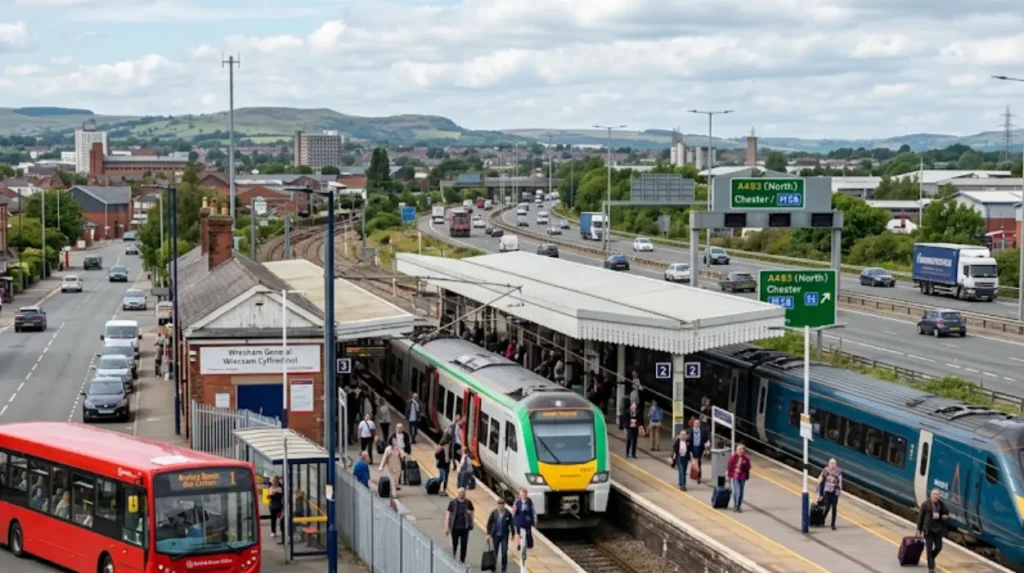
The highway infrastructure of Wrexham centers on the A483 dual carriageway, which acts as the primary north-south artery bypassing the city center. This route connects Wrexham directly to Chester to the north, where it interfaces with the M53 and M56 motorways, providing logistical access to the industrial centers of Liverpool and Manchester. To the south, the A483 links with the A5, establishing transportation routes to the Midlands, London, and South Wales destinations like Cardiff and Swansea.
Rail transport is serviced by two main stations: Wrexham General and Wrexham Central. Wrexham General is situated on the Shrewsbury to Chester line and the Borderlands line. It provides direct passenger services operated by Transport for Wales and Avanti West Coast, offering hourly connections to Cardiff Central, Birmingham New Street, Liverpool Lime Street, and London Euston. Wrexham Central station serves as the southern terminus for the Borderlands Line, providing local commuter rail access to Deeside and Bidston in Birkenhead, connecting passengers to the Merseyrail network.
The internal urban transit network is managed via the Wrexham Bus Station, located on King Street, which facilitates local and intercity bus routes operated by companies such as Arriva Buses Wales. The network provides high-frequency connections across the county borough and to neighboring towns. For international logistics and air travel, Wrexham sits within a 45-minute drive of both Liverpool John Lennon Airport and Manchester Airport, enabling local businesses on the Wrexham Industrial Estate to maintain seamless global supply chains.
What are the future regeneration and development plans for Wrexham?
The future development of Wrexham is driven by the Wrexham Gateway Project, a multi-million-pound masterplan designed to transform the western urban corridor through transport upgrades, commercial expansion, and stadium redevelopments.
The primary catalyst for urban renewal in Wrexham is the Wrexham Gateway Project, a partnership involving the Welsh Government, Wrexham County Borough Council, Wrexham University, and Wrexham A.F.C. The initiative focuses on regenerating the corridor around Mold Road and Wrexham General railway station. Key objectives include the creation of a modern transport interchange that integrates rail, bus, and active travel routes, alongside the construction of new commercial office spaces, conference facilities, and hotel accommodations to support the growing tourist influx.
A central element of this infrastructure investment is the redevelopment of the Racecourse Ground. The construction of a new Kop Stand aims to increase the stadium’s capacity to over 15,000 seats, meeting UEFA category 4 standards. This enables the venue to host official international football matches for the Wales national team, drawing visitors and generating matchday revenue. The stadium upgrade is integrated into wider public realm enhancements, including pedestrianizing surrounding pathways and improving links to the university campus.
On an environmental level, the city is implementing the Wrexham Carbon Reduction Strategy to achieve net-zero carbon emissions across council operations. This policy mandates the retrofitting of energy-efficient systems into public housing assets, the expansion of electric vehicle charging networks, and the integration of sustainable drainage systems into new housing developments. These initiatives ensure that Wrexham’s transition into a high-profile city balances rapid economic and demographic growth with stringent environmental standards.
Where is Wrexham located?
Wrexham is a city in northeast Wales, approximately 12 miles (19 km) south of Chester and close to the English border. It is the largest urban settlement in North Wales and serves as the administrative, economic, and cultural centre of Wrexham County Borough.